Case file 01
Why Do We Change the Clocks?The Strange History of Daylight Saving
Many people blame the farmers. The paper trail leads away from the farm, toward stores, grills and golf courses.

Coming to YouTube soon
Visit the channelThe case in brief
Ask why we change the clocks, and many people will tell you: the farmers. The record says it is close to backwards. Farmers were among the loudest opponents of daylight saving time. Benjamin Franklin's 1784 letter was a joke about shutters, candles and cannon; he never suggested moving the clocks. The first serious proposals came from George Vernon Hudson in New Zealand in 1895 and from William Willett, a London builder, in 1907. War made it happen: Germany moved its clocks forward in 1916, and America's first federal time law followed in 1918, pushed by city merchants and business groups. A year later, Congress repealed it over President Wilson's veto.
In 1974, America kept summer time all winter, and approval fell from 79 percent before the switch to 42 by February. The 1986 extension was pushed by a coalition funded mainly by 7-Eleven and the maker of Kingsford charcoal. Britain, Portugal and Russia each moved their clocks ahead, then reversed, pointing to dark winter mornings. The real fight is mornings against evenings: who gets the light.
In this file: Exhibits, Where it stands, Transcript, Sources and credits
Exhibits
5 frames from the film. Select one to see it at full size.
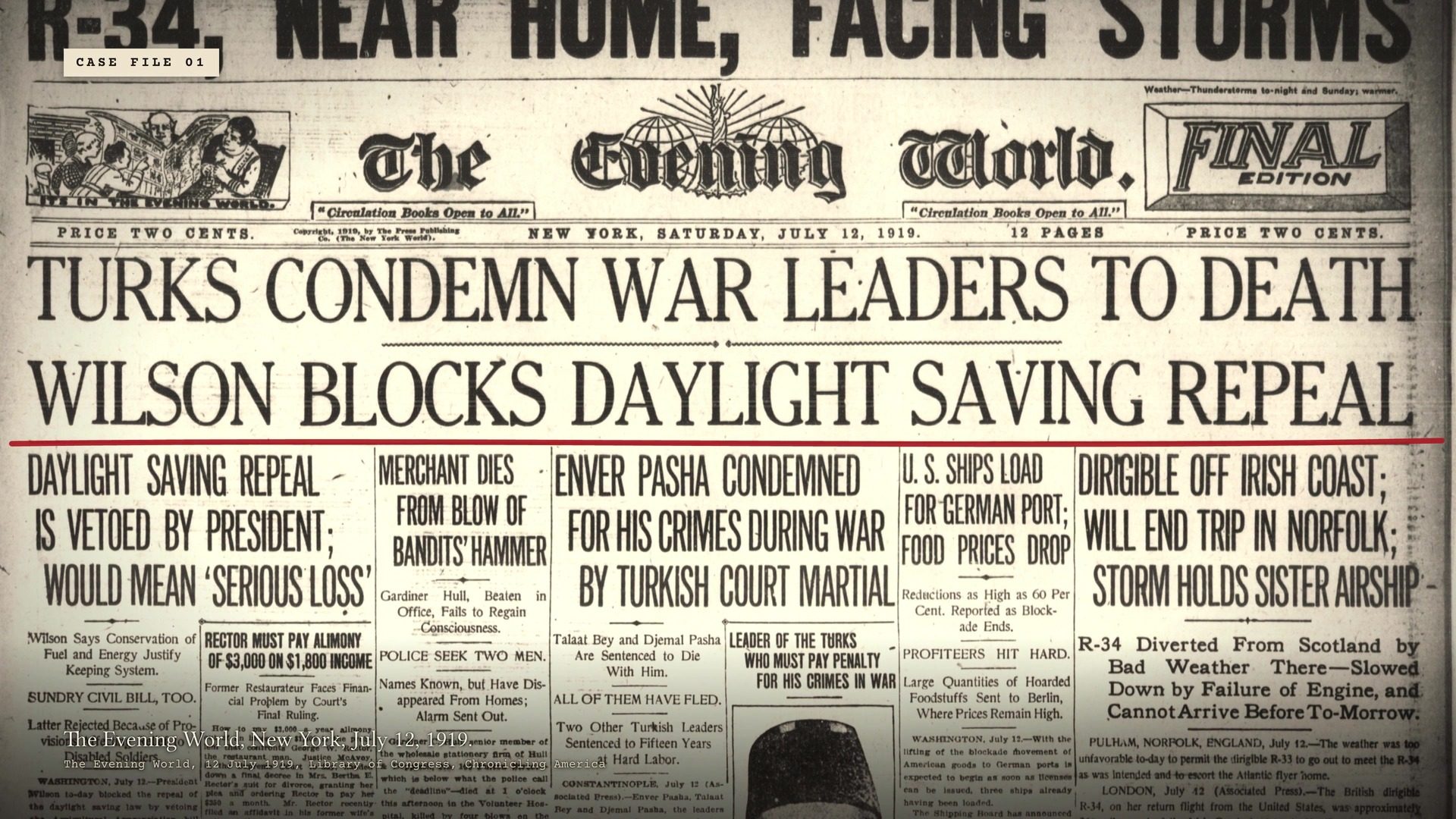
Exhibit AIn the film at 0:26
The veto on the front page
The Evening World, New York, July 12, 1919: “Wilson blocks daylight saving repeal.” Congress voted to repeal the 1918 law. President Wilson vetoed the repeal twice; the second time, Congress overrode him.
Source: The Evening World, 12 July 1919, Library of Congress, Chronicling America (public domain)
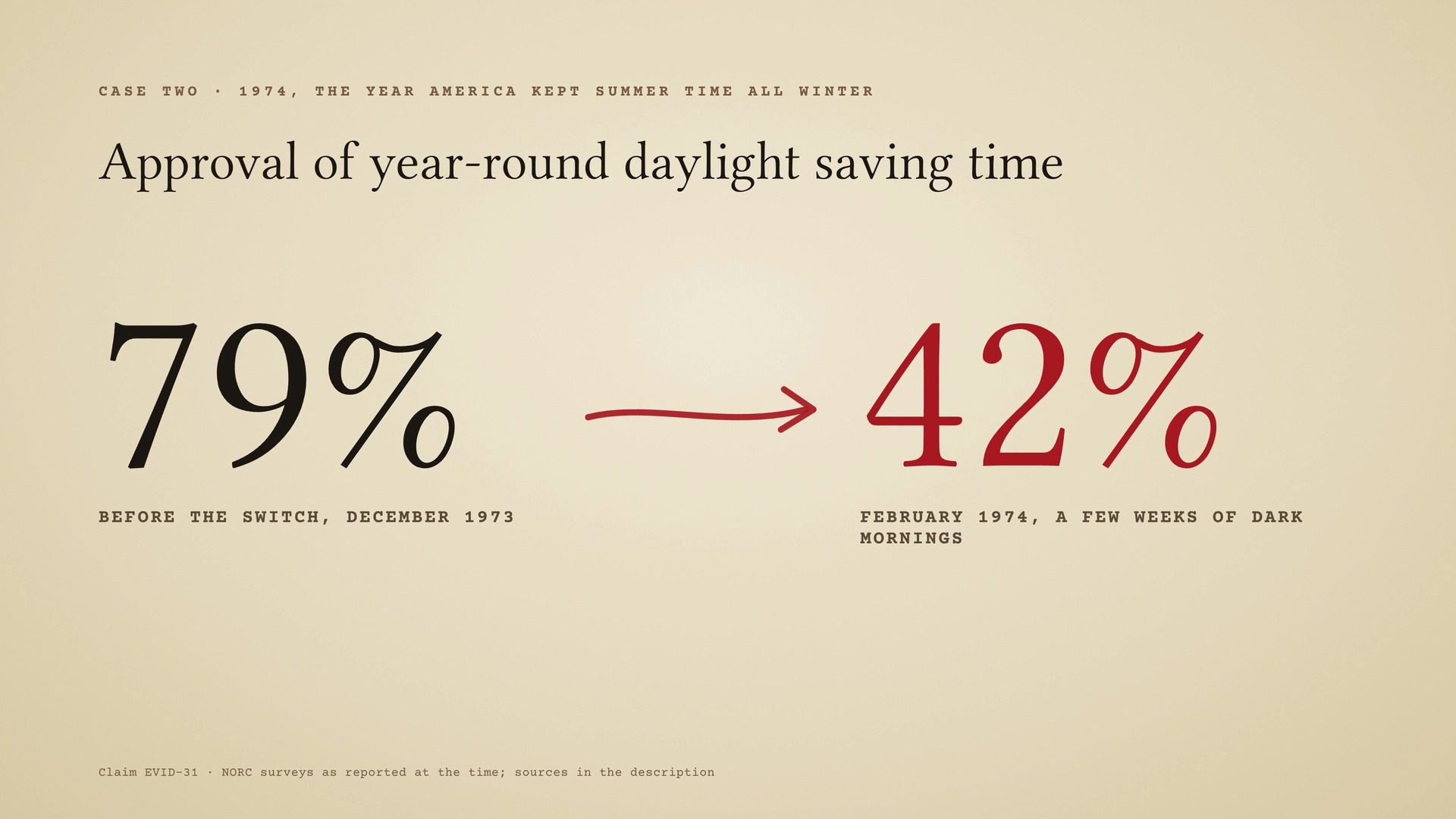
Exhibit BIn the film at 5:29
Approval, before and after
Approval of year-round daylight saving time: 79 percent before the switch, in December 1973, and 42 percent by February 1974, after a few weeks of dark winter mornings.
Source: National Opinion Research Center surveys, as reported at the time and in later histories (HISTORY, National Geographic, Washingtonian)
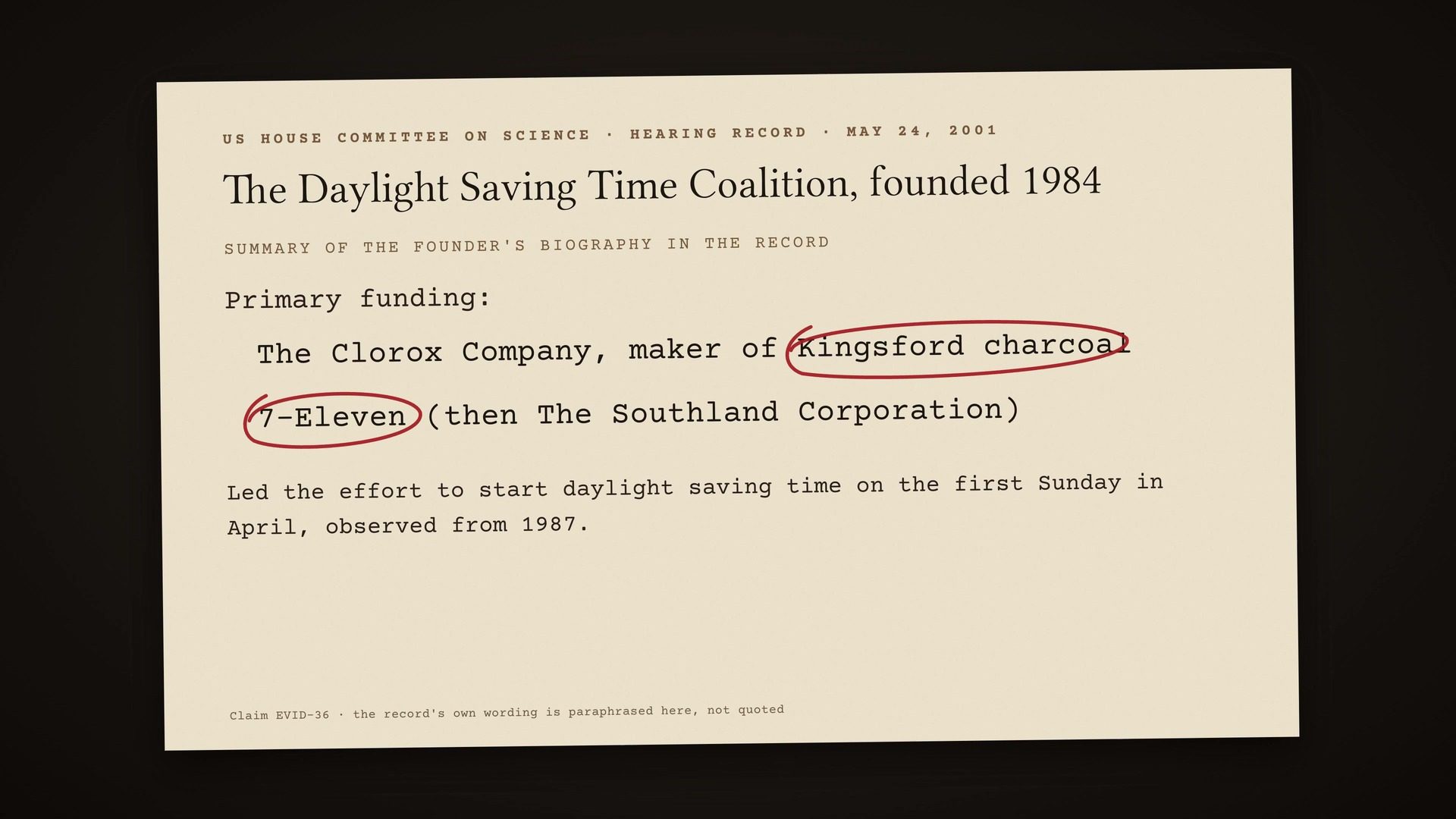
Exhibit CIn the film at 6:18
Who paid for the push
From the record of a 2001 House Committee on Science hearing: the Daylight Saving Time Coalition, founded in 1984, had two main funders, the Clorox Company (maker of Kingsford charcoal) and 7-Eleven. It led the effort to start daylight saving time on the first Sunday in April, observed from 1987.
Source: US House Committee on Science, hearing of May 24, 2001 (the founder's biography in the record, summarized)
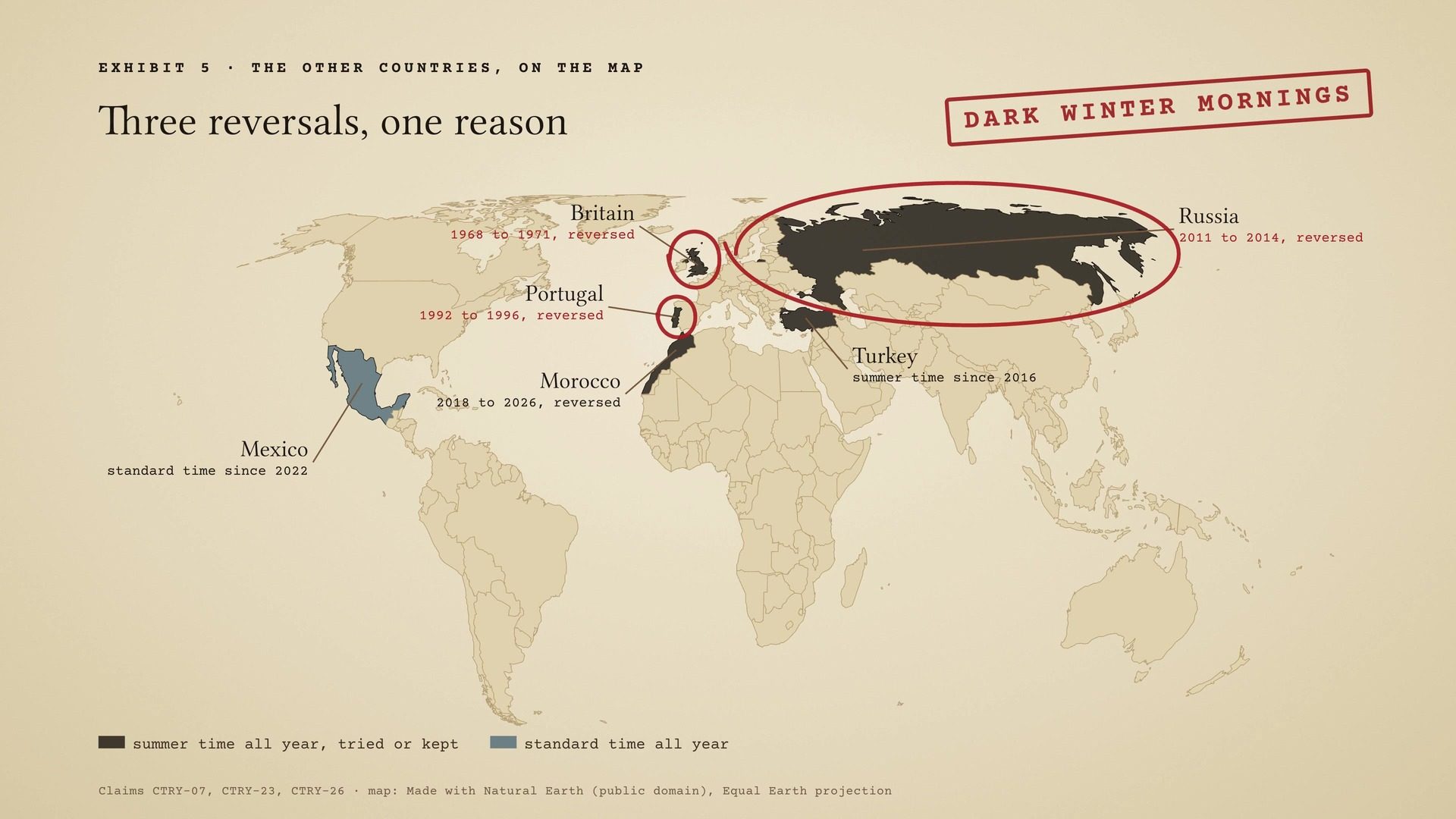
Exhibit DIn the film at 8:20
Three reversals, one reason
Britain kept summer time all year from 1968 to 1971, Portugal moved its clocks ahead from 1992 to 1996, and Russia stopped falling back from 2011 to 2014. All three went back, pointing to dark winter mornings. Morocco returned to Greenwich Mean Time in 2026. Turkey has kept summer time since 2016, and Mexico standard time since 2022, except along the US border.
Source: Sources under “Other countries” below. Map made with Natural Earth (public domain)
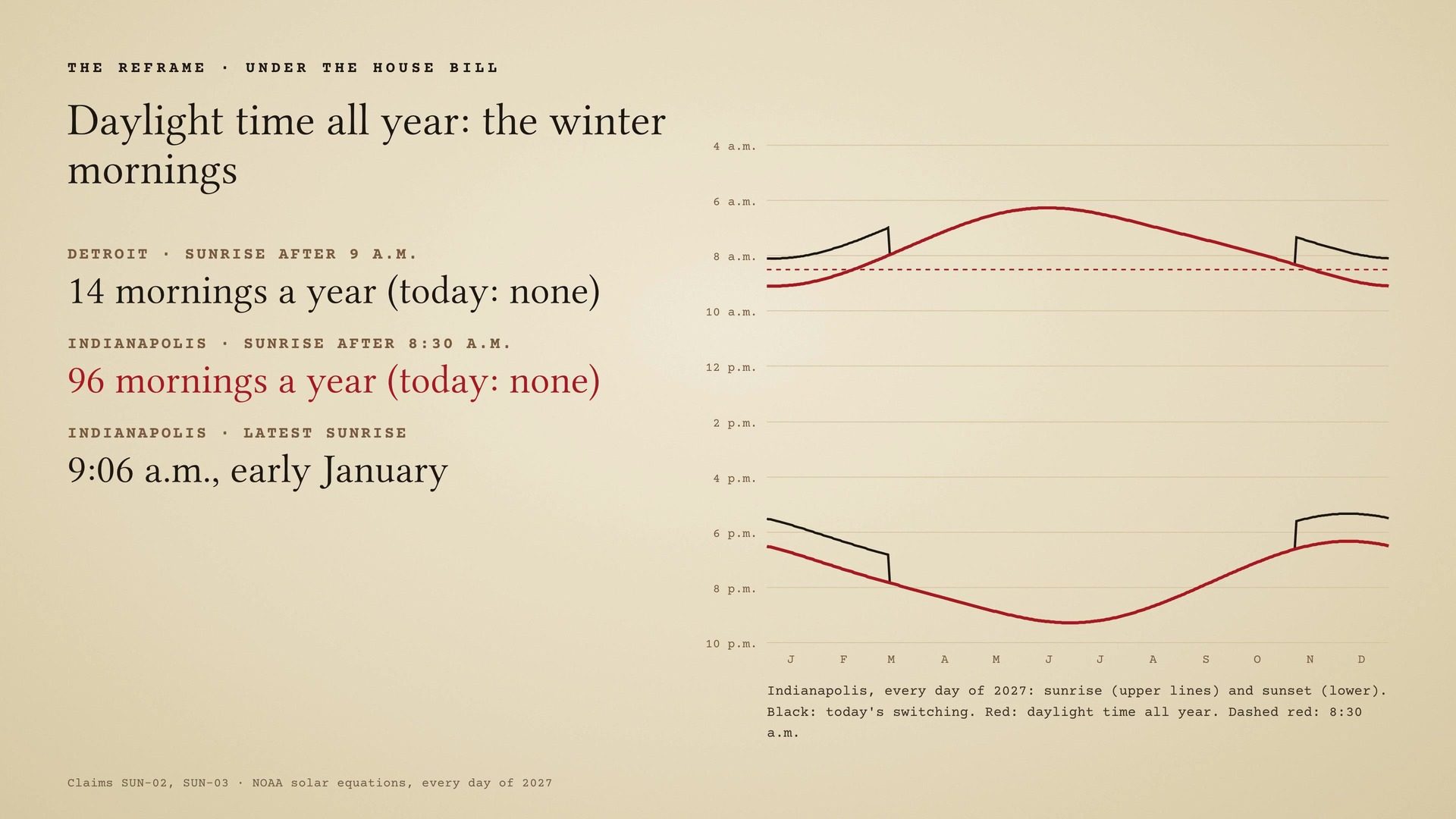
Exhibit EIn the film at 9:01
Daylight time all year: the winter mornings
Under the House bill, which keeps daylight time all year, Detroit would see sunrise after 9 a.m. on 14 mornings a year and Indianapolis after 8:30 on 96. Today: none. The latest sunrise in Indianapolis would be 9:06 a.m., in early January.
Source: Computed for every day of 2027 with NOAA's solar equations, checked against the US Naval Observatory
Status
Where it stands (as of October 13, 2026)
On July 14, 2026 the House passed H.R. 139 (308 to 117) to keep daylight saving time all year. The Senate has not voted on it; the Senate is away until after the November 3 elections, and a bill that has not passed by January 3, 2027 dies. Nothing has changed in law: most of the US falls back at 2 a.m. on Sunday, November 1, 2026.
Re-checked on
Transcript
The full narration, 1,564 words
0:00The belief and the record
Ask why we change the clocks, and many people will tell you: the farmers. It is a tidy story. The record says it is close to backwards. So let's open the case file, and put the story next to the documents. Farmers were among the loudest opponents of daylight saving time. Cows do not read clocks. In 1918, the first federal time law moved the nation's clocks forward. A year later, Congress repealed it, over President Wilson's veto. So if the farmers did not want it, who did? And why are we still arguing about it?
0:42Exhibit 1: the usual suspect, Paris, 1784
Start with the story you may have heard: Benjamin Franklin invented daylight saving time. Here is the evidence. In 1784, Franklin, then living in Paris, wrote a joking letter to a newspaper. His plan: tax window shutters, ration candles, and ring church bells, or fire cannon, at sunrise. He wanted Parisians out of bed earlier. He never suggested moving the clocks. For another century, America had no single clock to move. Towns kept their own local time. Then, on Sunday, November 18, 1883, the railroads put the country on standard time. Congress did not write time zones into law until 1918. Remember that: a time zone is an agreement. If Franklin never proposed it, who first asked to move the clock itself?
1:40Exhibit 2: the proposers, 1895 to 1916
The first serious proposal came from New Zealand, in 1895. George Vernon Hudson sorted mail by day and collected insects after work. He wanted more evening light, so he proposed moving the clocks two hours every summer. The idea went nowhere.
In London, a builder named William Willett paid to print a pamphlet in 1907. He called it The Waste of Daylight. Bills went to Parliament, and failed. Farming interests were among the objectors. Willett died in 1915. A year later, war did what persuasion could not. On April 30, 1916, Germany moved its clocks forward to save coal. Britain followed three weeks later. When America joined in, who was pushing?
2:37Exhibit 3: who wanted it, 1918 to 1919
The American campaign was run from New York, by businessmen like Marcus Marks, a clothing merchant. Look at who printed the posters. These came from a chain of cigar stores. The pitch was patriotic: set the clock ahead, save coal, win the war. The push came from the cities, from merchants and business groups who wanted shoppers out in the evening light.
On March 19, 1918, President Wilson signed the first federal time law. It drew the time zones, and on March 31, the nation's clocks went forward.
On the farm, the clock was a problem. Cows kept to the sun, and dew still had to dry. But the markets ran on the clock, so many farmers faced an extra hour of work in the morning dark. In October 1918, the clocks went back for the winter. In 1919, Congress voted to repeal it. President Wilson vetoed the repeal twice. The second time, Congress overrode him: 223 to 101 in the House, 57 to 19 in the Senate. Farmers were not the only ones who wanted it gone. But they were among the loudest. With no national law, who decided what time it was?
4:11Exhibit 4: every town for itself, 1919 to 1966
After 1919, every town chose for itself. Some cities kept summer time. The countryside around them often did not. In World War Two, the clocks went forward again, this time all year. Americans called it War Time, from February 1942 to September 1945.
By the 1960s, the map was a mess. Neighboring towns could keep different times. In April 1966, President Johnson signed the Uniform Time Act: one schedule for the whole country. And one escape hatch: a state could stay on standard time all year. Hawaii took it in 1967, and Arizona in 1968.
What happened when the whole country tried to stop switching?
5:09Case two: 1974, and who wanted more
Then came the oil crisis. On December 15, 1973, President Nixon signed a law putting the country on daylight saving time all year. On January 6, 1974, in the middle of winter, the clocks sprang forward. Before the switch, 79 percent of Americans approved. By February, after a few weeks of dark winter mornings, approval had fallen to 42.
A federal review later found more school-age children killed on winter-morning roads than a year before, but it could not prove the clock was to blame. And the energy savings were too small to measure reliably. It did not last the year. On October 5, 1974, President Ford signed a law putting the clocks back.
Now, the overlooked detail. In 1986, Congress started daylight saving time three weeks earlier. The coalition that pushed for it was funded mainly by two companies: 7-Eleven, and the maker of Kingsford charcoal. Since 2007, the clocks have stayed forward from March to November, almost eight months a year. Golf is still in this fight. In 2025, golf course owners told the Senate that permanent daylight time would add about a billion dollars a year, by their own estimate. Strange to say, the paper trail leads away from the farm, and toward stores, grills and golf courses. And what happened in the countries that tried to stop?
6:53Exhibit 5: the other countries
Britain tried permanent summer time once. From 1968 to 1971, its clocks stayed an hour ahead all year. Parliament voted to end it, after objections from Scotland, where winter sunrise came very late. Portugal moved its clocks an hour ahead in 1992, and back again in 1996, after parents complained that children walked to school in the dark. Russia stopped falling back in 2011, then reversed in 2014, citing dark winter mornings and health. Morocco kept summer time from 2018. In September 2026, it went back to Greenwich Mean Time for good. Europe came close. In 2019, the European Parliament voted 410 to 192 to end the switch. Member governments never agreed, and the plan is listed as blocked. Mexico did stop, in 2022. It kept standard time, except in towns along the US border. Next door, Canada is moving now. British Columbia sprang forward for the last time in March 2026, and Alberta and Manitoba will not fall back this November. On October 13, 2026, Ontario announced that its northwest corner plans to follow Manitoba. Britain, Portugal and Russia all pointed to the same thing: dark winter mornings. Why do the mornings keep winning? Look at a map.
8:30The reframe: who gets the light
Here is the reframe. The fight was never really farmers against clocks. It is mornings against evenings: who gets the light. Moving the clock does not make more daylight. It only moves it. A time zone is hundreds of miles wide, and the sun takes an hour to cross it. On the shortest day, the sun sets at 4:15 in Boston. In Detroit, on the same clock, it sets at 5:03. Under the House bill, daylight time all year, Detroit would see sunrise after 9 a.m. on 14 mornings a year. Indianapolis would wait until after 8:30 on 96 mornings. Today: none.
Under permanent standard time, the cost moves to summer. In June, Boston's sun would rise at 4:07 in the morning, and set at 7:25. And here is the rule that traps everyone: a state may choose standard time all year, but not daylight time. Only Congress can allow that. Arizona took that option in 1968, so Phoenix would not notice a thing. And the evidence? Less clear than either side would like. Sleep-medicine groups favor permanent standard time, arguing that morning light sets the body clock. After we spring forward, two large US studies found about 6 percent more fatal crashes that week, and another found robberies fell about 7 percent. The largest review so far, 157 studies, found a mixed picture. Where do things stand this fall?
10:15Where it stands, as of October 13, 2026
Here is what was said, and what changed in law, as of October 13, 2026. On July 14, the House voted 308 to 117 to keep daylight saving time all year. Most Republicans and a narrower majority of Democrats voted yes. Members of both parties voted no. The bill would move every time zone one hour ahead, for good. In the Senate, there has been no vote.
President Trump's position has moved. In December 2024, he said Republicans would try to eliminate daylight saving time. In March 2025, he called it a 50-50 issue. Since April 2025, he has urged Congress to make it permanent, most recently in early October. But a president cannot change the clocks alone. It takes Congress. The Senate is away until after the November elections. If it does not act by January 3, 2027, the bill dies. For now, nothing has changed in the law.
11:24Back to the case file
So, back to the case file. The farmers did not give us daylight saving time. They fought it. But the record cannot tell you which clock is right. That depends on where you live, and when you want your light. At 2 a.m. on Sunday, November 1, most of America falls back an hour. That evening in Boston, the sun will set at 4:37. The day before, it set at 5:39. Look at your own clock when the sun goes down that day, and ask which hour you would keep. In a wood south of London, William Willett's memorial is a sundial. According to the international time-zone database, it runs on summer time, all year. Under the dial, the stone carries a motto in Latin: Horas non numero nisi aestivas. I count only the summer hours.
Sources and credits
Every claim in the film has a source, and every photograph and document is credited. 99 sources, grouped by the part of the story they support, then the credits for every image and sound in the film, with the license for the 6 images used under Creative Commons.
Sources
History, 1784 to 1986
- KUOW (2013-11-01), interview with Michael Downing, author of Spring Forward (2005)Don't blame the farmers: the real story behind daylight saving time
- Connecticut Public (2014-03-12), interview with Michael DowningHate daylight saving time? Blame the man from Filene's Basement
- IANA Time Zone Databasetz database, file europe (release 2026e)
- Congressional Research Service (read via EveryCRSReport; official copy https://www.congress.gov/crs-product/R45208)Daylight Saving Time (DST), R45208, updated 2026-07-24
- IANA Time Zone Databasetz database, file northamerica (release 2026e)
- Voteview (UCLA)Senate roll call, 1919-08-20
- Woodrow Wilson Presidential LibraryVeto of Act for Repeal of Daylight-Saving Law
- Library of Congress, Chronicling AmericaThe Evening World (New York), 1919-07-12, Final Edition, page 1
- Library of Congress, Chronicling AmericaNew-York Tribune, 1919-08-21, page 1
- American Political Science Review (1919)Special Session of Congress
- The Franklin InstituteDid Ben Franklin Invent Daylight Saving Time?
- Founders Online, National ArchivesAux Auteurs du Journal de Paris, Papers of Benjamin Franklin vol. 42
- Wikipedia (secondary)George Hudson (entomologist)
- Te Ara, Dictionary of New Zealand BiographyHudson, George Vernon
- Royal Museums GreenwichWhat is British Summer Time (BST)?
- National Archives (US), Text Message blog, 2019-04-25Daylight Saving Time: The Early Experiences I: Germany
- Wikipedia (secondary)Marcus M. Marks
- Library of CongressMarcus M. Marks (Bain News Service photograph, LC-DIG-ggbain-13738)
- Woodrow Wilson Presidential LibraryMarcus M. Marks to William G. McAdoo (May 1917)
- NYC Department of RecordsNYC Municipal Archives blog (Clocks tag)
- British Sundial SocietyRegister of Dials, S0511: Wm Willett Memorial [NT], Petts Wood, Bromley
- Wikimedia Commons (photo: Ethan Doyle White, 2020-05-17, CC BY-SA 4.0)The William Willett Memorial in Petts Wood (photo #12 in this film; rights ledger row h11-commons-willett-memorial-petts-wood)
- Art UKWilliam Willett Memorial Sundial

Business and public opinion
- US House Committee on ScienceEnergy Conservation Potential of Extended and Double Daylight Saving Time (hearing, 2001-05-24)
- University of Colorado BoulderSpring Forward at Your Own Risk (working paper 14-05)
- US Senate Committee on Commerce, Science, and TransportationTestimony of Jay Karen, CEO, National Golf Course Owners Association
Other countries
- timeanddate.comMost of Arizona Has No Daylight Saving Time
- IANA Time Zone Databasetz database, northamerica file (America/Phoenix)
- National Conference of State LegislaturesDaylight Saving Time: State Legislation
- Hawaii State LegislatureSession Laws of Hawaii 1967, Act 4 (H.B. 18)
- IANA Time Zone Databasetz database, europe file (GB-Eire rules and Europe/London)
- Hansard (UK Parliament)British Standard Time, House of Commons debate, 2 December 1970
- UPIPortugal turns back the clock
- timeanddate.comRussia Abolishes Winter Time
- InterfaxReport on the law restoring standard time (2014-07-22)
- SBS NewsRussia turns back the clocks
- The Moscow TimesDuma Deputies Want Winter Time Back
- The Moscow TimesNation Ticked Off After a Winter of Summer Time
- timeanddate.comMorocco Announces DST Will Be Abolished After Summer
- IANA Time Zone Databasetz database, africa file (Morocco) and NEWS release 2026c
- European ParliamentLegislative Train: Discontinuing seasonal changes of time
- European Commission, DG Mobility and TransportSummertime
- Council of the European UnionCouncil note 10045/26: Ongoing study on discontinuing seasonal time changes
- timeanddate.comEurope Ends DST 2026
- Associated Press (via KTVU)Mexico scraps daylight savings time except along US border
- Zeta TijuanaSenado aprueba eliminar horario de verano; se acaba el domingo 30 de octubre
- timeanddate.comDaylight Saving Time Around the World 2026
- Government of British ColumbiaAdopting permanent daylight saving time
- Province of AlbertaOrder in Council 204/2026
- timeanddate.comAlberta Is Set to Adopt Permanent Daylight Saving Time
- CTV News Edmonton'Alberta Time' legislation tabled to move Alberta to permanent daylight time
- Government of ManitobaManitoba Will Move to Permanent Daylight Saving Time
- timeanddate.comManitoba Ends Clock Changes and Stays on DST
- Government of OntarioOntario Moving to Permanent Daylight Saving Time in Parts of Northwestern Ontario
- Legislative Assembly of OntarioBill 214, Time Amendment Act, 2020
- Turkish MinuteTurkey to use summer time throughout entire year
- timeanddate.comDaylight Saving Time Statistics
- MedyascopeKaranlik kislar, aydinlanamayan sabahlar: Kalici yaz saati uygulamasina ne zaman gecildi?
- Grand National Assembly of TurkeyCHP bill to amend the law on time (2023-12-01)
- El FinancieroAhorro de energia por horario de verano ha decaido en los ultimos anos: Rocio Nahle
- Elections AlbertaReferendum Results
- CP24 (The Canadian Press)N.W.T. ends seasonal time changes, will stay on daylight time year-round
The sun and the clock
- Strange to SaySunrise and sunset times computed with NOAA's solar equations, checked against the US Naval Observatory
- US Naval ObservatoryAstronomical Applications API
- govinfoH.R. 139 engrossed
Health, safety and energy
- Congressional Research ServiceDaylight Saving Time (CRS Report R44411)
- WashingtonianThe US Tried Permanent Daylight Saving Time in the '70s. People Hated It.
- HISTORY (A&E)Why America's Permanent Daylight Saving Time Experiment Failed
- National GeographicHistory of daylight saving time in America
- Oxford University Research Archive (European Journal of Epidemiology)A systematic review of epidemiological studies into daylight-saving time and health identifying beneficial and adverse effects
- University of KentIt may be too soon to scrap Daylight Saving Time, suggests Kent research
- US Senate Committee on Commerce, Science, and TransportationTestimony of David Harkey, President, IIHS, 'If I could turn back time: Should we lock the clock?'
- Journal of Clinical Sleep Medicine (via PubMed Central)Permanent standard time is the optimal choice for health and safety: an American Academy of Sleep Medicine position statement
- National Sleep FoundationPermanent Standard Time: A Position Statement from the National Sleep Foundation
- Journal of Biological Rhythms (PubMed record)Why Should We Abolish Daylight Saving Time?
- Sleep Research SocietySleep Research Society position statement supports adoption of permanent standard time
- Coalition for Permanent Standard TimeEnd the Switch and Support Permanent Standard Time
- ScienceDailyBody's Clock Doesn't Adjust To Daylight Saving Time, Study Suggests
- University of Colorado BoulderSpring forward to daylight saving time brings surge in fatal car crashes
- Current Biology 2020;30(7) via arXivCorrespondence on Fritz et al. (accepted manuscript)
- Review of Economics and Statistics (RePEc abstract)Under the Cover of Darkness: How Ambient Light Influences Criminal Activity
- College of William and MarySanders: DST and crime
- US Department of EnergyImpact of Extended Daylight Saving Time on National Energy Consumption: Report to Congress
Where it stands
- Clerk of the US HouseRoll Call 238, H.R. 139, 2026-07-14
- Congress.govH.R. 139, all actions
- Fox News, 2026-10-08Daylight saving time fight isn't over
- Congress.govS. 29, all actions
- ABC News (ABC7), 2024-12-13Trump calls for ending daylight saving time
- Colorado Politics (Washington Examiner), 2025-03-06Trump not sold on push to change daylight saving time: '50-50 issue'
- Associated Press via Fortune, 2025-04-11Trump urges Congress on daylight saving time
- Time, 2026-08-13Trump Renews Push to Pass Bill That Would Make Daylight Saving Time Permanent
- NBC News, 2026-07-14House passes Trump-backed bill that would make daylight saving time permanent
- Jewish Insider, 2026-10-05Trump, Cotton feud over daylight saving time legislation
- The White HousePresidential Actions
- United States Senate2026 Senate Schedule
- Congress.govLegislative glossary (Congress)
- NISTDaylight Saving Time (DST)
- Congress.govS. 29, cosponsors
- govinfoS. 29 as introduced
Credits
Photographs and film
- Library of Congress, Prints & Photographs Division, National Child Labor Committee Collection, LC-DIG-nclc-00412 (photo: Lewis W. Hine)Series showing the day's work of Estelle and Felix Humphrey, Elizabethtown vicinity, Kentucky (Lewis W. Hine), May 1916
- Library of Congress, Prints & Photographs Division, Harris & Ewing Collection, LC-DIG-hec-13949Senate Sergeant at Arms Charles Higgins turns forward the Ohio Clock for the first Daylight Saving Time, with Senators Calder, Saulsbury and Robinson, 1918
- Library of Congress, Prints & Photographs Division, Bain Collection, LC-DIG-ggbain-13738Marcus M. Marks, president of the Daylight Saving Association and Manhattan borough president
- Library of Congress, Prints & Photographs Division, Detroit Publishing Company Collection, LC-DIG-det-4a24552Main concourse, Grand Central Terminal, N.Y. Central Lines, New York
- Library of Congress, Prints & Photographs Division, FSA/OWI Collection, LC-DIG-fsa-8d27403 (photo: Jack Delano)Seligman, Arizona. Teletype operator in the telegraph office of the Santa Fe Railroad, where the time changes from Mountain to Pacific
- Royal Society of New Zealand, Transactions vol. 76 (1946), via Wikimedia Commons (public domain)George Vernon Hudson later in life (photograph published 1946)
- Samuel Page, 1907, National Library of New Zealand, via Wikimedia Commons (public domain)Members of the Auckland Islands Party of the Sub-Antarctic Expedition (Hudson in the centre row)
- The Waste of Daylight, 1914, Royal College of Surgeons of England, via Internet Archive (public domain)William Willett, frontispiece portrait from The Waste of Daylight (1914 edition)
- Sir Benjamin Stone, 1909, National Portrait Gallery, London, via Wikimedia Commons (public domain)Sir Robert Pearce and William Willett at the Members' Entrance, Houses of Parliament, 1909
- Library of Congress, Prints & Photographs Division, Harris & Ewing Collection, LC-DIG-hec-03886William Musgrave Calder, senator from New York, 1917
- Library of Congress, Prints & Photographs Division, LC-USZ62-19271Woodrow Wilson at his desk, pen in hand, March 1918
- Library of Congress, Prints & Photographs Division, Harris & Ewing Collection, LC-DIG-hec-10561Naval Observatory. C.B. Watts turning back the clock, 1918
- Library of Congress, Prints & Photographs Division, National Photo Company Collection, LC-DIG-npcc-33494Chas. C. Wylie setting back clock at Naval Observatory
- Library of Congress, Prints & Photographs Division, FSA/OWI Collection, LC-DIG-fsa-8d27970 (photo: Marjory Collins)Philadelphia. Workers punching the clock at the SKF roller bearing factory
- Library of Congress, Prints & Photographs Division, FSA/OWI Collection, LC-USW3-007398-D (photo: Arthur Rothstein)Dearborn, Michigan. Karl Westerberg and his son Eric punching the time clock at the Ford Motor Company, September 1942
- Library of Congress, Prints & Photographs Division, FSA/OWI Collection, LC-DIG-fsa-8d28362 (photo: Arthur S. Siegel)Bethlehem-Fairfield shipyards, Baltimore. Lining up before a time clock at the changing of the shifts
- Library of Congress, Prints & Photographs Division, FSA/OWI Collection, LC-DIG-fsa-8d28357 (photo: Arthur S. Siegel)Bethlehem-Fairfield shipyards, Baltimore. Lining up before time clock at the changing of the shifts ('Time is short' sign)
- Library of Congress, Prints & Photographs Division, FSA/OWI Collection, LC-DIG-fsa-8d28363 (photo: Arthur S. Siegel)Bethlehem-Fairfield shipyards, Baltimore. A shipyard worker looking at a time clock from outside of the yard
- Saguaro National Park, National Park ServiceSaguaro Sunset, Saguaro National Park, Arizona (17 November 2020)
- National Park ServiceSunrise view from Kalahaku Lookout, Haleakala National Park, Hawaii (1 March 2013)
- National Archives (NAID 555459), EPA DOCUMERICA, photo: David FalconerAfter hours in a gasoline line a driver could find the car ahead was the last to get fuel; stations used a 'Sorry' sign (Portland, December 1973)
- National Archives (NAID 555460), EPA DOCUMERICA, photo: David FalconerA motorist who ran out of gas stands in line with a gas can (Portland, December 1973)
- National Archives (NAID 555489), EPA DOCUMERICA, photo: David FalconerOregon's odd-even gasoline rationing: even-numbered licences line up on an even day (Portland, February 1974)
- Library of Congress, Prints & Photographs Division, Harris & Ewing Collection, LC-DIG-hec-44316Setting the clock's hands by radio, U.S. Bureau of Standards, 1924
- National Archives (NAID 558215), EPA DOCUMERICA, photo: David ReesStudents have just arrived by bus at the senior high school, New Ulm, Minnesota (October 1974)
- National Archives (NAID 6422494), US Navy photo by PH2 Sherrie De LongA sailor resets his clock using a sundial to reflect the one-hour difference between standard and daylight time (Naval Station San Diego, 5 April 1987)
- US Space Force photo by Airman 1st Class Justin ToddThe Alternate Master Clock at Schriever Space Force Base, Colorado (27 October 2023)
- Rob Bogaerts / Anefo, Nationaal Archief (CC0)1 April summer time begins; a woman sets clocks one hour forward (Netherlands, 28 March 1978), License: CC0 1.0
- Photo: formulanone, CC BY-SA 2.0, via Wikimedia CommonsI-10 West, entering Jackson County, Central Time Zone (Florida, 12 February 2015), License: CC BY-SA 2.0
- National Archives (NAID 547133), EPA DOCUMERICA, photo: Paul SequeiraChildren playing in a rural school bus stop shelter (May 1973)
- Photo: Beethoven, CC BY-SA 4.0, via Wikimedia CommonsUnited States Capitol West Front, viewed from the Newseum terrace (25 March 2018), License: CC BY-SA 4.0
- Photo: JBandJohnK, CC BY-SA 4.0, via Wikimedia CommonsThe Ohio Clock outside the Senate chamber (photographed 2004), License: CC BY-SA 4.0
- Library of Congress, Prints & Photographs Division, FSA/OWI Collection, LC-USF34-032358-D (photo: Russell Lee)Mexican woman setting clock. Crystal City, Texas, March 1939
- Photo: Ethan Doyle White, CC BY-SA 4.0, via Wikimedia CommonsThe William Willett Memorial in Petts Wood (sundial set to summer time), License: CC BY-SA 4.0


.jpg)


.jpg)

.jpg)


Documents and maps
- The Evening World, 12 July 1919, Library of Congress, Chronicling AmericaThe Evening World (New York), 12 July 1919, Final Edition, page 1: 'Wilson Blocks Daylight Saving Repeal'
- Journal de Paris, 26 April 1784, via Wikimedia Commons (public domain)Journal de Paris, no. 117, 26 April 1784, front page (Franklin's anonymous letter begins)
- Popular Science Monthly, vol. 26, 1884, via Wikimedia Commons (public domain)Outline map of standard railway time, Popular Science Monthly vol. 26 (1884)
- William Willett, The Waste of Daylight, 1914, Royal College of Surgeons of England, via Internet Archive (public domain)The Waste of Daylight, William Willett, nineteenth edition, March 1914 (cover)
- Landesarchiv Baden-Württemberg, Hauptstaatsarchiv Stuttgart, J 151 Nr 657 (CC BY 4.0)Verordnung on summer time, German 4th Army area, 26 April 1916 (German, Dutch and French), License: CC BY 4.0
- The Birmingham Age-Herald, 21 May 1916, Library of Congress, Chronicling AmericaThe Birmingham Age-Herald, 21 May 1916, page 1 ('British public is saving daylight')
- New-York Tribune, 21 August 1919, Library of Congress, Chronicling AmericaNew-York Tribune, 21 August 1919, page 1: 'Daylight Law Is Killed by Senate... 57 to 19, over the President's Veto'
- Maps: Made with Natural EarthNatural Earth 1:50m admin-0 countries and admin-1 states and provinces, version 5.1.1
- State outlines: US Census Bureau (via us-atlas)us-atlas v3 states-10m (US state outlines)


Artwork and graphics
- Joseph-Siffred Duplessis, Benjamin Franklin, about 1785, National Portrait Gallery, Smithsonian Institution (NPG.87.43)Benjamin Franklin, oil on canvas, Joseph-Siffred Duplessis, about 1785
- George Vernon Hudson, Plate XXX, about 1927, Museum of New Zealand Te Papa Tongarewa, via Wikimedia Commons (public domain)Plate XXX, The Butterflies and Moths of New Zealand, watercolour by George Vernon Hudson
- Photo: Grafj, CC BY-SA 4.0, via Wikimedia Commons; postcard, Deutsches UhrenmuseumPostcard marking the start of German summer time, 30 April 1916, License: CC BY-SA 4.0
- United Cigar Stores Company, 1918, National Museum of American History Archives Center, via Wikimedia Commons (public domain)Saving Daylight! Save 1,000,000 tons of coal by using an extra hour of daylight, No April Fool! First saving daylight working day starts today!
- National Archives (NAID 512689)Saving Daylight! Uncle Sam, your enemies have been up and are at work on the extra hour of daylight. When will you wake up?
- Library of Congress, Prints & Photographs Division, LC-USZC4-8124"Saving daylight!" Sign and mail one of these post cards to your congressman (United Cigar Stores poster no. 3)
- Library of Congress, Prints & Photographs Division, LC-DIG-ppmsca-50987Victory! Congress passes daylight saving bill
- National Archives (NAID 6011373), Clifford K. BerrymanClifford Berryman cartoon: Uncle Sam and the bear move the clock forward one hour, 30 March 1918
- National Archives (NAID 6011375), Clifford K. BerrymanClifford Berryman cartoon: a man bewildered between two clocks, 7 April 1918
- Library of Congress, Prints & Photographs Division, LC-USZC4-9924Saving daylight ends, for 1918, Sunday, Oct. 27th. Set your clock back one hour at 2 A.M.
- National Archives (NAID 6011733), Clifford K. BerrymanClifford Berryman cartoon 'Opposition to Daylight Savings' (Washington, D.C.), 25 May 1922


Music
- Music generated with ElevenLabs Music
Narration
- Narration voice generated with ElevenLabs (voice: Peter)
Sound effects
- Sound effects generated with ElevenLabs sound effects
Cards, maps and charts
- Drawn in code for this film from the sourced numbers. Maps made with Natural Earth; US state outlines from the US Census Bureau.