Case file 02
Did a Punch Kill Houdini?How Houdini Died, Halloween 1926
The world remembers a punch. His death certificate never mentions one, and an insurance file made the punch the official story.

Coming to YouTube soon
Visit the channelThe case in brief
By most accounts it was Friday, October 22, 1926, when a McGill student struck Harry Houdini in his Montreal dressing room. Nine days later, on Halloween, he was dead, and the world would remember one reason: a punch. The witnesses do not agree. Jack Price swore to at least four very hard blows; the student, J. Gordon Whitehead, swore to two, the day before, at Houdini's invitation.
Houdini played on in pain and took the night train to Detroit, where a doctor told him it was appendicitis. He put off the hospital to finish a sold-out show, on stage with a fever of 104. His appendix had already burst, and in 1926 there were no antibiotics. His death certificate gives diffuse peritonitis, with a ruptured appendix as the contributing cause. It never mentions a punch.
The punch became official in an insurance file. His insurer first found no evidence of any punch, then, in June 1927, paid double and accepted the punch as the cause. Doctors today are far less sure. The blows happened, and an infection killed him. Whether one caused the other, nobody can show. Then there is the code he left his wife.
In this file: Exhibits, Where it stands, Transcript, Sources and credits
Exhibits
5 frames from the film. Select one to see it at full size.
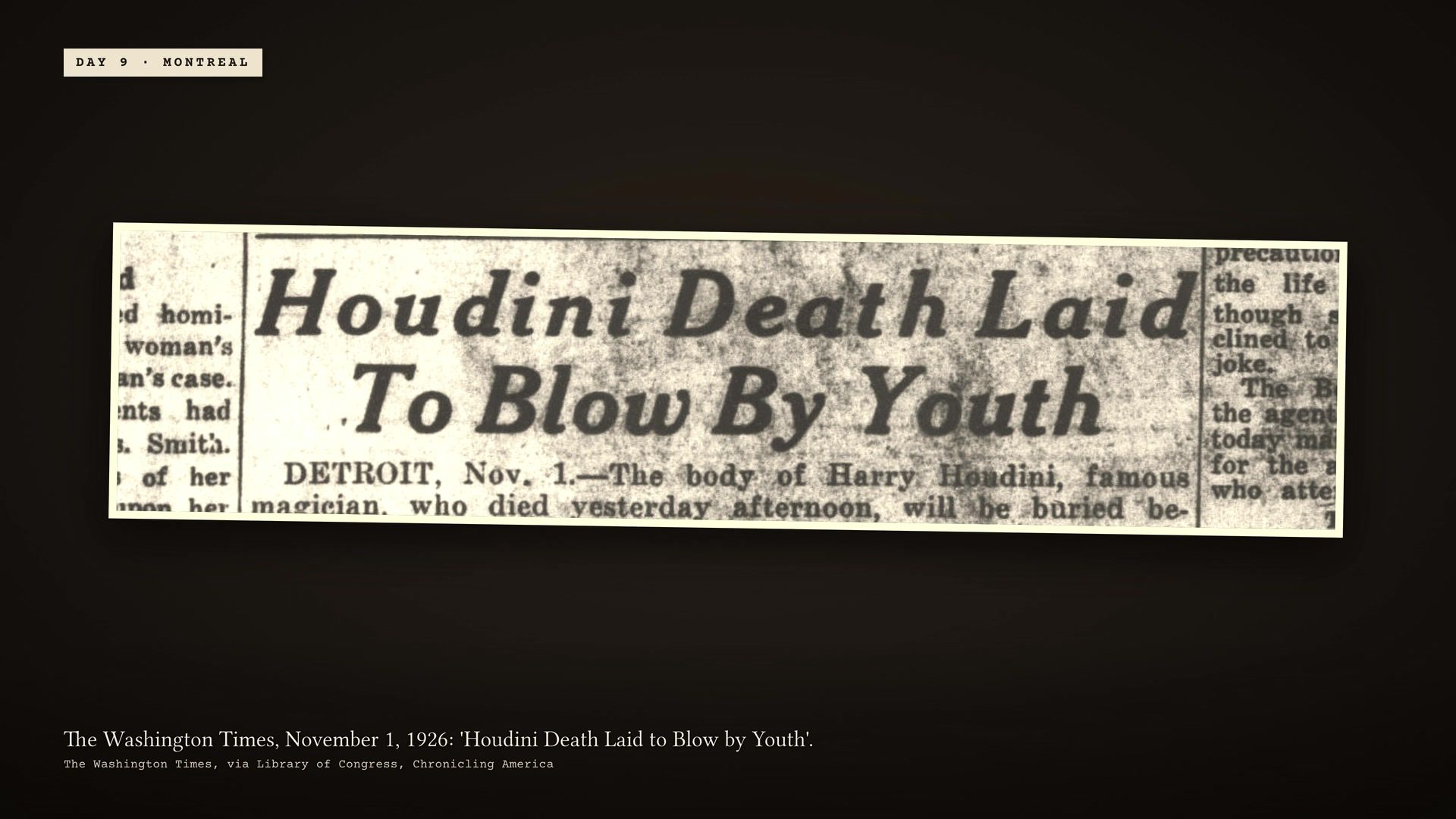
Exhibit AIn the film at 0:22
The blow, on the front page
The Washington Times, November 1, 1926, the day after he died: “Houdini Death Laid to Blow by Youth.” The world would remember one reason, a punch, and it was in print within a day.
Source: The Washington Times, 1 November 1926, p. 1, Library of Congress, Chronicling America (public domain)
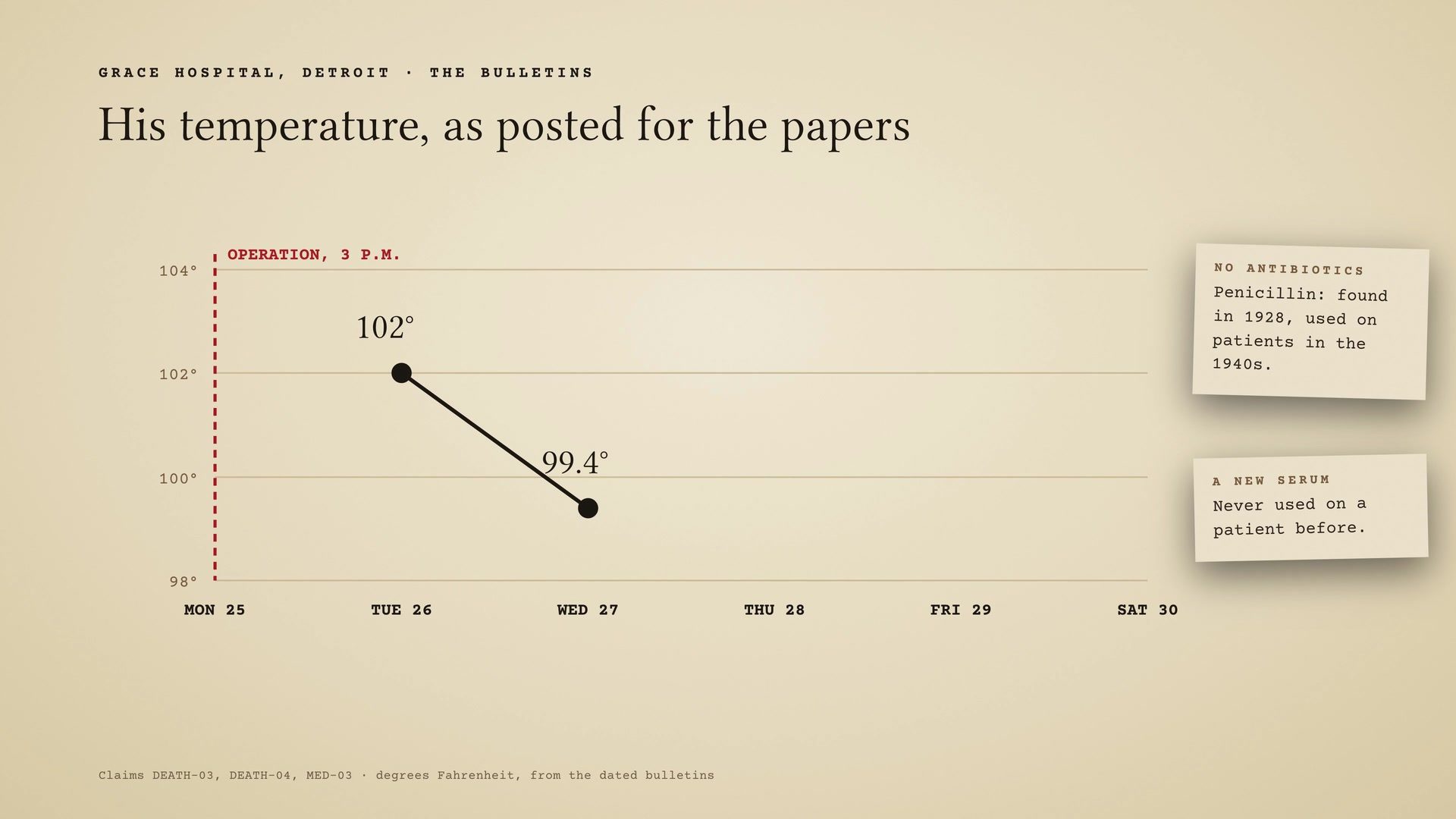
Exhibit BIn the film at 6:51
His temperature, as posted for the papers
After the operation on Monday, October 25, his doctors at Grace Hospital in Detroit posted his temperature for the newspapers: 102 on Tuesday, 99.4 on Wednesday. For a day, the numbers came down. On Friday evening he relapsed and the surgeons operated again; on Saturday it was 103. There were no antibiotics: penicillin was found in 1928.
Source: The physicians' dated bulletins, The New York Times, October 26 to 30, 1926 (transcribed at intervalmagic.com). Chart drawn in code for this film
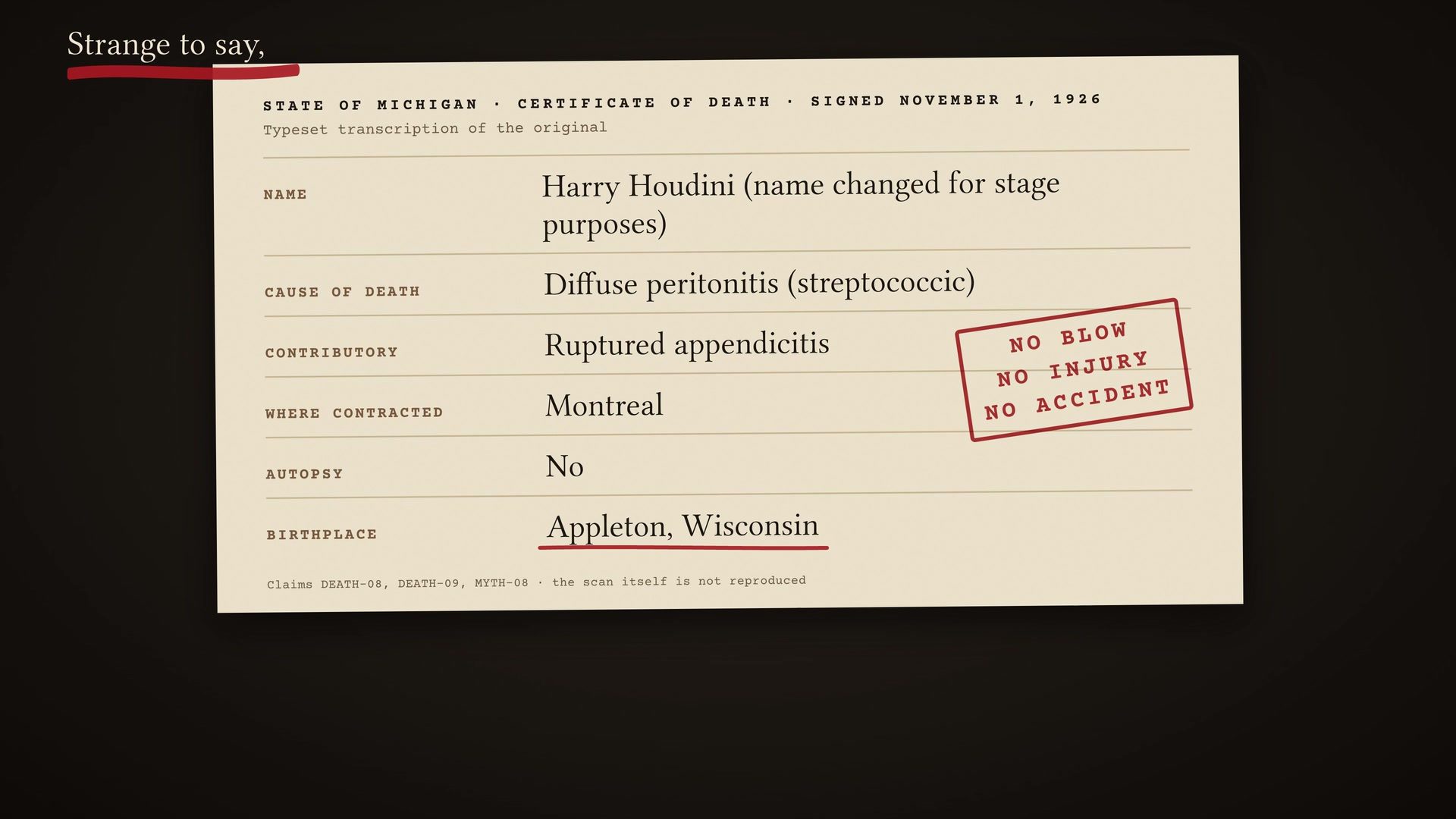
Exhibit CIn the film at 7:56
The one document that had to name the cause
His Michigan certificate of death, signed November 1, 1926, shown in the film as a typeset transcription (the scan itself is not reproduced). Cause of death: diffuse peritonitis (streptococcic). Contributory: ruptured appendicitis. Where contracted: Montreal. Autopsy: no. It names no blow, no injury, no accident. And it keeps the showman's story: born in Appleton, Wisconsin. He was born in Budapest.
Source: Certificate of Death, Harry Houdini, Grace Hospital, Detroit (Michigan Department of Health), Archives of Michigan, published on Michiganology. Transcribed in code for this film
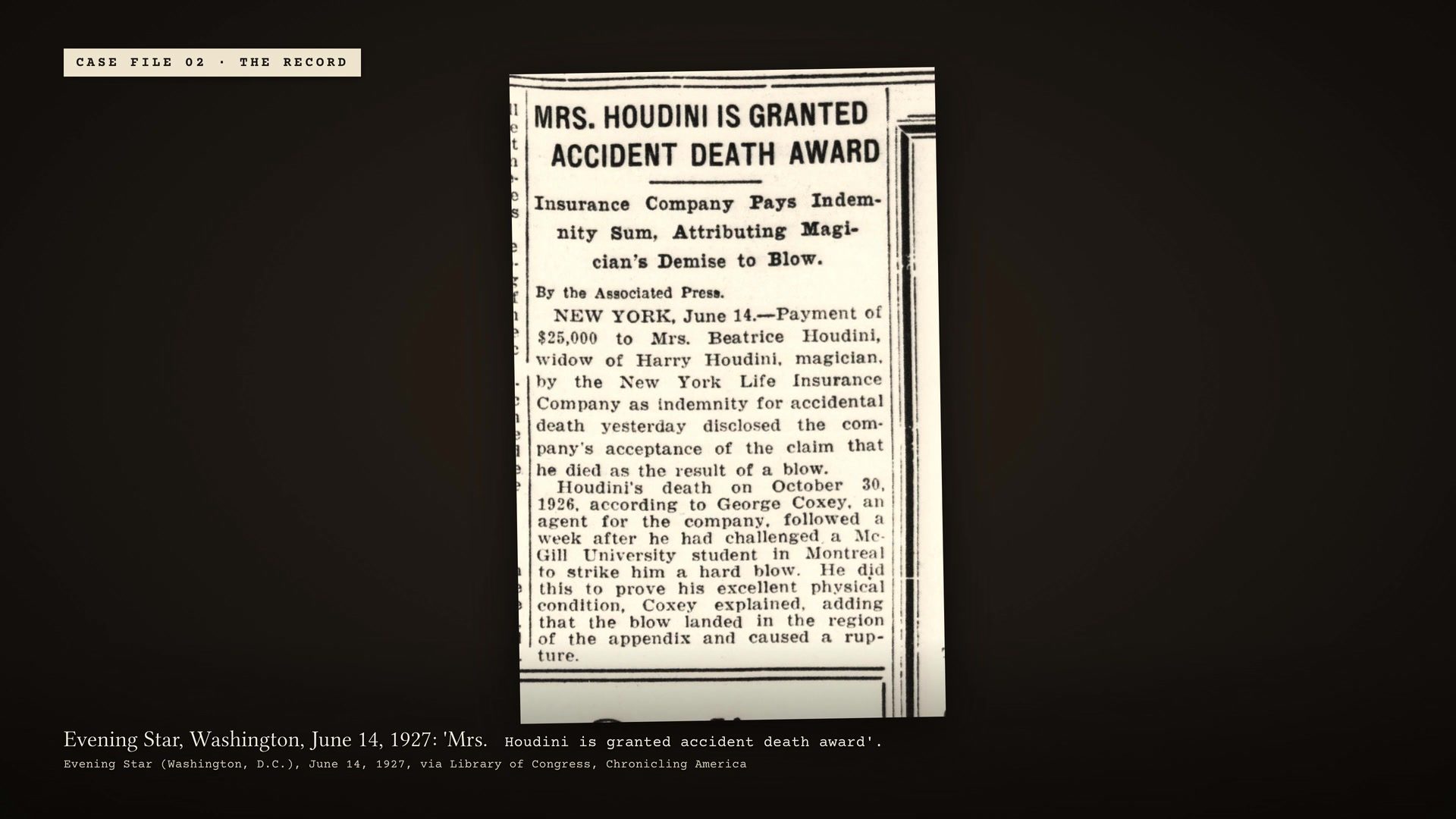
Exhibit DIn the film at 8:48
How the punch became official
In December 1926 his insurer, New York Life, said it had found no evidence of a blow and paid the ordinary $25,000. Bess then filed for double, with sworn statements from three McGill students. In June 1927 the company paid a further $25,000, $50,000 in all, and accepted the claim that he died of a blow. That decision, more than any doctor, made the punch the official story.
Source: Evening Star, Washington, D.C., 14 June 1927, p. 46 (Associated Press), Library of Congress, Chronicling America (public domain)
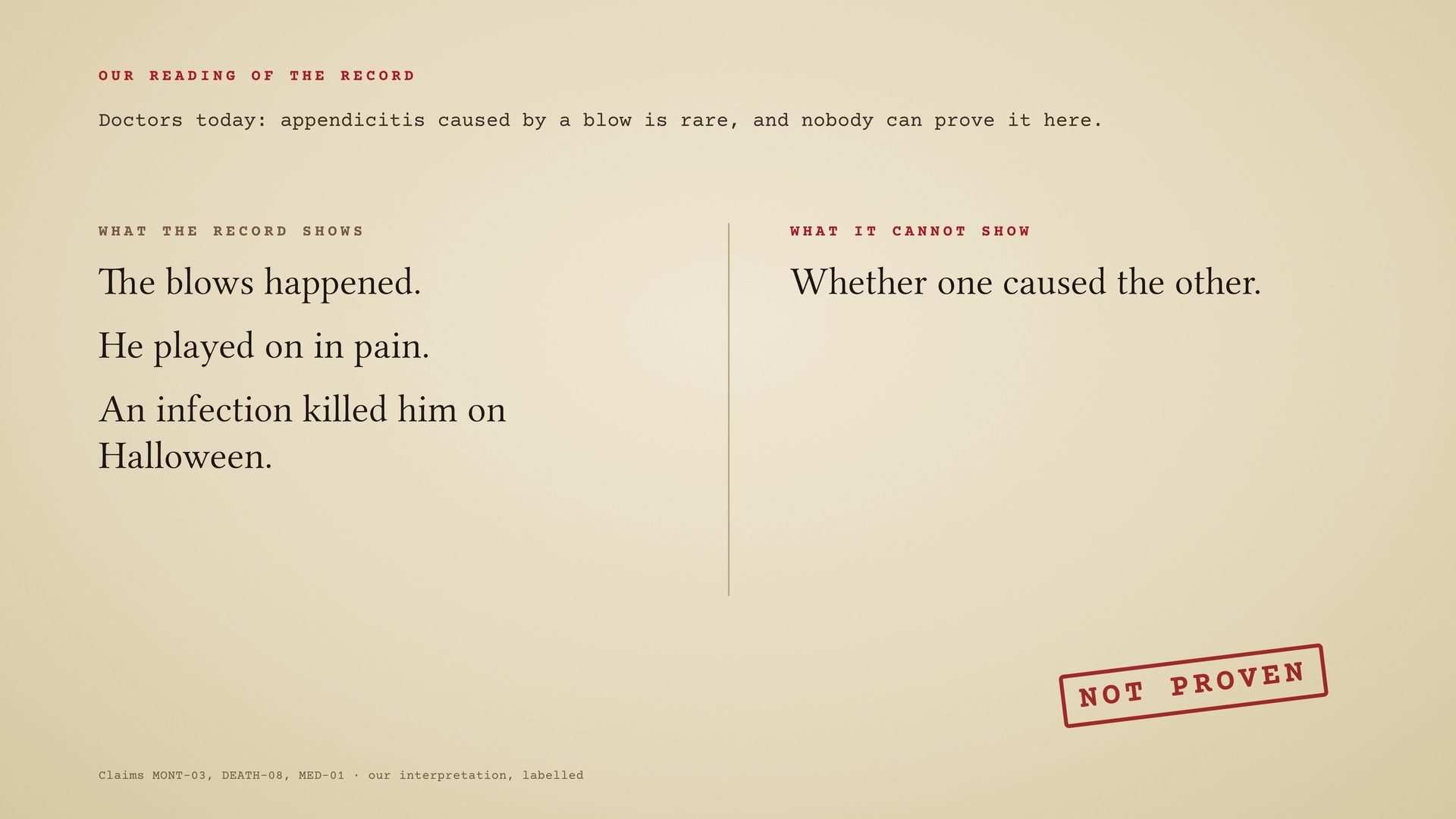
Exhibit EIn the film at 9:02
What the record shows, and what it cannot
The film's own reading of the record, labelled as such on screen. The blows happened. He played on in pain. An infection killed him on Halloween. Whether one caused the other, the record cannot show: doctors today say appendicitis caused by a blow is rare, and nobody can prove it here.
Source: Drawn in code for this film from claims MONT-03, DEATH-08 and MED-01. The medical sources are under “Detroit, Grace Hospital and the medicine” below
Status
Where it stands (as of October 21, 2026)
Whitehead's grave in Montreal has its 2026 marker, and a Houdini séance is set for Halloween, the 100th anniversary of his death.
Re-checked on
Transcript
The full narration, 1,642 words
0:00Day 9: the man on the couch
Montreal. Friday, October 22, 1926. Harry Houdini is lying on a couch in his dressing room, reading his mail. In nine days he will be dead. On Halloween. Nobody in this room knows that. You do. The world would remember one reason: a punch. A student hit him, and the man who escaped everything could not escape that. A hundred years later, the record tells a stranger story. Did a punch kill Houdini?
0:38Erik Weisz becomes Houdini
He was born Erik Weisz, in Budapest, Hungary, on March 24, 1874. Around 1878 the family emigrated to Appleton, Wisconsin, where his father became a rabbi. For most of his life he told the world he was born there, on April sixth. Remember that. He took the name Houdini from a French magician he admired, Robert-Houdin. In June 1894 he married a young performer, Wilhelmina Beatrice Rahner. Everyone called her Bess.
In 1899 a booking agent told him to drop the card tricks and do escapes. Within a year he was a star in Europe. Handcuffs. Chains. A packing crate, nailed shut and lowered into New York harbor. He escaped from a milk can full of water, flew an airplane over Australia, vanished an elephant in New York and starred in silent films. From 1912 his signature act was the Water Torture Cell: upside down, locked by the ankles, in a tank of water. Hold on to that tank. The movies will need it.
1:58Why Montreal: his war on fake mediums
So why was the world's greatest escape artist in Montreal in October 1926, lecturing about ghosts? It began with his mother. In July 1913, while Houdini was performing in Europe, his mother Cecilia suffered a stroke in New York. She died on July 17, before he could get home. For weeks he barely worked. He visited her grave almost every day, and had her letters typed so he could read them again. For years he hoped a medium might bring him a real message from her. None did.
In June 1922, in Atlantic City, Lady Doyle, the wife of Sherlock Holmes's creator, Sir Arthur Conan Doyle, produced pages of automatic writing she said came from his mother. The page began with a cross. It was written in English, which his mother barely spoke. And it never mentioned that the day was her birthday. Houdini said publicly that he had seen no proof. The friendship cooled into a public argument that lasted until he died.
Then he went to war. In Boston he sat with the most famous medium in America, known as Margery, and built a wooden box to hold her in the dark. He went to séances in disguise, often as an old man with a white beard, with a reporter and a detective beside him. He offered up to ten thousand dollars to any medium who could produce something he could not explain and reproduce. In 1926 he testified before Congress for a bill to ban fortune-telling for money in Washington. The bill never left committee. And he put the fight on stage. His last show was magic and escapes, then a whole act exposing the tricks of fake mediums.
Harry and Bess also agreed on something private: a secret code. If one of them died, any message that claimed to come from the other could be tested. Keep that code in mind.
4:10Day 20: Albany
Albany, New York. Twenty days before Halloween. As he was lifted into the Water Torture Cell, part of the apparatus struck his foot, and he broke a bone in his ankle. He finished the show, and kept touring. After Albany he seems to have dropped the water cell from his show. By the time he reached Montreal, the trick the movies would kill him with was already off the bill.
4:34Days 12 to 9: the dressing room
5:10 to 5:42: the paper-cutout scenes are a RECONSTRUCTION of three accounts (Price's, Bess's and Whitehead's), drawn for the film and labelled on screen. They are not footage.
In Montreal he played the Princess Theatre. On Tuesday, October 19, he lectured at McGill University on how fake mediums fool people. On Friday, October 22, three McGill students came to his dressing room. One, Sam Smilovitz, was sketching him. His friend Jack Price watched. The third, a first-year student named J. Gordon Whitehead, asked if it was true he could take any punch to the stomach.
What happened next, we know only from what people said afterwards. And they do not agree. Price swore that Houdini said yes, and that Whitehead struck at least four very hard blows, just right of the navel. Bess, in the biography written from her memories, said Harry was absorbed in a letter, gave an absent-minded reply the student took as a yes, and stopped him at the fourth blow. Whitehead's own sworn statement put it on Thursday, the day before. Two blows, he said, left of the navel, at Houdini's invitation. And Houdini never complained. According to Price, Houdini said at once that he had not had time to brace himself. With his broken ankle, he had not even stood up.
5:51Day 8: the night train
That night he could not sleep. On Saturday he did two more shows in pain, then boarded the night train to Detroit. At first the newspapers said a reporter had hit him. Then a student at his lecture. The university said nothing happened at the lecture, and the theatre said he arrived in Montreal already ill. The story was still changing. It would change again.
6:19Day 7: Detroit, the last show
In Detroit a doctor told him it was appendicitis, and that he needed a hospital. The theatre was sold out. He put off the hospital for almost a day, to finish a show. He went on stage with a fever of 104. He got through the show, just, and collapsed when it was over.
6:39Days 6 to 1: Grace Hospital
On Monday afternoon, October 25, surgeons at Grace Hospital removed his appendix. It had already burst. Infection had spread through his abdomen. In 1926 there were no antibiotics. Penicillin was discovered two years later, and not used to treat patients until the 1940s. His doctors tried a new serum, never used on a patient before. Twice a day they posted his temperature for the newspapers. Tuesday: a hundred and two. Wednesday: ninety-nine point four. For a day, the numbers came down. On Friday evening he relapsed, and the surgeons operated again. Saturday: a hundred and three.
7:25Day 0: Halloween
He died on Sunday afternoon, October 31, 1926. Halloween. He was fifty-two. His brother said his last words were: I'm tired of fighting. The next morning The New York Times ran the words: death due to poisoning. It meant infection, not poison. At the time, his doctors blamed the punches.
7:52The certificate and the insurance file
Strange to say, the one document that had to name the cause never mentions a punch. His death certificate says: diffuse peritonitis. Contributing cause: a ruptured appendix. Where was the illness contracted? Montreal. Was there an autopsy? No. There is no punch on it. No blow, no injury, no accident. Even here the showman's story survives: born, it says, in Appleton, Wisconsin.
So how did a punch become the cause of death? The answer is in an insurance file. Two months after his death, his insurance company said there was no evidence of any punch. It paid the ordinary twenty-five thousand dollars, not double. Then Bess filed for the double payment, with sworn statements from three McGill students. In June 1927 the insurer changed its mind. It paid double, fifty thousand dollars, and accepted the punch as the cause. That decision, more than any doctor, made the punch the official story.
Doctors today are far less sure. Appendicitis caused by a blow is rare, and nobody can prove it here. The punches may simply have hidden an infection that was already starting. So: the blows happened. He played on in pain. An infection killed him on Halloween. Whether one caused the other, nobody can show.
9:25Afterwards
He went home in a bronze coffin he had built for his act. It had been left behind in Detroit by mistake. On November 4, two thousand people came to his funeral in New York. He was buried beside his mother, his head resting on her letters, as he had asked.
The student who threw the punches, J. Gordon Whitehead, was never charged. He died in Montreal in 1954, in an unmarked grave. In 1953, Paramount's Houdini, starring Tony Curtis, gave the story a Hollywood ending: he passes out upside down in his water torture cell, in front of an audience. It never happened that way. In 2007 a great-nephew asked to have his body dug up and tested for poison. No court petition was ever filed. Houdini still lies where he was buried in 1926.
And this year, Whitehead's grave in Montreal finally got a headstone: Falsely Accused No More.
10:34The code
Which leaves the code. The message would begin with Rosabelle, the name of a song Bess sang on stage when they were young. The rest used the code from their old mind-reading act, in which words stood for numbers, and numbers for letters. In January 1929 a medium named Arthur Ford delivered it, word for word, and Bess signed that it was correct. But the code words had already been published, the year before, in a biography written with her help. In 1934 she swore she had never received a genuine message from her husband. How Ford got it has never been proven.
Ten years to the day after his death, on Halloween 1936, Bess went up to the roof of the Knickerbocker Hotel in Hollywood for one last séance, broadcast on the radio. Houdini did not come. She switched off the small electric light that had burned beside his photograph since he died. A man who spent his last years exposing fake mediums died on the one night of the year made for ghosts. Since 1946, every Halloween, someone somewhere has set a chair for him. This Halloween, the hundredth, they will try again. He has never sat in it. The code they agreed, decoded, reads two words. Rosabelle. Believe.
Sources and credits
Every claim in the film has a source, and every photograph and document is credited. 87 sources, grouped by the part of the story they support, then the credits for every image and sound in the film, with the license for the 2 images used under Creative Commons.
Sources
His life and act
- Library of Congress, Rare Book and Special Collections Division (Joan F. Higbee, October 1996)Houdini: A Biographical Chronology
- Nacho Ares, National Geographic, 2025-03-20Debunking the myths behind Harry Houdini's life and death
The war on fake mediums
- Arthur Conan Doyle (G. P. Putnam's Sons, New York, 1930), Internet Archive full textThe Edge of the Unknown, chapter 'The Riddle of Houdini'
- Internet Archive (Digital Library of India scan)Houdini: His Life Story, by Harold Kellock, "from the recollections and documents of Beatrice Houdini" (1928; London: Heinemann edition scanned by the Digital Library of India)
- The New York Times, via Tom Interval's transcription at intervalmagic.com"Unveil Monument to Houdini at Grave", The New York Times, Oct. 31, 1927, p. 19 col. 4 (transcription)
- Internet ArchiveA Magician Among the Spirits (Harry Houdini, Harper & Brothers, 1924), full text
- Internet Archive (State Library of Victoria copy)Houdini Exposes the Tricks Used by the Boston Medium "Margery" to Win the $2500 Prize Offered by the Scientific American (Adams Press, New York, 1924)
- The New York Times, via Tom Interval's transcription at intervalmagic.com"'Margery's' Spirits Fail to Win Prize", The New York Times, Feb. 12, 1925 (transcription)
- Library of Congress, Chronicling America (newspaper page scan and OCR)The Milwaukee Leader, March 6, 1929, p. 2
- Library of Congress, Chronicling America (newspaper page scan and OCR)Evening Star (Washington, D.C.), May 18, 1926, p. 1
- The New York Times, via Tom Interval's transcription at intervalmagic.com"Hints of Séances at White House", The New York Times, May 19, 1926, p. 26 col. 2 (transcription)
- The New York Times, via Tom Interval's transcription at intervalmagic.com"Houdini Assails Medium as Fraud", The New York Times, Dec. 20, 1924, p. 18 col. 3 (transcription)
- The New York Times, via Tom Interval's transcription at intervalmagic.com"Say Lawmakers Consult Mediums", The New York Times, Feb. 27, 1926, p. 17 col. 3 (transcription)
- Society for Psychical Research (spr.ac.uk), April 1, 2012Review by Tom Ruffles of the reprinted hearing record, Fortune Telling: Hearings before the Subcommittee on Judiciary of the Committee on the District of Columbia, House of Representatives (69th Congress), Feb. 26, May 18, 20 and 21, 1926
- The New York Times, via Tom Interval's transcription at intervalmagic.com"Houdini Opens a New Show", The New York Times, Dec. 15, 1925, p. 4 col. 6 (transcription)
- The New York Times, via Tom Interval's transcription at intervalmagic.com"An Explanation from Houdini", The New York Times, Dec. 29, 1925, p. 22 col. 6 (transcription)
Montreal: the lecture and the dressing room
- The New York Times, transcribed by Tom Interval (intervalmagic.com)Mrs. Houdini Revives Report of Fatal Blow (The New York Times, 1927-02-26)
- John Cox, Wild About Harry, 2013-11-24Getting punchy
- The New York Times, transcribed by Tom Interval (intervalmagic.com)Houdini Near Death After an Operation (The New York Times, 1926-10-25)
- The New York Times, transcribed by Tom Interval (intervalmagic.com)Houdini's Body Gets Here Today (AP, Montreal, Nov. 1: 'Injury in Montreal is Denied') (The New York Times, 1926-11-02, page 27, column 1)
Detroit, Grace Hospital and the medicine
- Harold Kellock (Harcourt, Brace, 1928; Blue Ribbon Books reprint), Internet Archive full textHoudini: His Life-Story, from the recollections and documents of Beatrice Houdini
- Howard Markel, M.D., PBS NewsHour, 2019-03-24What caused Harry Houdini's mysterious death?
- Archives of Michigan (Michiganology)Houdini in Detroit
- Science History InstituteAlexander Fleming
- The New York Times, transcribed by Tom Interval (intervalmagic.com)Give Houdini New Serum (The New York Times, 1926-10-26)
- The New York Times, transcribed by Tom Interval (intervalmagic.com)Houdini Has Restful Day (The New York Times, 1926-10-27)
- The New York Times, transcribed by Tom Interval (intervalmagic.com)Houdini Still in Danger (The New York Times, 1926-10-28)
- The New York Times, transcribed by Tom Interval (intervalmagic.com)Houdini Undergoes a Second Operation (The New York Times, 1926-10-29)
- The New York Times, transcribed by Tom Interval (intervalmagic.com)Houdini Slightly Better (The New York Times, 1926-10-30)
- Bouassria A. et al., World Journal of Emergency Surgery 8:31 (2013)Traumatic appendicitis: a case report and literature review
The certificate and the insurance file
- Library of Congress, Chronicling America (Associated Press dispatch)Mrs. Houdini Is Granted Accident Death Award (Evening Star, Washington, D.C., 1927-06-14, page 46)
- Archives of Michigan, image published on MichiganologyCertificate of Death, Harry Houdini, Grace Hospital, Detroit (Michigan Department of Health)
- The New York Times (AP), 1926-12-23, transcribed by Tom Interval (intervalmagic.com)Find Houdini Was Not Hurt
- The New York Times, 1927-06-14, p. 34, transcribed by Tom Interval (intervalmagic.com)$50,000 for Mrs. Houdini

The myths: the punch, the water cell, the film
- The New York Times, transcribed by Tom Interval (intervalmagic.com)Harry Houdini Dies After Operations (The New York Times, 1926-11-01, page 1, column 3)
- The New York Times, 1927-02-26, p. 3, transcribed by Tom Interval (intervalmagic.com)Mrs. Houdini Revives Report of Fatal Blow (index page; article at 1927_02.26.html)
- The Public Domain ReviewHoudini on his Water Torture Cell (1914)
- Wild About Harry (John Cox), 2012-09-21The Chinese Water Torture Cell at 100
- Wild About Harry (John Cox), reference pageThe Chinese Water Torture Cell
- Wild About Harry (John Cox), 2014-10-12The Albany accident
- Wild About Harry (John Cox), 2021-10-14Three days in Schenectady
- Houdini's Ghost (Patrick Culliton's website)The Sworn Affidavit of J. Gordon Whitehead (transcription)
- The New York Times (McCandlish Phillips), 1972-11-01, transcribed by Tom Interval (intervalmagic.com)In Escape to Past, Magicians Hail Houdini
- The Official Houdini SeanceOur History
- Wild About Harry (John Cox), reference pageJ. Gordon Whitehead
- Geist magazine, issue 56 (Jill Mandrake)The Man Who Killed Houdini (review)
- Wild About Harry (John Cox), 2005-07-04J. Gordon Whitehead revealed in 'The Man Who Killed Houdini'
- AFI Catalog of Feature Films, American Film InstituteHoudini (1953)
- Wild About Harry (John Cox), 2012-03-23The biggest myth
- Wild About Harry (John Cox), 2011-11-21, quoting Turner Classic Movies' online article (tcm.com/tcmdb/title/4642)HOUDINI (1953) on TCM tonight (quoting TCM's article on the film)
- Wild About Harry (John Cox), 2026-09-30Dr. Larrian Gillespie absolves J. Gordon Whitehead
- Genii Magazine (George Hardeen), 2026-09-29Houdini's Death: J. Gordon Whitehead, Falsely Accused No More
Afterwards: the funeral and the grave
- The New York Times, transcribed by Tom Interval (intervalmagic.com)Harry Houdini Rites Tomorrow Morning (The New York Times, 1926-11-03, page 23, column 4)
- The New York Times, transcribed by Tom Interval (intervalmagic.com)Houdini Eulogized in Impressive Rites (The New York Times, 1926-11-05, page 21, column 1)
- Wild About Harry (John Cox), 2007-03-22, reposting the Associated Press story by Larry McShane of the same dateAP: Houdini kin wants body exhumed, tested
- Wild About Harry (John Cox), dated 2009-02-28 in the post headerTime to bury the Houdini exhumation
- Wild About Harry (John Cox), 2026-06-28Houdini's grave is ready for its closeup!
- Associated Press via NBC News, 2007-03-22One final trick for Houdini: exhumation
The code and the séances
- The New York Times, via Tom Interval's transcription at intervalmagic.com"Says Houdini Sent Word from Beyond", The New York Times, Nov. 23, 1926, p. 15 col. 4 (transcription)
- The New York Times, via Tom Interval's transcription at intervalmagic.com"Houdini's Friends Doubt 'Message'", The New York Times, Jan. 10, 1929, p. 24 col. 1 (transcription)
- Library of Congress, Chronicling America (newspaper page scan and OCR)Evening Star (Washington, D.C.), Oct. 31, 1936, p. 1 (Associated Press, Hollywood)
- Library of Congress, Chronicling America (newspaper page scan and OCR)The Washington Times, Dec. 14, 1927, p. 3
- The New York Times, via Tom Interval's transcription at intervalmagic.com"Reports Message of Houdini Decoded", The New York Times, Jan. 9, 1929, p. 3 col. 5 (transcription)
- Library of Congress, Chronicling America (newspaper page scan and OCR)Springfield Weekly Republican (Mass.), Jan. 17, 1929, p. 2, editorial "A Message From Houdini?"
- The New York Times, via Tom Interval's transcription at intervalmagic.com"Widow's Séance for Houdini Fails", The New York Times, Nov. 1, 1936, p. 22 col. 1 (transcription)
- Library of Congress, Chronicling America (newspaper page scan and OCR)The Milwaukee Leader, Jan. 9, 1929, p. 4, "Claim Houdini Code Received by Medium" (United Press, by Harry R. Zander)
- Wild About Harry (wildabouthoudini.com), June 22, 2017Happy Anniversary Harry and Bess (blog post by John Cox)
- Library of Congress, Chronicling America (newspaper page scan and OCR)The Indianapolis Times, Jan. 8, 1929, p. 1 (United Press, New York, Jan. 8)
- Wild About Harry (wildabouthoudini.com), Jan. 16, 2013The Margery Files: Inside man (blog post by John Cox), with image "Bess Houdini Statement, 9 Jan 1929" from the Libbet Crandon de Malamud Collection
- Library of Congress, Chronicling America (newspaper page scan and OCR)New Britain Herald (Conn.), Jan. 10, 1929, p. 9, "Mrs. Houdini to Receive Message" (United Press)
- Library of Congress, Chronicling America (newspaper page scan and OCR)The Indianapolis Times, Jan. 10, 1929, p. 1, "'Publicity Hoax' Label on Houdini Message Is Denied" (United Press)
- Library of Congress, Chronicling America (newspaper page scan and OCR)The Washington Times, Jan. 10, 1929, p. 24 (International News Service)
- Library of Congress, Chronicling America (newspaper page scan and OCR)Brownsville Herald (Tex.), Feb. 11, 1928, p. 1 (Associated Press)
- The New York Times, via Tom Interval's transcription at intervalmagic.com"Mrs. Houdini Abandons Faith in Message from Dead Husband", The New York Times, Mar. 19, 1930, p. 21 col. 3 (transcription)
- The New York Times, via Tom Interval's transcription at intervalmagic.com"Says Spiritism Fails", The New York Times, Oct. 12, 1938, p. 29 col. 4 (transcription)
- The Skeptic's Dictionary (Robert Todd Carroll), last updated Dec. 16, 2015Arthur Ford hoax
- The New York Review of Books, Nov. 1, 1973A Spirited Exchange (letters, Allen Spraggett and Martin Gardner)
- jamyianswiss.com (undated reprint of a magazine review column)Review of William V. Rauscher, The Houdini Code Mystery: A Spirit Secret Solved (2000), by Jamy Ian Swiss
- Wild About Harry (wildabouthoudini.com), Oct. 31, 2014Halloween 1936: The Final Houdini Seance (blog post by John Cox)
- The New York Times, via Tom Interval's transcription at intervalmagic.com"Mrs. Houdini Died Spiritualism Foe", The New York Times, Feb. 27, 1943 (transcription)
A hundred years on
- Wild About Harry (John Cox), 2016-10-01The Houdini-Weiss exedra turns 100
- Library of Congress Blog (guest post by Mark Dimunation, chief of Rare Book and Special Collections), 2020-10-30Hollywood, Houdini and the Halloween Seance of 1936
- Wild About Harry (John Cox), 2026-10-01A rundown of October Houdini events
- Wild About Harry (John Cox), 2020-10-31The secret origins of the annual Houdini Seance
- The Official Houdini SeanceThe Official Houdini Seance (home page)
- Wild About Harry (John Cox), 2025-10-03The Official Houdini Seance 2025 in Glenside
- WBUR (Olivia Deng), 2026-09-01Harry Houdini death centennial: Salem handcuffs at the Peabody Essex Museum
Credits
Photographs and film
- Archives de la Ville de Montréal (photo: M.E.-Lactance Giroux, 1925), via Wikimedia CommonsCongestion sur la Place d'Armes, Montréal
- F. S. Challener at the Princess Theatre, Montreal, 1917, via Wikimedia CommonsF. S. Challener seated in front of "Orpheus Charming the Nymphs", a panel for the proscenium of the Princess Theatre, Montreal
- Conrad Poirier, 1935, BAnQ, via Wikimedia CommonsPrincess Theatre façade, Montreal
- Library of Congress, Prints & Photographs Division, National Photo Company Collection, LC-DIG-npcc-27425Houdini, 1/20/26
- Library of Congress, Prints & Photographs Division, George Grantham Bain Collection, LC-DIG-ggbain-50392Dempsey, Houdini, Leonard (boxing)
- Library of Congress, Rare Book and Special Collections Division, McManus-Young Collection, LC-USZ62-112420Harry Handcuff Houdini
- Library of Congress, Rare Book and Special Collections Division, McManus-Young Collection, LC-USZ62-112436[Harry Houdini, full-length portrait, standing, facing front, in chains]
- Library of Congress, Prints & Photographs Division, McManus-Young Collection, LC-DIG-ppmsca-40859[Houdini jumps from Harvard Bridge, Boston, Massachusetts] / John H. Thurston, stereopticons.
- Library of Congress, Rare Book and Special Collections Division, McManus-Young Collection, LC-USZ62-112419[Harry Houdini, full-length portrait, standing, facing right, in chains]
- Library of Congress, Prints & Photographs Division, LC-DIG-ppmsca-23992[Harry Houdini stepping into a crate that will be lowered into New York Harbor as part of an escape stunt on July 7, 1912]
- National Archives, Ford Motor Company Collection (FC-FC-50)New York City Harbor and Bridges / Buffalo Bill Cody and Ringling Brothers Circus / Niagara Falls / Fourth of July Parade / Winter Forest, Belle Isle, Detroit
- Library of Congress, Prints & Photographs Division, LC-USZ62-110548[Crate containing Harry Houdini, being lowered from ship into water] / Dietz, N.Y.
- Library of Congress, Rare Book and Special Collections Division, McManus-Young Collection, LC-USZ62-112435[Harry Houdini performs the great milk can escape]
- Library of Congress, Prints & Photographs Division, LC-USZ62-45017[Three scenes of Harry Houdini as aviator; close-up in Voisin biplane cockpit (1910?); ascending in biplane; flying low]
- Library of Congress, Prints & Photographs Division, National Photo Company Collection, LC-DIG-npcc-22560Houdini [dangling from the B.F. Keith's Theatre, G and 15th Streets, N.W., in an upside-down straitjacket escape, Washington, D.C.]
- The Master Mystery (1919), Eye Filmmuseum, public domainThe Master Mystery (Dutch trailer or episode excerpt, EYE FLM41533)
- Terror Island (1920), public domain, via Internet ArchiveTerror Island (5-reel 1922 Realart print)
- The Man from Beyond (1922), public domain, via Internet ArchiveThe Man from Beyond (high-resolution copy)
- Library of Congress, Rare Book and Special Collections Division, McManus-Young Collection, LC-USZ62-112427[Harry Houdini with his mother Cecilia Steiner Weiss, Rochester, New York]
- Library of Congress, Rare Book and Special Collections Division, McManus-Young Collection, LC-USZ62-112416[Harry Houdini with his wife Beatrice and mother Cecilia Steiner Weiss, half-length portrait]
- Houdini, A Magician Among the Spirits (Harper & Brothers, 1924), scan: Internet Archive / Princeton Theological Seminary LibraryA magician among the spirits (1924), frontispiece: Sir Arthur Conan Doyle and Houdini photographed at the Auto Club, London, England
- Library of Congress, Rare Book and Special Collections Division, McManus-Young Collection, LC-USZ62-112375[Houdini makes spirit hands]
- Library of Congress, Prints & Photographs Division, McManus-Young Collection, LC-USZ62-99116[The Medium Margery, Mina Crandon, posed with Harry Houdini, J. Malcom Bird, and O.D. Munn, members of the committee which investigated her Boston seances]
- Library of Congress, Prints & Photographs Division, LC-USZ62-26517[Houdini in the "Margie Box"]
- Library of Congress, Prints & Photographs Division, McManus-Young Collection, LC-USZ62-96050[Harry Houdini and woman looking at crystal ball]
- Library of Congress, Prints & Photographs Division, LC-USZ62-26521[Houdini in classroom]
- Library of Congress, Prints & Photographs Division, LC-DIG-ppmscd-04010[Houdini and the ghost of Abraham Lincoln]
- McCord Stewart Museum, M2014.128.659McCord: Harry Houdini and Mrs. Benninghofen, Chicago, about 1926 (Butler Photography)
- McCord Stewart Museum, M2014.128.661McCord: Houdini Testifying in Front of Congress, Washington DC, about 1926
- Library of Congress, Prints & Photographs Division, National Photo Company Collection, LC-DIG-npcc-27498Harry Houdini & Senator Capper (Senate District Com.), 2/26/26
- McCord Stewart Museum, M2014.128.618McCord: Houdini Souvenir Program, Coast to Coast Tour, Season 1926-27
- McCord Stewart Museum, M2014.128.702.21McCord: Marquee of the Shubert Princess Theatre announcing Harry Houdini, Chicago, about 1926
- McCord Stewart Museum, M2014.128.683.2McCord: Billboard for the performance of Harry Houdini, Chicago, 1926 (H. A. Atwell Studios)
- Library of Congress, Rare Book and Special Collections Division, McManus-Young Collection, LC-USZ6-2074[Harry and Beatrice Houdini in Nice, France, full-length portrait, standing, facing front]
- Library of Congress, Prints & Photographs Division, Detroit Publishing Company Collection, LC-DIG-det-4a24893St. Catherine Street, Montreal, Quebec
- McCord Stewart Museum, Montreal, via Flickr Commons and Wikimedia CommonsArts Building wing under construction, McGill University, 1926
- Library of Congress, Prints and Photographs DivisionMcGill University, Montreal, Canada (postcard), Grace Hospital, Detroit, Mich., Pedestrians and automobile traffic, Monroe Avenue and Cadillac Square, Griswold St., south from Michigan Ave.
- Library of Congress, Prints & Photographs Division, Detroit Publishing Company Collection, LC-DIG-det-4a18915Woodward Avenue and Central Methodist Episcopal Church, Detroit, Mich.
- National Archives, Ford Motor Company Collection (FC-FC-45)U.S. Army General Hospital No. 36, Detroit / Industrial School, Lansing / others
- Library of Congress, Prints & Photographs Division, George Grantham Bain Collection, LC-DIG-ggbain-11724Houdini
- Photo: Anthony22 / Wikimedia Commons, CC BY-SA 3.0Harry Houdini Grave Marker 8-2008.jpg, Houdini Gravesite 1024.jpg, License: CC BY-SA 3.0
- McCord Stewart Museum, M2014.128.703.44McCord: Portrait of Harry and Bess Houdini, Chicago, about 1923 (Butler Photography)
- McCord Stewart Museum, M2014.128.705.36Science and Invention, April 1929, p. 1151: "'Rev' Ford Faked Houdini Message" by Rea Jaure (a full magazine page in the McCord's Houdini collection)
- McCord Stewart Museum, M2014.128.889McCord: Invitation card for the Final Houdini Seance, 1936
- McCord Stewart Museum, M2014.128.676.3McCord: Bess Houdini, Hollywood, California, 1935 (The Little Photo Studio)
- Library of Congress, Rare Book and Special Collections Division, McManus-Young Collection, LC-USZ62-112428[Harry and Beatrice Houdini, half-length portrait, seated]


Documents and maps
- Internet Archive scanThe McGill Daily, front page, Old McGill 1926, printed p. 54: a class group photo on the steps, printed sideways; the page carries no class title, Popular Science Monthly, November 1925, pp. 12 to 13: "How I Unmask the Spirit Fakers" by Houdini, Conan Doyle, The Edge of the Unknown (Putnam, New York, 1930), printed p. 21: Jack Price's statement (the four blows; no chance to prepare), Popular Science Monthly, December 1925, p. 12: "How I Do My 'Spirit Tricks'" by Houdini
- The Washington Times, via Library of Congress, Chronicling AmericaThe Washington Times, 1926-11-01, p. 1, The Washington Times, 1926-11-01, p. 2, The Washington Times, 1926-10-25, p. 5 (printed page 3), The Washington Times, 1926-11-05, p. 27 ("Magazine Page"), The Washington Times, p. 3: "Has Houdini Spoken?"
- 1880 U.S. Census, Appleton, Wisconsin (U.S. Census Bureau), via Wikimedia CommonsFile:Houdini 1880 census.jpg (1880 U.S. Census, Schedule 1, Appleton, Outagamie County, Wisconsin, Enumeration District 114, page 12)
- Library of Congress, Rare Book and Special Collections Division, McManus-Young Collection, LC-USZ62-112429[Harry Houdini, half-length portrait, facing front]
- The New York Public LibraryMaster Mystifier Houdini: program from Walter C. Jordan's National Theatre, New York
- Houdini, A Magician Among the Spirits (Harper & Brothers, 1924), scan: Internet Archive / Princeton Theological Seminary LibraryA magician among the spirits (1924), frontispiece: Sir Arthur Conan Doyle and Houdini photographed at the Auto Club, London, England
- Houdini, Houdini Exposes the Tricks Used by the Boston Medium "Margery" (Adams Press, 1924), scan: Internet ArchiveHoudini Exposes the Tricks Used by the Boston Medium "Margery" to Win the $2500 Prize Offered by the Scientific American (1924), front cover
- The Indianapolis Star, March 14, 1915, p. 14, via Wikimedia CommonsHoudini escapeology advertisement (newspaper, 1915)
- The McGill Daily, October 20, 1926, McGill University Library, via Internet ArchiveThe McGill Daily (1926-10-20), p. 1: 'Attacks All Mediums as Fraudulent' (crop)
- Old McGill yearbook, McGill University LibraryOld McGill 1927 yearbook, Arts graduates page with "Samuel J. Smilovitz" portrait and write-up (left column, fourth portrait), Old McGill 1927: Arts '29 class group photo, plus the class list continued on printed p. 328 naming "Whitehead, J. Gordon"
- Evening Star (Washington), via Library of Congress, Chronicling AmericaEvening Star (Washington), 1926-11-01, p. 2, Evening Star, 1926-10-25, p. 1, Evening Star, 1926-10-26, p. 7, Evening Star, 1926-11-05, p. 1, Evening Star, 1926-10-29, p. 17; 1926-10-30, p. 1; 1926-10-31, p. 25
- The Milwaukee Leader, via Library of Congress, Chronicling AmericaThe Milwaukee Leader, 1926-10-30, p. 1, The Milwaukee Leader, 1929-01-09, p. 4
- South Bend News-Times, via Library of Congress, Chronicling AmericaSouth Bend News-Times, 1926-11-01, p. 1, South Bend News-Times, 1929-01-15, p. 4, South Bend News-Times, 1926-10-30, p. 1 and 1926-10-31, p. 1
- Appleton Post-Crescent, 1926-10-30, scan via Internet Archive (NewspaperArchive collection)Appleton Post Crescent (1926-10-30), p. 1: 'Houdini's Condition Is Reported As Grave' (crop)
- The Montgomery Advertiser, via Library of Congress, Chronicling AmericaThe Montgomery Advertiser, 1926-11-01, p. 1
- Appleton Post-Crescent, 1926-11-01, scan via Internet Archive (NewspaperArchive collection)Appleton Post Crescent (1926-11-01), front page, top third (crop)
- Evening Star (Washington, D.C.), June 14, 1927, via Library of Congress, Chronicling AmericaMrs. Houdini Is Granted Accident Death Award (Evening Star, Washington, D.C., 1927-06-14, page 46)
- Intermountain Jewish News, via Library of Congress, Chronicling AmericaIntermountain Jewish News (Denver), 1926-11-11, p. 1
- New Britain Herald, via Library of Congress, Chronicling AmericaNew Britain Herald, 1926-11-05, p. 6
- Appleton Post-Crescent, 1929-01-09, scan via Internet Archive (NewspaperArchive collection)Appleton Post Crescent (1929-01-09), p. 2: 'Houdini Sends Message to Wife from Spirit World' (crop)
- The Indianapolis Times, via Library of Congress, Chronicling AmericaThe Indianapolis Times, 1929-01-09, p. 11, The Indianapolis Times, 1929-01-10, p. 1 and 1929-01-15, p. 9
- Maps: Made with Natural EarthNatural Earth 1:50m admin-0 countries and admin-1 states and provinces, version 5.1.1


Artwork and graphics
- Library of Congress, Prints & Photographs Division, McManus-Young Collection, LC-USZC2-3785Harry Houdini, king of cards
- Library of Congress, Prints & Photographs Division, McManus-Young Collection, LC-DIG-var-1631Return of the greatest of all magicians, the Houdinis, Harry, Bessie original introducers of metamorphosis, greatest and finest trunk mystery the world has ever seen, challenge hand-cuff act, open to the world ....
- Library of Congress, Prints & Photographs Division, McManus-Young Collection, LC-USZC2-1505The Houdinis, Harry, Bessie introducing the only and original.
- Library of Congress, Prints & Photographs Division, McManus-Young Collection, LC-USZC2-3786Challenge to Houdini, Regent Theatre, Salford
- Library of Congress, Prints & Photographs Division, Magic Poster Collection, LC-DIG-ds-14569Special starring record engagement of the world's famous jail breaker, Houdini the only and original handcuff king.
- Library of Congress, Rare Book and Special Collections Division, McManus-Young Collection, LC-USZC4-3290[The world-famous self-liberator Houdini will escape from the water torture cell, Cardiff, Wales]
- Library of Congress, Prints & Photographs Division, McManus-Young Collection, LC-DIG-var-2097Stone walls and chains do not make a prison --- for Houdini
- Library of Congress, Prints & Photographs Division, McManus-Young CollectionMaster mystifier, Houdini the greatest necromancer of the age - perhaps of all times--The literary digest.
- Library of Congress, Prints & Photographs Division, McManus-Young Collection, LC-DIG-var-1627Do spirits return? Houdini says no - and proves it. 3 shows in one : magic, illusions, escapes = fraud mediums exposed.
- Tichnor Brothers postcard, Boston Public Library, Tichnor Brothers Collection #63646Hollywood Knickerbocker Hotel, Hollywood, California (Tichnor Brothers postcard #63646)
- Hallowe'en (Willis Music Co., 1926), cover by George Hauman; Gaylord Music Library, Washington University in St. Louis, via Internet ArchiveHallowe'en: a recreation for piano solo or voice words ad. lib. (cover)
- Library of Congress, Prints & Photographs Division, McManus-Young Collection, LC-DIG-var-2072Houdini, nothing on earth can hold Houdini! Fred Ray & Co. in an intensely funny "Roman travesty" ....

Music
- Music generated with ElevenLabs Music
Narration
- Narration voice generated with ElevenLabs (voice: Peter)
Sound effects
- Sound effects generated with ElevenLabs sound effects
Cards, maps and charts
- Drawn in code for this film from the sourced records: the case-file cards and charts, the map, the typeset transcription of the death certificate (the scan is not reproduced) and the paper-cutout reconstruction at 5:10 to 5:42, labelled RECONSTRUCTION on screen with whose account it follows. The photographs cut into it are real and credited above. No picture in the film is AI-generated. Map made with Natural Earth.