

Case file 06
He Predicted the 1929 Crash. Then He Declared War on Gravity
On 5 September 1929 Roger Babson told a room full of businessmen that a crash was coming, and Wall Street laughed. Seven weeks later he was proved right. Then the forecaster went to war with the force he blamed for his sister's death: gravity.
Roger Babson, 1930sEconomist Roger W. Babson, [1930s?]. Los Angeles Times Photographic Archive, UCLA Library Special Collections, CC BY 4.0

The film plays from YouTube (youtube-nocookie.com) only when you press play.
The case in brief
On 5 September 1929, the forecaster Roger Babson told a room full of businessmen that a stock market crash was coming. That afternoon the market dropped, a fall historians call the Babson Break. The next day a Wall Street broker answered in the Washington Times: “Today he appears to be wrong.” Seven weeks later, the market crashed.
Babson had built his business on one line from Isaac Newton: to every action there is an equal reaction, so every boom would be paid for by an equal slump. This case file follows that idea through the 1920s boom, his warnings, Irving Fisher's reply and the fall that took the Dow down 89 percent by the summer of 1932.
Then it follows the other half of his life. His sister Edith drowned in 1893 and his grandson Michael in 1947, and Babson came to see gravity as the enemy. He set up the Gravity Research Foundation and paid more than a dozen colleges to put up stones that wait for the day someone learns to harness it. His essay prize is still awarded; Stephen Hawking won it in 1971.
In this file: Exhibits, Where it stands, Transcript, Sources and credits
Exhibits
5 frames from the film. Select one to see it at full size.
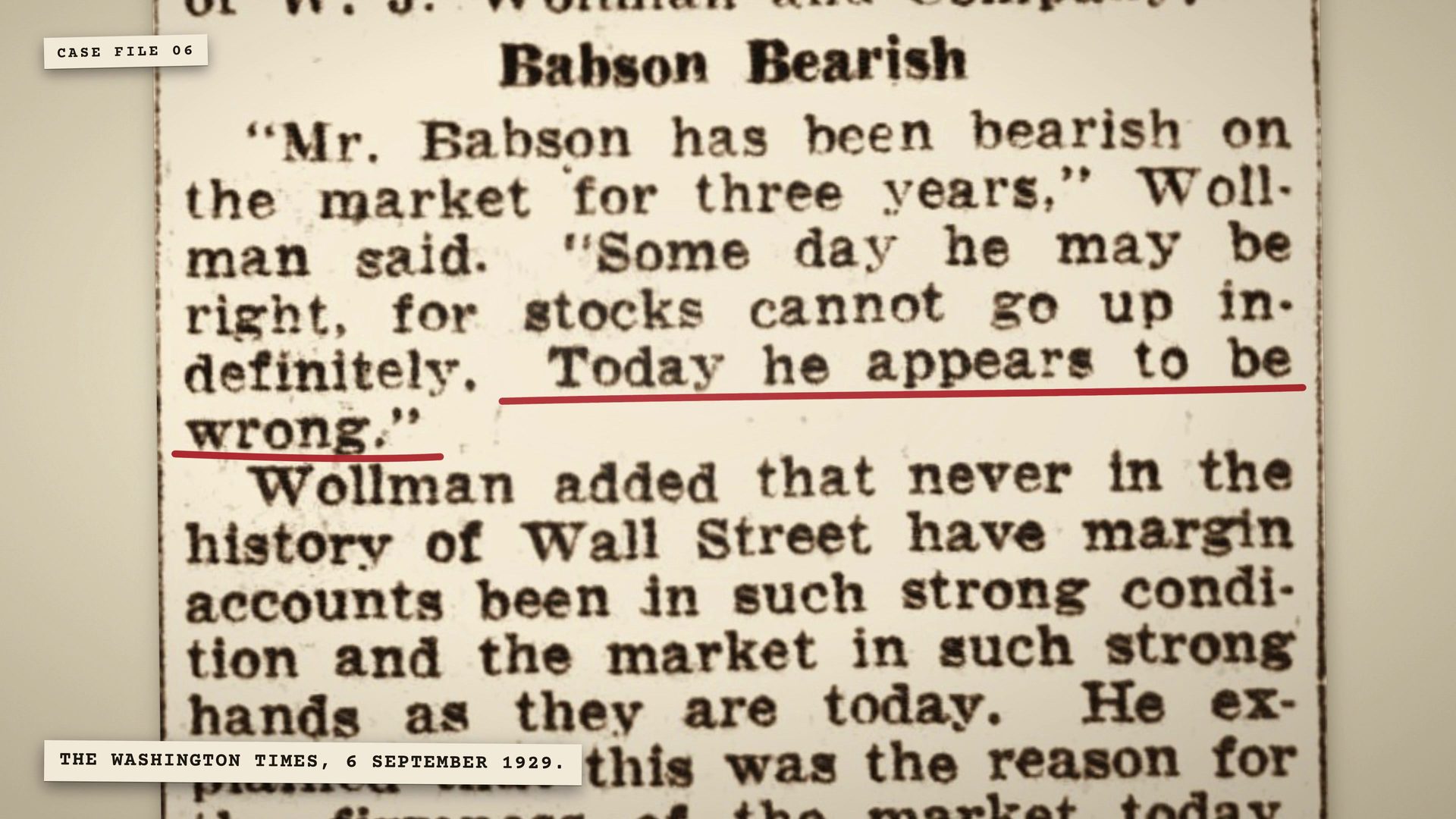
Exhibit AIn the film at 0:10
Exhibit one: “Today he appears to be wrong”
On 6 September 1929, the day after Babson's warning, the Washington Times quoted the broker William J. Wollman: “Mr. Babson has been bearish on the market for three years. Some day he may be right, for stocks cannot go up indefinitely. Today he appears to be wrong.” The film opens on the last sentence and ends on the middle one.
Source: The Washington Times, 6 September 1929, page 1 (INS), Library of Congress, Chronicling America (claim MOCK-01). The sources are under “5 and 6 September 1929” below
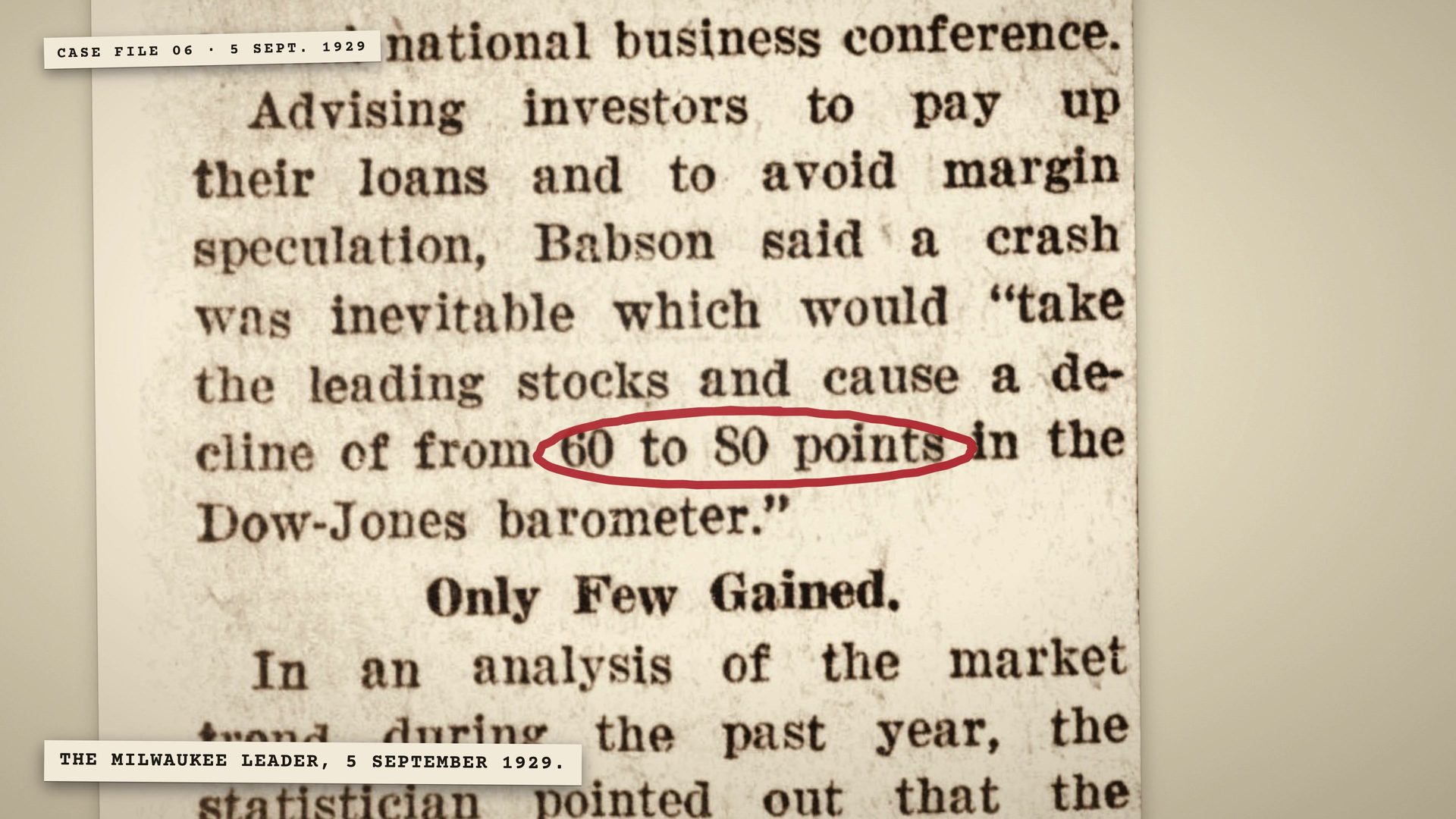
Exhibit BIn the film at 4:12
Exhibit two: a crash, with a number
The United Press carried Babson's warning to front pages on 5 September 1929: “Sooner or later there is a crash coming, and it may be a terrific one.” He even put a number on it: a fall of 60 to 80 points in the Dow-Jones average, from a peak of 381.17 two days before.
Source: The Milwaukee Leader (Mail Edition), 5 September 1929, page 1 (United Press), Library of Congress, Chronicling America (claims SEP5-01, SEP5-02); the Dow peak from MeasuringWorth (DOW-01)
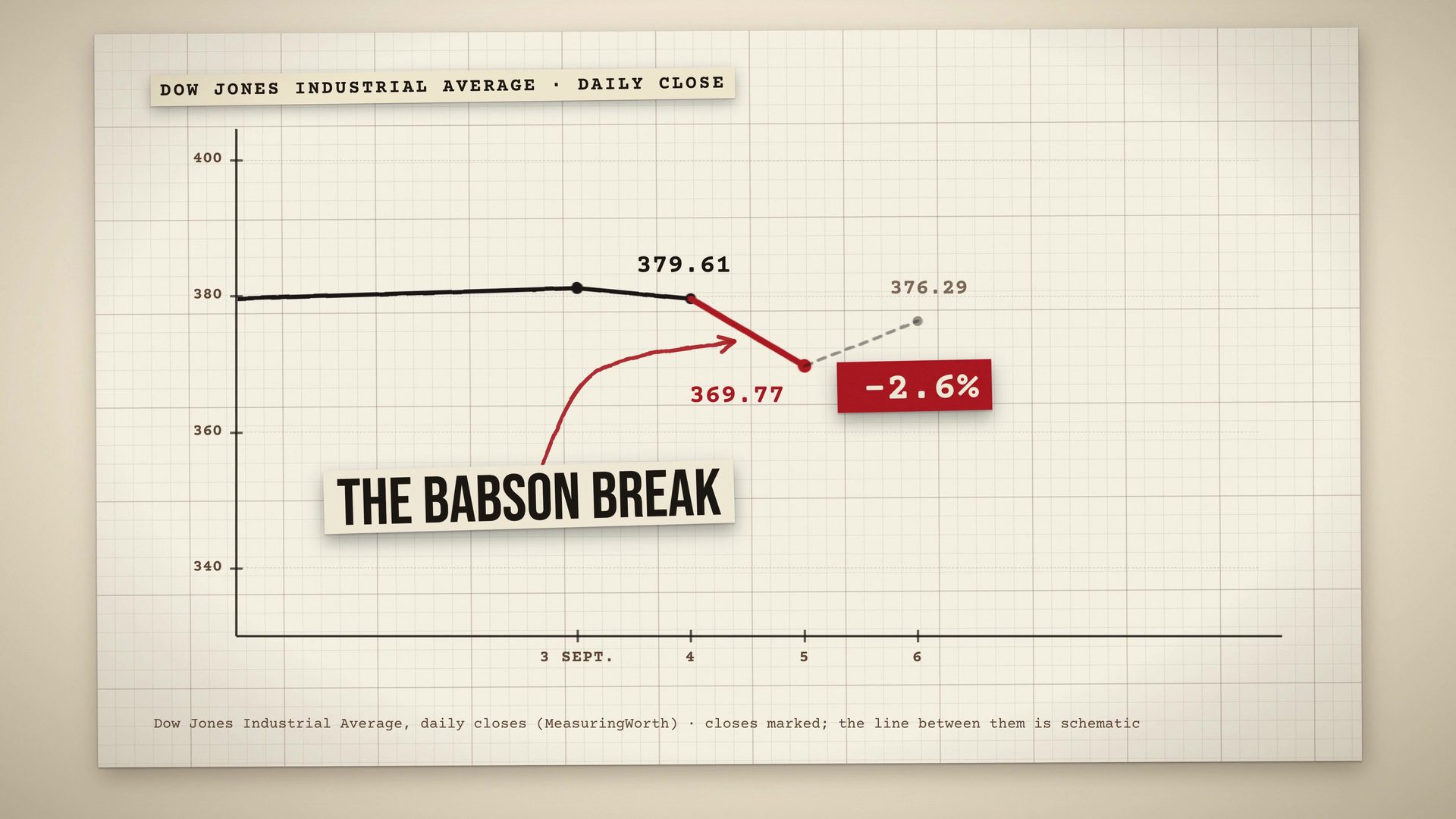
Exhibit CIn the film at 4:29
Exhibit three: the Babson Break
His words reached the news tickers that afternoon, and in the last hour of trading the market broke. The Dow Jones average closed at 379.61 on 4 September and 369.77 on 5 September, a fall of 2.6 percent. Historians call it the Babson Break. The next day prices bounced back to 376.29.
Source: Drawn in code for this film from MeasuringWorth's daily closes of the Dow Jones average (claims SEP5-03, BREAK-01)
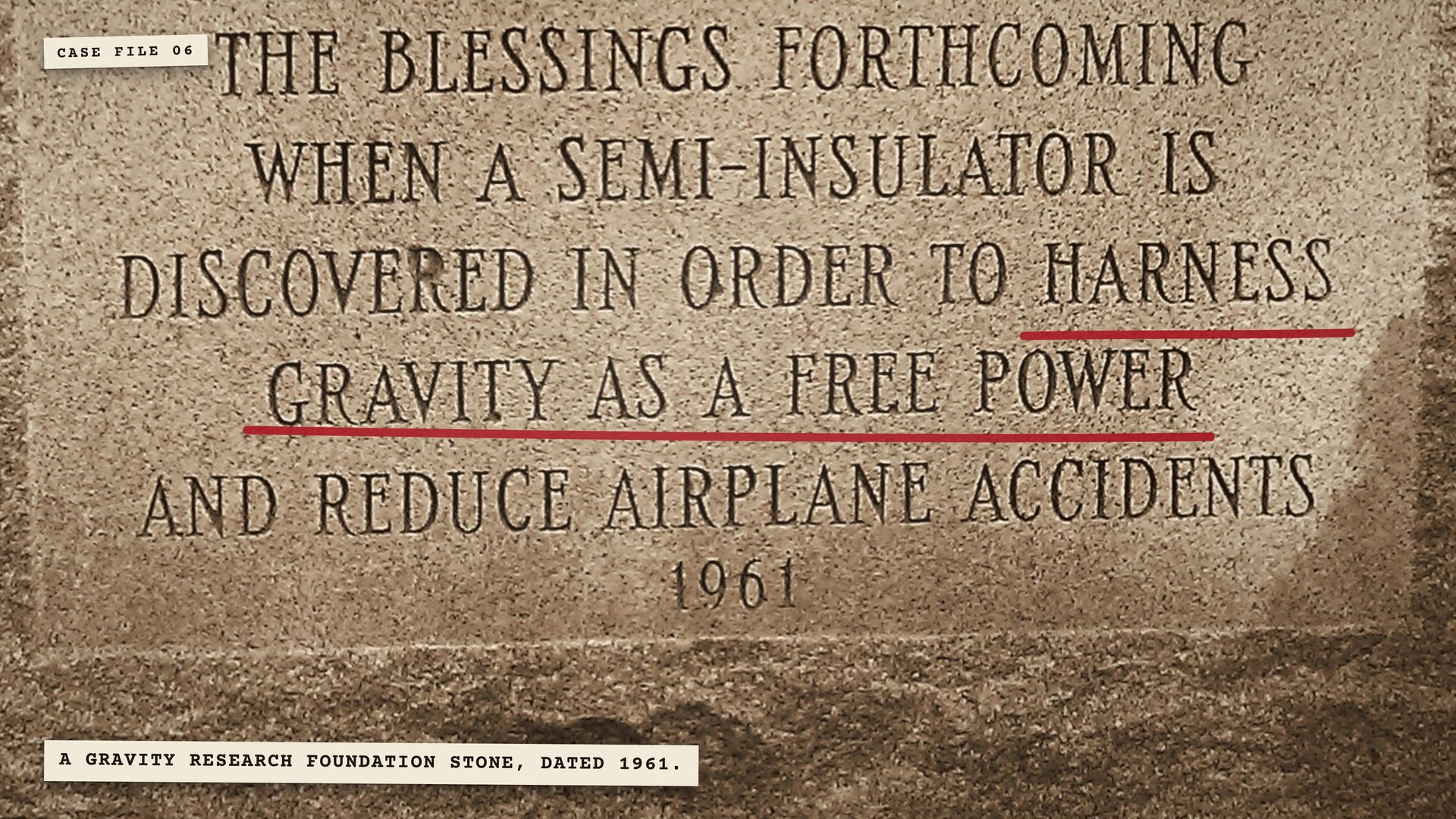
Exhibit DIn the film at 0:28
Exhibit four: a stone against gravity
In the 1960s, more than a dozen colleges took money from Babson's foundation on one condition: put up a stone. This one, dated 1961, is “to remind students of the blessings forthcoming when a semi-insulator is discovered in order to harness gravity as a free power and reduce airplane accidents”. No one has found that insulator.
Source: Photograph by Doug Orleans, CC BY-SA 2.0, via Flickr (claims STONE-01, PHYS-01; the physics review is under “The war on gravity” below)
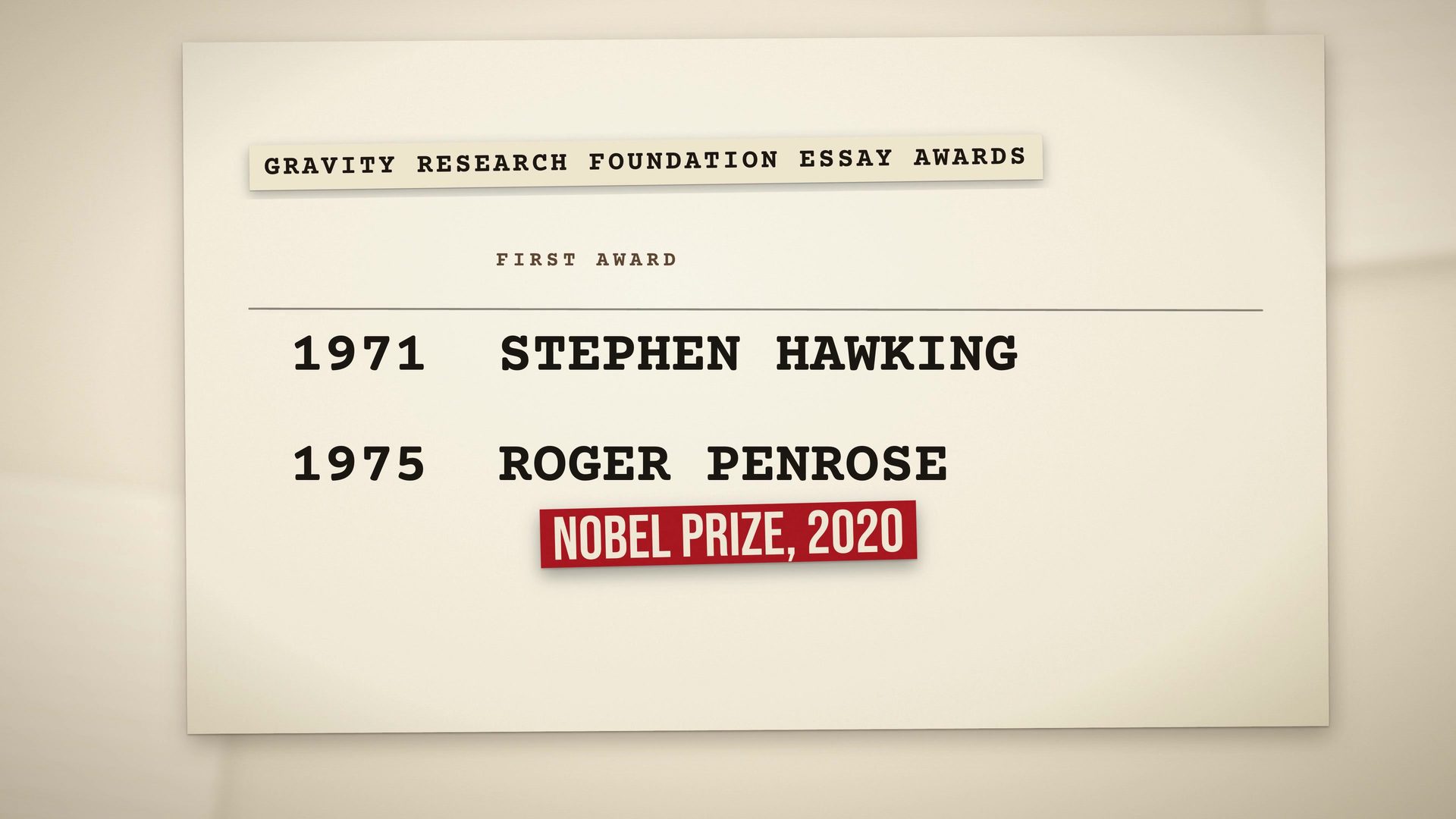
Exhibit EIn the film at 9:07
Exhibit five: the prize that outlived him
The foundation's first essay awards went out on 1 December 1949, for a partial insulator, reflector or absorber of gravity. Its later winners include Stephen Hawking, who won its first award in 1971, and Roger Penrose in 1975, who won the Nobel Prize in Physics in 2020. The 78th competition closes on 31 March 2027.
Source: Gravity Research Foundation, the essay competition and its winners (claims PRIZE-01, PRIZE-02)
Status
Where it stands (as of November 18, 2026)
The Gravity Research Foundation's essay competition is still running (its 78th closes on 31 March 2027), and the Babson Globe still stands at Babson College in Wellesley, Massachusetts.
Re-checked on
Transcript
The full narration, 1,382 words
0:00He called it
On the fifth of September, 1929, one man told a room full of businessmen that a stock market crash was coming. That same afternoon, the market dropped. The next day, Wall Street answered: "Today he appears to be wrong." Seven weeks later, the stock market crashed.
Then he declared war on something else. Gravity. He paid colleges to put up stones like these, waiting for the day someone learns to harness it. This is the story of how one man saw the crash coming, and then went to war with the force he blamed for his sister's death.
0:411893: the river
Roger Babson grew up in Gloucester, Massachusetts, a fishing town where the Annisquam River runs out to the sea. In the summer of 1893 he was eighteen, and far from home, working at the World's Fair in Chicago. On the twenty-sixth of August, his little sister Edith, thirteen years old, rode her bicycle to the swimming hole at the end of their street. She could swim. The girl with her could not. A neighbor dived in and brought Edith up, but the doctor could not revive her. Roger got home after the funeral.
When their mother died in 1929, the family found a little trunk that had been kept for thirty-six years. Inside were Edith's broken doll and her playthings. Years later he would write that she had been unable to fight gravity, "which came up and seized her like a dragon and brought her to the bottom." Remember that word. Gravity. It will come back.
1:48The forecaster: action and reaction
Babson went into the numbers business. From an office in Wellesley, outside Boston, he sold forecasts to bankers and businessmen. His whole system rested on one line from Isaac Newton. "To every action there is always opposed an equal reaction." Babson drew a line through the ups and downs of American business. Every boom above the line, he argued, had to be paid for by a slump of the same size below it. What goes up, in other words, must be balanced by what comes down. It made him rich. By the late 1920s more than ten thousand subscribers paid for his letters, and his column ran in newspapers across the country. He loved Newton so much that he and his wife later bought the paneled parlor of Newton's London home and rebuilt it at their school.
2:40The boom
In the 1920s, America had a new hobby. Buying stocks. You could buy on margin: put down a fraction of the price and borrow the rest. As long as prices kept rising, everyone looked like a genius. Babson was not always gloomy. As late as September 1927, his conference called the business outlook "moderately good." Babson had seen a boom like this before. In Florida, in the middle of the decade, land had sold and resold at ever higher prices, until the buyers ran out. In September 1928 he stood up at his own business conference and said it plainly. "It is Florida all over again." One newspaper filed him next to Irving Fisher of Yale, the country's most famous economist: "profound and statistical, but having small influence upon the surging multitudes." On the last day of 1928 he warned that 1929 would be "no time for indiscriminate buying of securities." The market kept climbing. A year later, it was still climbing, and Babson was still warning.
3:545 September 1929
On Thursday, the fifth of September, 1929, he spoke again, at the same conference in Wellesley Hills. "More people are borrowing and speculating today than ever in our history," he said. "Sooner or later there is a crash coming, and it may be a terrific one." He even put a number on it: a fall of sixty to eighty points in the Dow-Jones average. His words hit the news tickers that afternoon. In the last hour of trading, the market broke. One reporter said prices came down "like a burnt-out rocket." The Dow fell two and a half percent. Historians call it the Babson Break. The next morning, prices bounced right back. The papers ran headlines like "Rise in Market Brings Joy." One paper even joked that he had lost money in Florida's land boom himself. And Irving Fisher of Yale, the most famous economist in America, answered him: there would be nothing "in the nature of a crash." Today, he appears to be wrong.
4:58The crash
Six weeks later, on the fifteenth of October, Fisher said stock prices had reached "what looks like a permanently high plateau." By the following Monday, the Dow was sixty points below its peak. A news agency asked Babson for a comment. He wired back thanking them for noticing that the drop he forecast had come, and added: "I am, however, sorry to have it come so quickly because I hate to see people hurt." Two days later came Thursday, the twenty-fourth of October.
Prices fell so fast that the ticker ran far behind, and men on the street could not tell what their stocks were worth. At about half past one, Richard Whitney, the Exchange's acting president, walked to the post where U.S. Steel was traded and bid two hundred and five for a block of Steel, far above the last price. He was buying for the big banks. For a day, it worked. Then came Monday, and Tuesday the twenty-ninth. Black Tuesday. In two days the Dow lost nearly a quarter of its value. By the middle of November, it was down by almost half from its peak. By the summer of 1932, it had lost eighty-nine percent.
And nine years later, Richard Whitney, the man who had tried to hold the market up, walked into Sing Sing prison, convicted of stealing from his clients. Roger Babson was now the man who had seen it coming. Will Rogers joked that the market had helped him make suckers out of everyone who had laughed. Through the Depression he paid out-of-work stonecutters in Gloucester to carve advice on the boulders outside town. "Keep out of debt." "Get a job." "Courage."
6:56Newton's other law: gravity
Strange to say, the story of Roger Babson and Isaac Newton was not over.
On the twenty-ninth of August, 1947, almost fifty-four years to the day after Edith, his grandson Michael, seventeen, drowned in a New Hampshire lake while saving someone else. Michael had been born in November 1929, a month after the crash. A year later, Babson announced a new crusade. In his newspaper column he explained why. Newton's law of action and reaction, he wrote, "has been so good to me" that he would now give time and money to Newton's other law. Gravity.
He called it our enemy number one.
He set up the Gravity Research Foundation in New Boston, New Hampshire, a village he picked because it was a safe distance from Boston if a third world war came. He admitted the name helped. Every August, he held lectures on gravity in a hall in the village. The newspapers had fun with it. "Roger Babson believes the pull of gravity can be overcome," one wrote, "and we shouldn't be surprised." He offered a thousand dollars for the best essay on a way to block or absorb gravity. And to more than a dozen colleges he gave money, on one condition: put up a stone.
At one college, the shares that came with the stone were later worth well over a million dollars. In 1955 he unveiled a twenty-eight-foot globe that turned on its axis, the largest of its kind at the time, an idea he had sketched in 1947 with another grandson, Roger. It still stands on his campus. In his own chapter about his war on gravity, Babson used the same three words this film just did.
8:53Some day he may be right
Roger Babson died in 1967, at ninety-one. No one has ever found his gravity shield. But the prize he started, for essays on gravity, is still awarded every year. In 1971, the first prize went to a young physicist named Stephen Hawking. In 1975, to Roger Penrose, who later won the Nobel Prize. The man who used one of Newton's laws to see the crash coming spent the rest of his life fighting another. So far, gravity is winning. In 1929, a broker had the perfect line for men like Roger Babson. "Some day he may be right."
Sources and credits
Every claim in the film has a source, and every photograph and document is credited. 48 sources, grouped by the part of the story they support, then the credits for every image and sound in the film, with the license for the 12 images used under Creative Commons.
Sources
Gloucester and the river, 1893
Newton's law and the forecasting business
- Roger W. BabsonBusiness Barometers Used in the Accumulation of Money (1915 edition, p. 113; 1910, p. 115; 1912 edition, p. 31)
- Walter A. Friedman"Roger W. Babson: Yankee Prophet", Financial History no. 157 (Spring/Summer 2026), pp. 22 to 25
- The Durant News (Durant, Miss.)29 December 1949, page 6
- Babson Magazine"Four Hidden Places on Campus", 1 April 2025
- London Remembers35 St Martin's Street
The boom and his warnings
- Gary Richardson, Alejandro Komai, Michael Gou and Daniel Park"Stock Market Crash of 1929", Federal Reserve History (written as of 22 November 2013)
- New Britain Herald10 September 1927, page 1 (United Press)
- Palm Beach County History Online"Land Boom & Bust"
- KnowltonBubble in the Sun (2020), through a review in Cato's Regulation
- New Britain Herald18 September 1928, page 10 (United Press)
- New Britain Heraldeditorial, 19 September 1928, page 6
- Evening Star (Washington)31 December 1928, page 20
5 and 6 September 1929
- The Milwaukee Leader (Mail Edition), 5 September 1929, page 1 (United Press)Babson Sees Collapse of Stock Market
- Claude A. Jagger (AP)Douglas Daily Dispatch, 6 September 1929, page 9
- The Washington Times7 September 1929, page 16 (INS)
- The Washington Times, 6 September 1929, page 1 (INS)Rise in Market Brings Joy
- GalbraithThe Great Crash 1929 (1955)
- The Producers News (Plentywood, Mont.)20 September 1929, pages 2 and 3
- Alex PlanesMotley Fool, 5 September 2013 (citing the New York Times)
- Mises InstituteAmerica's Money Machine
- Alex Planes"The Last Days of Optimism", Motley Fool, 15 October 2012
- Edward Angly, Oh Yeah? (1931), through Novel InvestorOh Yeah? Forecasting Follies Around the '29 Crash
The crash and after
- Samuel H. Williamson"Daily Closing Value of the Dow Jones Average, 1885 to Present", MeasuringWorth
- The Milwaukee Leader23 October 1929, page 12 (United Press)
- PBS American Experience"The Crash": selected Wall Street chronology
- Pittsburgh Post-GazetteThe Digs, 24 October 2012
- New Britain Herald25 October 1929, page 2 (AP)
- Peter Carlson"Wall Street Embezzler Richard Whitney", HistoryNet, 23 May 2023
- Evening Star (Washington)11 August 1941, page A-6 (AP)
- Evening Star (Washington)10 November 1929, Will Rogers's column (image 107)
- New Britain Heraldeditorial, 24 October 1929, page 8
- New England Historical SocietyBabson's Boulders
The war on gravity
- Babson's columnMilford Chronicle (Milford, Del.), 8 October 1948, page 4
- Gravity Research FoundationFounding of the Gravity Research Foundation
- Wikimedia Commons"Gravity Research Foundation Monument Colby College.tif" (CC0, photographed 19 February 2026)
- Natalie Wolchover"How One Man Waged War Against Gravity", Popular Science, 15 March 2011
- Wikipedia"Gravity Research Foundation" (its list of colleges, as a lead)
- Evening Star (Washington)9 September 1948, page 18
- Hobart and William Smith Collegesnews, 15 October 2009 (after the Chronicle of Higher Education, 20 July 2009)
- Babson College“Babson World Globe” and “Babson Globe” pages
- Antonio Gallerati, Giovanni Modanese and Giovanni Ummarino"Interaction between macroscopic quantum systems and gravity", Frontiers in Physics 10 (2022) 941858, section 2.1
- Gravity Research Foundationthe essay competition, and its winners by name and by year
His own words, his life
- Babson College ArchivesActions and Reactions, chapters 34 and 35 with addenda (PDF, Wayback Machine copy of 27 September 2007)
- Babson College (Babson's dates, 1875 to 1967)
- WikipediaRoger Babson (died 5 March 1967, Lake Wales, Florida)
- The New York Times6 March 1967, obituary (as cited elsewhere; not opened)
Credits
Photographs and film
- Los Angeles Times Photographic Archive, UCLA Library Special Collections, CC BY 4.0Economist Roger W. Babson, [1930s?], License: CC BY 4.0
- Paul Strand and Charles Sheeler, Manhatta (1921), via Wikimedia CommonsManhatta (Paul Strand and Charles Sheeler), 1921
- A. Nonymous at English Wikipedia, via Wikimedia Commons (Public domain)Gravity monument Tampa
- TheRedSeven, CC BY-SA 3.0, via Wikimedia CommonsGRF Monument Wheaton, License: CC BY-SA 3.0
- Chris Roddy, via Wikimedia Commons (Public domain)Gravity monument
- Elizabeth B. Thomsen, CC BY-SA 3.0, via Wikimedia CommonsGravity Research Foundation monument at Gordon College, License: CC BY-SA 3.0
- Doug Orleans, CC BY-SA 2.0, via FlickrGravity Research Foundation monument (1961), License: CC BY-SA 2.0
- International News, 1921 (National Archives)International News No. 442 (Hearst newsreel, released by Universal), 1921: story 'Schooner Elsie wins contest to represent U.S. in Halifax race, Gloucester, Mass.'
- Detroit Publishing Co., Library of Congress Prints and Photographs DivisionAnnisquam River, Gloucester, Mass., Annisquam Village, Gloucester, Mass., Water sports at Annisquam, Gloucester, Mass., Panorama of Gloucester, Mass.
- Detroit Photographic Co., Library of Congress Prints and Photographs DivisionAnnisquam Light, Gloucester, Mass.
- Library of Congress, Paper Print Collection (Edison, 1897)Corner Madison and State Streets, Chicago (Edison), 1897
- Arnold, C. D. (Charles Dudley), 1844-, Library of Congress Prints and Photographs Division[Manufacturer's Building and basin, at the World's Columbian Exposition, Chicago, 1893]
- Bain News Service, Library of Congress Prints and Photographs DivisionRoger Babson
- Ford Motor Company Collection, National Archives (1920)Boston and Vicinity (Ford Educational Library, 'Landmarks of the American Revolution' Part 1), 1920
- Harris & Ewing, Library of Congress Prints and Photographs DivisionBABSON, ROGER W., BABSON, ROGER W. OF LABOR DEPARTMENT. LEFT, WITH SEC. W.B. WILSON, Former head of New York Stock Exchange before Senate Committee. Washington D.C. Richard Whitney; former President of the New York Stock Exchange, was the first witness as the Senate Committee investigating railroad financing reopened hearings today. After testifying of his buying activity in Alleghany Corporation stock, a Van Swerigan holding company, Whitney proposed adoption of a rule preventing exchange Governors from passing on listing of new stock in which they or their business firms have an underwriting interest. He defended past practices of exchange officials, including himself, of passing on acceptability for listing of issues in which they were persoanlly interested
- Daderot, via Wikimedia Commons (Public domain)Babson's Statistical Organization plaque, Babson College - IMG 0425, Horn Library, Babson College - IMG 0405, Gravity Research Foundation monument - Tufts University - IMG 0938, Globe, Babson College - IMG 0434, Globe, Babson College - IMG 0442, Courage - Babson's Boulders - Dogtown, MA - DSC01549, Truth - Babson's Boulders - Dogtown, MA - DSC01550, Work - Babson's Boulders - Dogtown, MA - DSC01547, Isaac Newton apple tree, Babson College - IMG 0430
- Robert Florey, Skyscraper Symphony (1929), via Wikimedia CommonsSkyscraper Symphony (Robert Florey), 1929
- The Crowd (King Vidor, 1928)The Crowd (King Vidor, MGM), 1928 [FICTION]
- The Nation's Market Place (Visugraphic Pictures for the New York Stock Exchange, 1928), Prelinger ArchivesThe Nation's Market Place (New York Stock Exchange film, Visugraphic Pictures), 1928; reissue titles 'Distributed by Dynamic Pictures', 'Copyrighted MCMXXXII'
- Pathegrams Review No. 1, Pathe Exchange (Prelinger Archives)Pathegrams Review (No. 1) (Pathe Exchange, home-movie release), title card 1927, contents to 1928
- Library of Congress Prints and Photographs Division[Cartoon of Florida real estate agent showing dense swampland to client, saying: "Can't ye just see it? The sunken garden here, the garage here, and the kiddies playing around the house!"], Billboard for the Sale of Subdivision Real Estate Lots., Alhambra entrance to Coral Gables, Merrick's suburb beautiful, Fla, Prof Irving Fisher, noted economist / photo. by Bain News Service, New York., Prof. Irving Fisher of Yale / photo. by Bain News Service, New York.
- Miami Photo View Co., Library of Congress Prints and Photographs DivisionMiami business district looking east, October 1st, 1925
- Robert Flaherty, Twenty-Four Dollar Island (1927)Twenty-Four Dollar Island (Robert Flaherty), 1927
- Ford Motor Company Collection, National Archives (1921)New York City, Regional Geography, Volume V (Ford Educational Library), 1921, The Message (Ford Educational Library), 1921
- The Plow That Broke the Plains, US Resettlement Administration, 1936 (National Archives)The Plow That Broke the Plains (Pare Lorentz, US Resettlement Administration), 1936
- Universal Newsreel, 9 April 1930 (National Archives)Universal Newsreel Vol. 2, Release 29, 9 Apr 1930, story 2: 'Starving thousands fill bread line in unemployed crisis', New York
- Universal Newsreel, 9 March 1933President Roosevelt's Emergency Bank Bill Passed by Congress (Universal Newspaper Newsreel), 9 Mar 1933
- C. M. Stieglitz, Library of Congress Prints and Photographs Division[Old cell block, Sing Sing Prison where Richard Whitney is housed] / World Telegram photo by C.M. Stieglitz.
- John Phelan, CC BY 4.0, via Wikimedia CommonsKindness, Dogtown MA, License: CC BY 4.0
- US Department of Agriculture, 1934 (National Archives)Winter Sports in the White Mountain National Forest (US Department of Agriculture), 1934
- DavidWBrooks, CC BY-SA 3.0, via Wikimedia CommonsNew boston babson monument, License: CC BY-SA 3.0
- PenelopeIsMe, CC BY-SA 3.0, via Wikimedia CommonsMiddleburyGravityResearchMonument, License: CC BY-SA 3.0
- Marc Merlin, CC BY-SA 4.0, via Wikimedia CommonsGravity Research Foundation monument at Emory University, License: CC BY-SA 4.0
- Daderot, via Wikimedia Commons (CC0)Gravity Research Foundation monument - Gordon College - DSC02696, License: CC0 1.0
- Dpbsmith (talk) (Uploads), CC BY-SA 3.0, via Wikimedia Commons
- Bryan.Lipiner, CC BY-SA 4.0, via Wikimedia CommonsThe Babson World Globe, License: CC BY-SA 4.0
- Kenneth C. Zirkel, CC BY-SA 4.0, via Wikimedia CommonsRoger Babson statue and globe at Kerry Murphy Healey Park, Isaac Newton apple tree grove at Babson College, Isaac Newton apples at Babson College, License: CC BY-SA 4.0
- CthosEris, via Wikimedia Commons (CC0)Gravity Research Foundation Monument Colby College, License: CC0 1.0
- Irving Underhill, Library of Congress Prints and Photographs DivisionWall & Broad Sts.
- Unknown, via Wikimedia Commons (Public domain)Annisquam, Massachusetts, 1897 title QS:P1476,en:"Annisquam, Massachusetts, 1897 "label QS:Len,"Annisquam, Massachusetts, 1897 "label QS:Lde,"Annisquam, Massachusetts, 1897", Annisquam, Massacahusetts, 1899 title QS:P1476,en:"Annisquam, Massacahusetts, 1899 "label QS:Len,"Annisquam, Massacahusetts, 1899 "label QS:Lde,"Annisquam, Massachusetts, 1899", Lighthouse, Annisquam, Massachusetts title QS:P1476,en:"Lighthouse, Annisquam, Massachusetts "label QS:Len,"Lighthouse, Annisquam, Massachusetts "label QS:Lde,"Leuchtturm, Annisquam, Massachusetts"
- Unknown authorUnknown author, via Wikimedia Commons (Public domain)Roger Babson
- Keystone View Company., Library of Congress Prints and Photographs DivisionWall Street, New York City, Looking W. on Wall St. to 285 foot spire of Trinity Church now dwarfed by skyscrapers of modern New York, Near view "Curb Market" on Broad St. looking north near Wall St. to Stock Exchange and Sub-Treasury, New York City


Documents and maps
- The Milwaukee Leader (Milwaukee, Wis.), 1929-09-05, Library of Congress, Chronicling AmericaThe Milwaukee Leader (Mail Edition), 5 September 1929, page 1
- The Bismarck Tribune (Bismarck, N.D.), 1929-09-05, Library of Congress, Chronicling AmericaThe Bismarck Tribune, 5 September 1929, page 1
- The Washington Times (Washington, D.C.), 1929-09-06, Library of Congress, Chronicling AmericaThe Washington Times, 6 September 1929, page 1
- The Washington Daily News (Washington, D.C.), 1929-10-29, Library of Congress, Chronicling AmericaThe Washington Daily News, 29 October 1929, page 1
- Rosenberg, James N. (James Naumburg), 1874-, Library of Congress Prints and Photographs DivisionOct. 29 dies irae
- Cecilia Beaux, via Wikimedia Commons (Public domain)Half-Tide, Annisquam River
- Hugh Bolton Jones, via Wikimedia Commons (Public domain)Lighthouse Beach, Annisquam title QS:P1476,en:"Lighthouse Beach, Annisquam "label QS:Len,"Lighthouse Beach, Annisquam "
- Roger W. Babson, 1915, via Internet ArchiveBusiness Barometers, eighth edition, title page (June 1915), Business Barometers (1915), Chapter IV, 'The Law of Action and Reaction. Theory of the Composite Plot'
- Roger W. Babson, 1910, via Internet ArchiveComposite Plot of the Actual Barometer Figures (the Babsonchart), Business Barometers, 2nd ed. 1910
- New Britain Herald (New Britain, Conn.), 1928-09-18, Library of Congress, Chronicling AmericaNew Britain Herald, 18 September 1928, page 10
- New Britain Herald (New Britain, Conn.), 1928-09-19, Library of Congress, Chronicling AmericaNew Britain Herald, 19 September 1928, page 6 (editorial)
- New Britain Herald (New Britain, Conn.), 1929-09-05, Library of Congress, Chronicling AmericaNew Britain Herald, 5 September 1929, page 5
- The Washington Times (Washington, D.C.), 1929-09-07, Library of Congress, Chronicling AmericaThe Washington Times, 7 September 1929, page 16
- Douglas Daily Dispatch (Douglas, Ariz.), 1929-09-06, Library of Congress, Chronicling AmericaDouglas Daily Dispatch, 6 September 1929, page 9
- The Producers News (Plentywood, Mont.), 1929-09-20, Library of Congress, Chronicling AmericaThe Producers News, 20 September 1929, page 3
- The Milwaukee Leader (Milwaukee, Wis.), 1929-09-06, Library of Congress, Chronicling AmericaThe Milwaukee Leader, 6 September 1929, page 14
- The Milwaukee Leader (Milwaukee, Wis.), 1929-10-23, Library of Congress, Chronicling AmericaThe Milwaukee Leader, 23 October 1929, page 12
- The Bismarck Tribune (Bismarck, N.D.), 1929-10-24, Library of Congress, Chronicling AmericaThe Bismarck Tribune, 24 October 1929, page 1
- The Indianapolis Times (Indianapolis, Ind.), 1929-10-24, Library of Congress, Chronicling AmericaThe Indianapolis Times, 24 October 1929, page 1
- The Washington Times (Washington, D.C.), 1929-10-24, Library of Congress, Chronicling AmericaThe Washington Times, 24 October 1929, page 1
- The Milwaukee Leader (Milwaukee, Wis.), 1929-10-24, Library of Congress, Chronicling AmericaThe Milwaukee Leader, 24 October 1929, page 1
- New Britain Herald (New Britain, Conn.), 1929-10-24, Library of Congress, Chronicling AmericaNew Britain Herald, 24 October 1929 (Black Thursday), page 1, New Britain Herald, 24 October 1929, page 8 (editorial)
- New Britain Herald (New Britain, Conn.), 1929-10-25, Library of Congress, Chronicling AmericaNew Britain Herald, 25 October 1929, page 2
- Evening Star (Washington, D.C.), 1929-10-24, Library of Congress, Chronicling AmericaEvening Star, 24 October 1929, page 1
- The Indianapolis Times (Indianapolis, Ind.), 1929-10-29, Library of Congress, Chronicling AmericaThe Indianapolis Times, 29 October 1929 (Black Tuesday), page 1
- The Washington Times (Washington, D.C.), 1929-10-29, Library of Congress, Chronicling AmericaThe Washington Times, 29 October 1929, page 1
- The Waterbury Democrat (Waterbury, Conn.), 1938-04-11, Library of Congress, Chronicling AmericaThe Waterbury Democrat, 11 April 1938, page 1
- Evening Star (Washington, D.C.), 1929-11-10, Library of Congress, Chronicling AmericaEvening Star, 10 November 1929 (Sunday), image 107
- Evening Star (Washington, D.C.), 1948-08-24, Library of Congress, Chronicling AmericaEvening Star, 24 August 1948, page 6
- Milford Chronicle (Milford, Del.), 1948-10-08, Library of Congress, Chronicling AmericaMilford Chronicle, 8 October 1948, page 4
- DavidWBrooks, via Wikimedia Commons (Public domain)Gravity Research Foundation pamphlet
- Evening Star (Washington, D.C.), 1948-09-06, Library of Congress, Chronicling AmericaEvening Star, 6 September 1948, page 6
- Evening Star (Washington, D.C.), 1948-09-09, Library of Congress, Chronicling AmericaEvening Star, 9 September 1948, page 18
- Milford Chronicle (Milford, Del.), 1949-08-05, Library of Congress, Chronicling AmericaMilford Chronicle, 5 August 1949, page 4


Music
- Music generated with ElevenLabs Music
Narration
- Narration voice generated with ElevenLabs (voice: Peter)
Sound effects
- Sound effects generated with ElevenLabs sound effects
Cards, maps and charts
- Drawn in code for this film from the sourced records: the case-file cards, labels and tabs, the Dow Jones charts, the balance of boom and slump, the typed quotes and dates, and the red-pencil marks. The documents, photographs and film cut into them are real and credited above. No picture in the film is AI-generated; one portrait of Babson is shown colorized (colors estimated by an AI model) and is labelled COLORIZED on screen.