

Case file 04
Old American Houses Were Designed to Fight a Disease
The story says old radiators were made big for the 1918 flu. The oldest paper trail we found leads to 1910, and to the tuberculosis fresh-air craze that shaped the American house.
Washington, photo 2018Historic American Buildings Survey, 2018. Library of Congress, Prints & Photographs Division, HABS DC-890-25 (CT) (public domain)

The film plays from YouTube (youtube-nocookie.com) only when you press play.
The case in brief
Walk into an old apartment in winter and you will often find a cast-iron radiator under the window, far bigger than the room seems to need. The story says it was made that big in 1918, so a room could be heated with the windows wide open during the flu. In 2020, during another pandemic, that story spread again.
This case file follows the paper trail. In 1918 we found no document that sizes a single radiator for the flu. The Army Surgeon General's open-window rule of September 1918 was real, but the national tuberculosis association reprinted it as advice it had been giving for years. The oldest paper trail we found leads to a heating trade paper of 14 May 1910, which reported a German rule: thirty per cent more radiator surface for rooms opened to the outside air at night.
Behind it stood tuberculosis, which killed 38,820 people in 1900 in the American states that kept death records, and a fresh-air campaign that built sleeping porches onto houses and painted the walls inside them. Then the file asks whether any of it worked.
In this file: Exhibits, Where it stands, Transcript, Sources and credits
Exhibits
5 frames from the film. Select one to see it at full size.
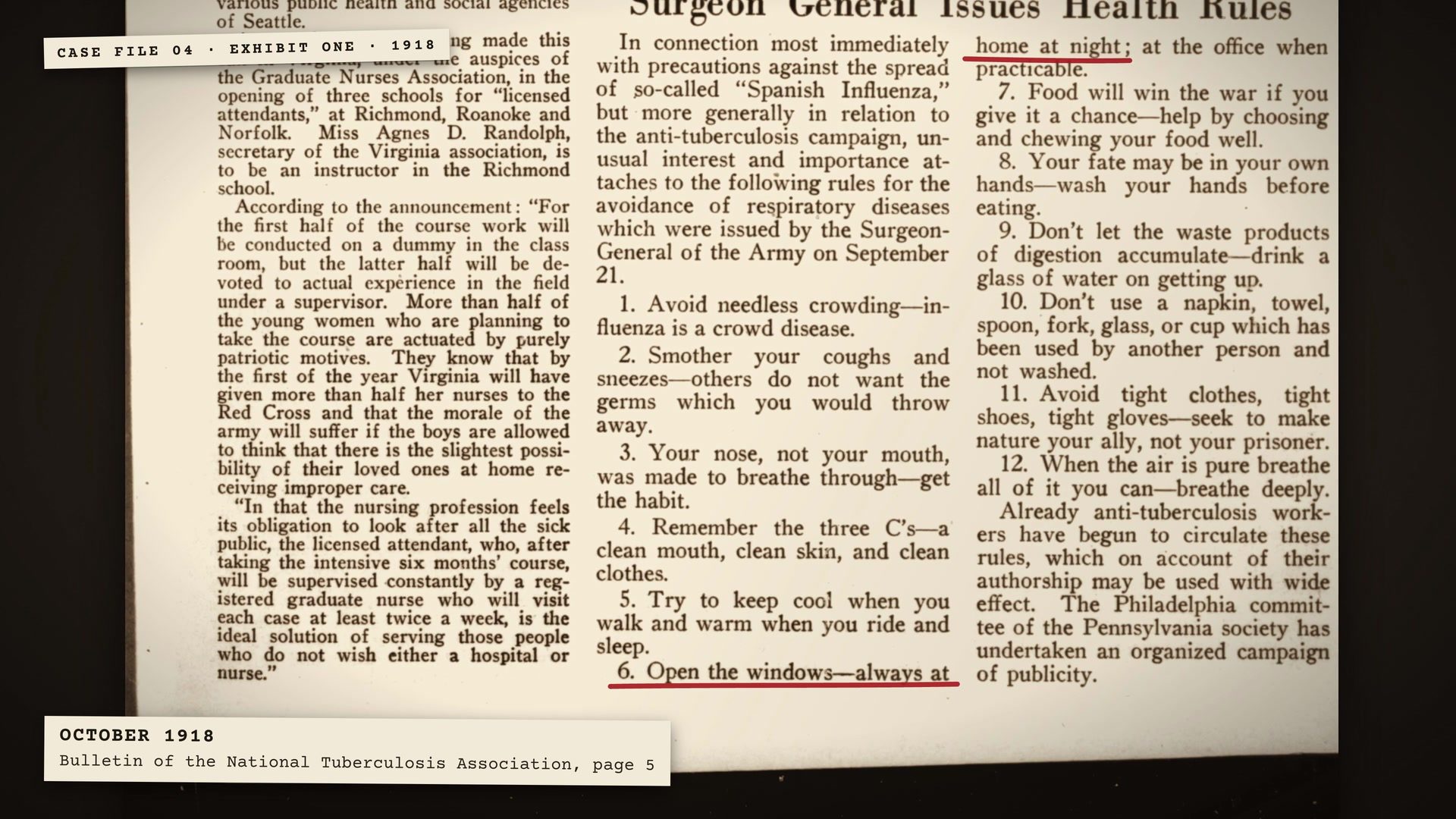
Exhibit AIn the film at 0:56
Exhibit one: the 1918 rules
In September 1918 the Army's Surgeon General issued rules for avoiding the flu. One of them reads: “Open the windows: always at home at night.” This copy ran in the October 1918 bulletin of the national tuberculosis association, which reprinted the rules “in relation to the anti-tuberculosis campaign”. To that association, open windows were not new advice. In 1918 we found no document that sizes a single radiator for the flu.
Source: Bulletin of the National Tuberculosis Association, vol. 5 no. 1, October 1918, page 5, “Surgeon General Issues Health Rules” (claim HEAT-01). The sources are under “The radiator story and the 1910 paper trail” below
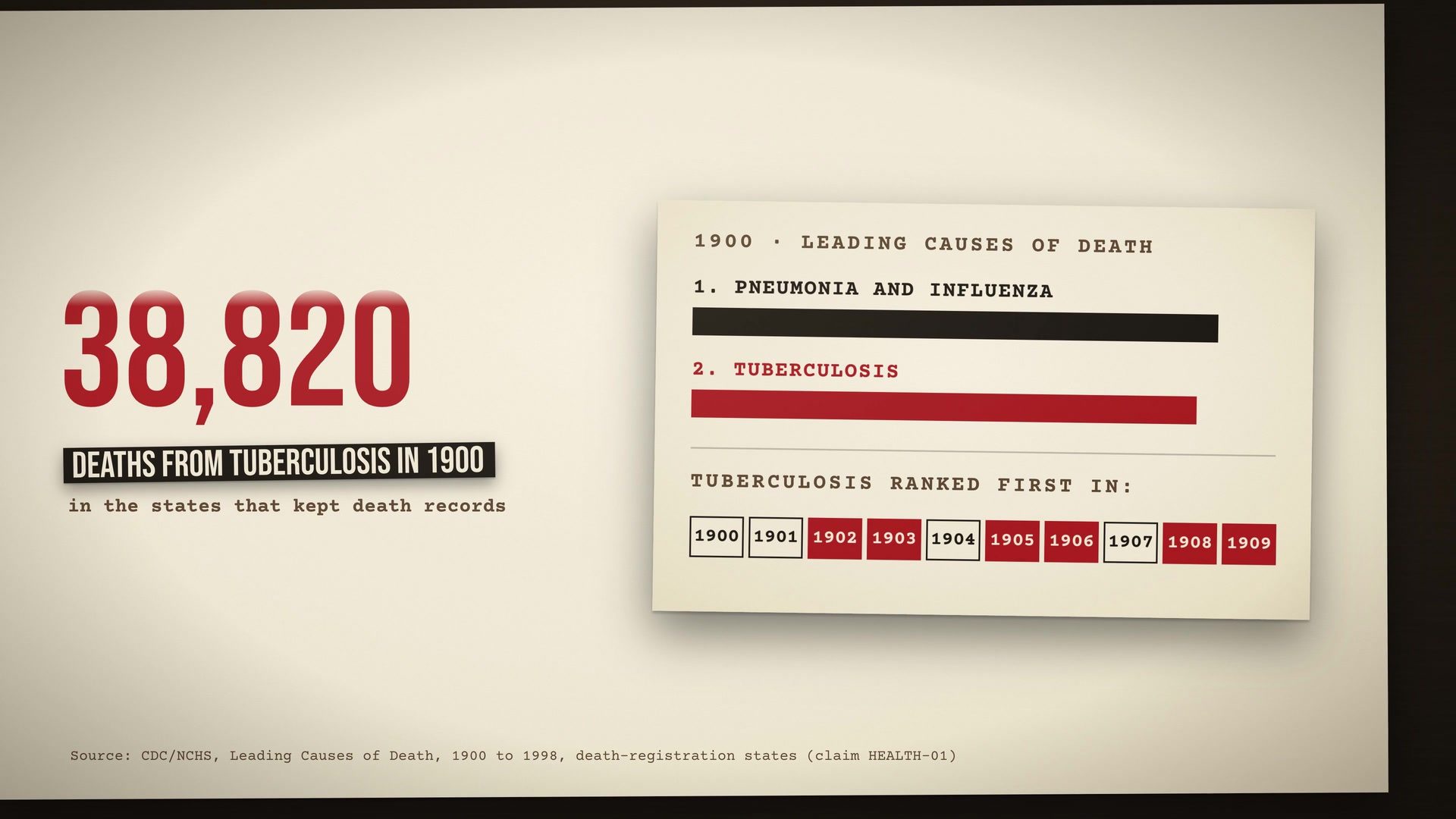
Exhibit BIn the film at 1:59
The disease behind the advice
In 1900, in the American states that kept death records, tuberculosis killed 38,820 people, 11.3 per cent of all deaths. That year it was the second-biggest killer, just behind pneumonia and influenza; it ranked first in 1902, 1903, 1905, 1906, 1908 and 1909. A household-science textbook of 1905 put it at one tenth of all deaths in the country. There was no cure, only a belief that fresh air, rest and food might let the body heal itself.
Source: Drawn in code for this film from CDC/NCHS, Leading Causes of Death, 1900 to 1998, death-registration states (claims HEALTH-01 and HEALTH-04). The sources are under “Tuberculosis and the fresh-air cure” below
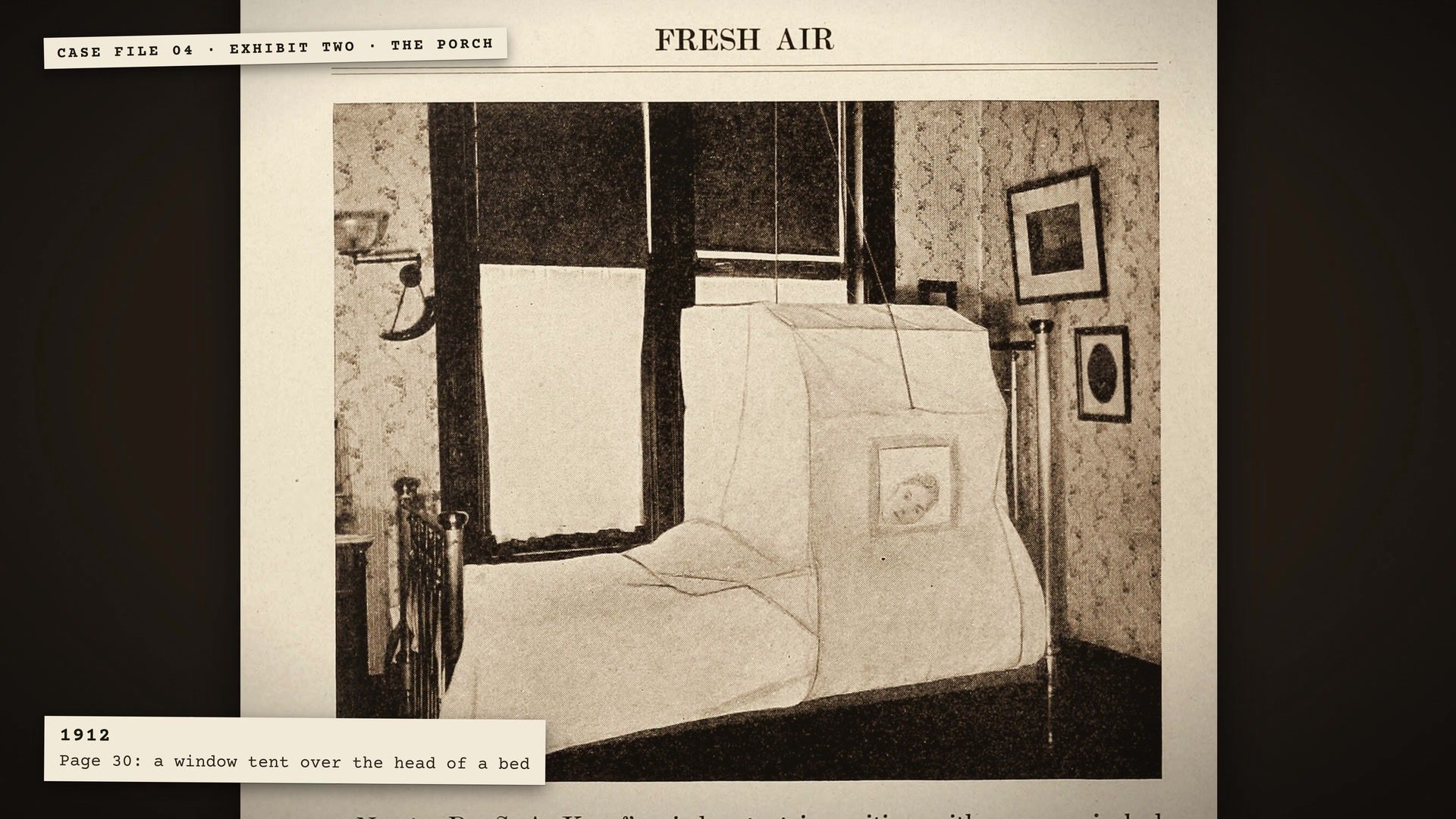
Exhibit CIn the film at 4:10
Exhibit two: the window tent
In 1912 the national tuberculosis association published a manual, Fresh Air and How to Use It, for healthy families as well as the sick. Its preface says fresh air, “emphasized first as an agent of cure”, was now valued “as a mode of prevention”. It shows how to add a sleeping porch to an ordinary house, and for families without one it offers the window tent: a canvas hood fitted to an open window, first devised for patients and “now used by many healthy persons” in winter.
Source: Thomas Spees Carrington, Fresh Air and How to Use It (New York: National Association for the Study and Prevention of Tuberculosis, 1912), page 30 (claims HOUSE-01 and HOUSE-02). The sources are under “The fresh-air house: porches, walls, floors and bathrooms” below
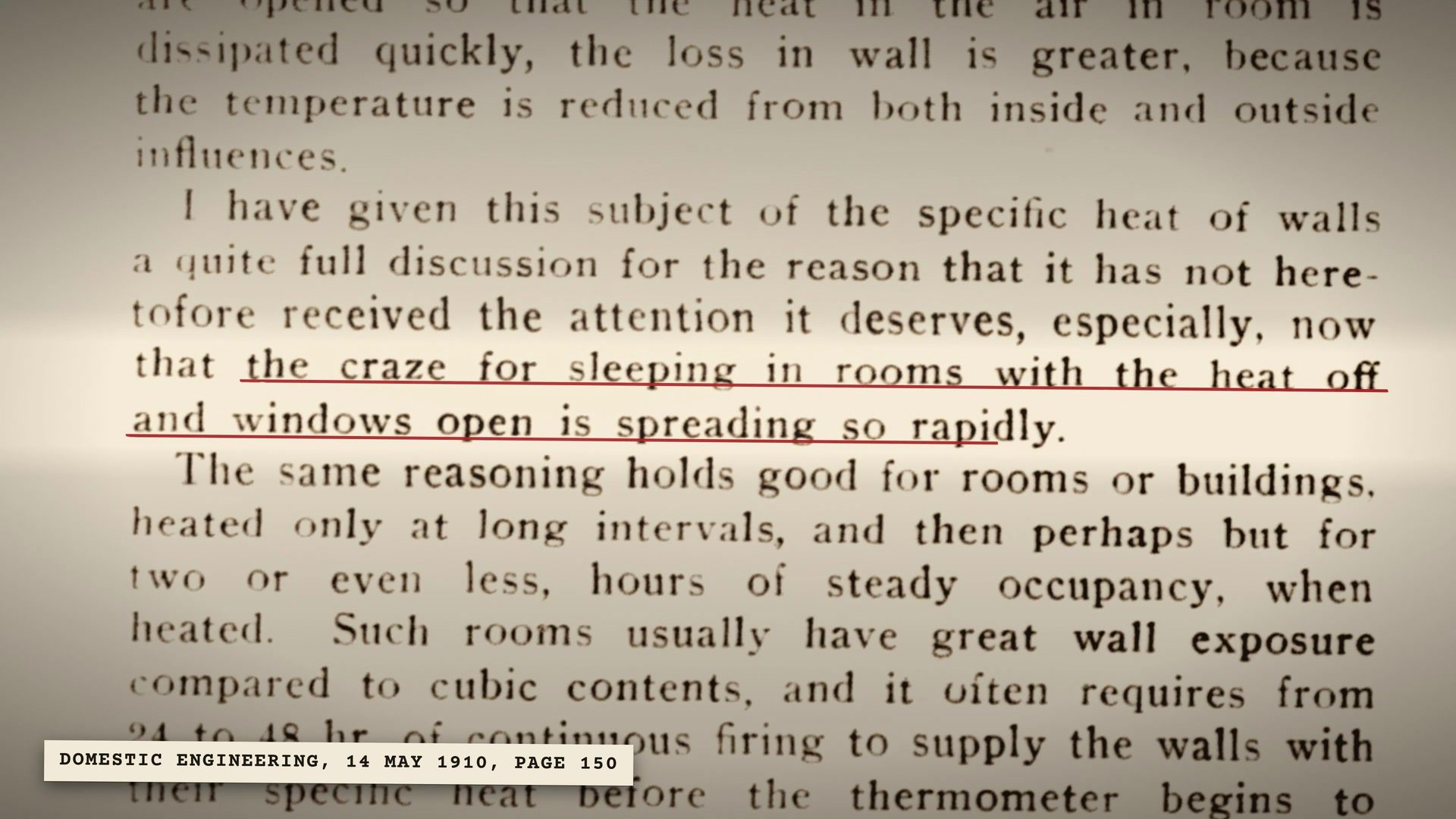
Exhibit DIn the film at 4:53
Exhibit three: the 1910 paper trail
On 14 May 1910 the heating engineer Edward Richmond Pierce wrote in the Chicago trade paper Domestic Engineering that “the craze for sleeping in rooms with the heat off and windows open is spreading so rapidly”. He reported a German rule: thirty per cent more radiator surface for rooms heated by day and opened to the outside air at night. For people who shut off the heat at night and leave a window open, he advised twenty to forty per cent more radiator in that room. That is the big radiator, in print, eight years before the flu. That it was standard American practice is unverified.
Source: Edward Richmond Pierce, Domestic Engineering vol. 51 no. 7, 14 May 1910, pages 149 and 150, reprinted in his manual of 1911, pages 46 to 48 (claim HEAT-01). The sources are under “The radiator story and the 1910 paper trail” below
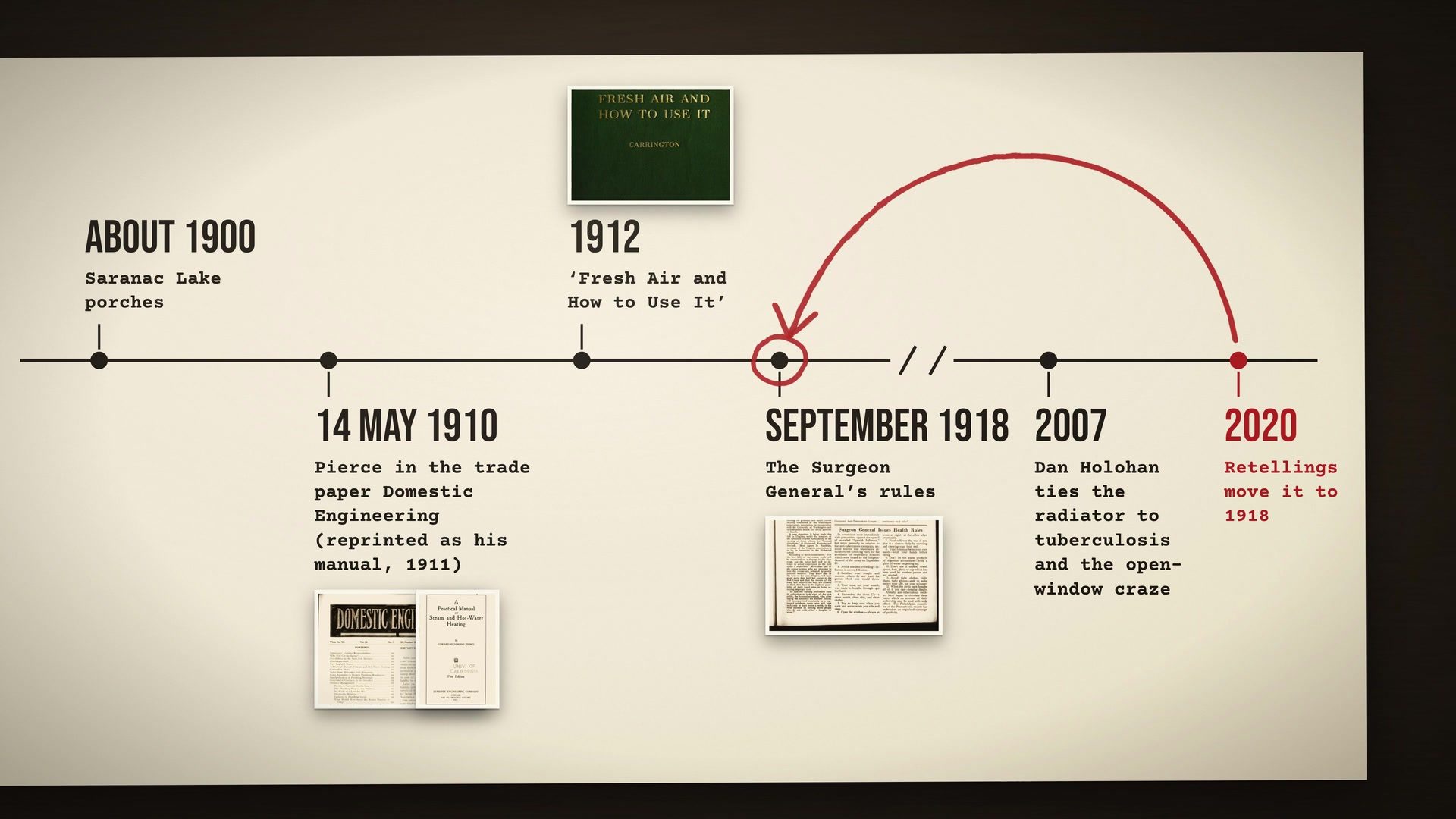
Exhibit EIn the film at 5:31
The paper trail, in order
Around 1900, patients at Saranac Lake began sleeping on porches in winter. In 1910 Pierce's article ran in Domestic Engineering, and in 1912 the tuberculosis association published Fresh Air and How to Use It. The Surgeon General's rules came in September 1918. The heating writer most associated with the story, Dan Holohan, first told it in 2007 as part of the open-window craze and tuberculosis; his retellings in 2020 moved it to 1918.
Source: Drawn in code for this film from claims HOUSE-01, HOUSE-02 and HEAT-01. The sources are under “The radiator story and the 1910 paper trail” and “The fresh-air house: porches, walls, floors and bathrooms” below
Status
Where it stands (as of November 8, 2026)
The oldest paper trail we found for the big radiator is the heating trade paper Domestic Engineering of 14 May 1910; we found no 1918 document that sizes a radiator for the flu. Tuberculosis is not history everywhere: the WHO fact sheet of 24 March 2026 counts about 1.23 million deaths from it in 2024, more than any other single infectious disease.
Re-checked on
Transcript
The full narration, 1,390 words
0:00The story everyone tells
Walk into an old apartment in winter and you will often find it: a cast-iron radiator under the window, far bigger than the room seems to need. And if you ask why it is so big, there is a story you will probably hear. In 1918, the story goes, a pandemic flu swept the world. Doctors said fresh air would help, so engineers sized radiators to heat a room with the windows wide open. In 2020, during another pandemic, that story spread again.
It is a good story. It makes sense of an odd object, and it ties your living room to history. But a good story is not evidence. So we did what this channel always does. We went looking for the paper trail.
0:49Exhibit one: 1918
If radiators were sized for the flu, the first place to look is 1918 itself. In September 1918 the Army's Surgeon General issued rules for avoiding the flu. One of them reads: "Open the windows: always at home at night."
So the advice was real. But look at where this copy was printed. It appears in the bulletin of the national tuberculosis association, which reprinted the rules, in its own words, in relation to its campaign against tuberculosis. Why would a tuberculosis association print flu advice? Because to that association, "open the windows" was not new. It was their own advice, and they had been giving it for years. And in 1918 we found no document that sizes a single radiator for the flu.
1:40The disease behind the advice
To see why, we have to go back to a disease that most of us now think of as history. In 1882 a German doctor, Robert Koch, identified the germ that causes tuberculosis. Announcing it, he said that one in every seven human beings died of the disease. In 1900, in the American states that kept death records, tuberculosis killed 38,820 people in a single year. That year it was the second-biggest killer, just behind pneumonia and influenza. In most years of the next decade, it was the first. A household-science textbook of 1905 put it simply: tuberculosis was responsible for one tenth of all deaths in the country.
There was no cure. There was only a belief: that fresh air, rest and food might let the body heal itself. At a sanatorium, that belief became a daily routine: hours of bed rest in the open air, in all weather, wrapped in blankets on a porch or in a hut. Film from a Pennsylvania sanatorium in 1926 shows children playing in the snow below its porches. By 1904 America had 115 sanatoriums, with about 8,000 beds. In 1907, a woman in Delaware named Emily Bissell sold the first Christmas Seals to keep one of them open.
3:14Exhibit two: the sleeping porch
The most famous of those places was in the Adirondack mountains of New York, at Saranac Lake. Around 1900, patients there began sleeping outdoors, on porches, in winter. After that, the record says, no cottage was built without direct access to a porch.
Then the idea left the hospital. Schools tried it first. In Rochester, New York, in 1912, children took their rest period in an open-air classroom, bundled up against the cold. In 1912 the national tuberculosis association published a manual called "Fresh Air and How to Use It". It was not written only for the sick. It was written for healthy families. Its preface says fresh air had been valued first as a cure, and was now valued as a way to prevent the disease. It shows how to add a sleeping porch to an ordinary house. And for families without one, it offers the window tent: a canvas hood fitted to an open window, so a healthy person could sleep with their head outside all winter. By 1915 a Seattle builders' guide said at least one sleeping porch was usually included in the modern house. Not every one was medical. Some were simply cooler on a summer night.
4:34Exhibit three: the 1910 paper trail
So now we had a craze for sleeping with the windows open, years before the flu. And a craze like that has a cost. Someone has to heat those rooms.
Strange to say, the oldest paper trail we found for the big radiator does not lead to 1918. It leads to 1910, and to an article in a heating trade paper. Its author worried about a new problem for heating engineers: "the craze for sleeping in rooms with the heat off and windows open is spreading so rapidly." And he reported a German rule: add thirty per cent more radiator surface to rooms that are heated by day and opened to the outside air at night. And his own advice, for people who shut off the heat at night and leave a window open: twenty to forty per cent more radiator in that room. That is the big radiator, in print, eight years before the flu.
Even the heating writer most associated with the story, Dan Holohan, first told it in 2007 as part of the open-window craze and tuberculosis. Later retellings moved it to 1918. The flu did not start the open-window habit. It met a habit that tuberculosis had already built into the house.
5:52The house: walls, floors and bathrooms
And once you know what to look for, the radiator is not alone. The same 1912 manual tells families how to build a room that dust cannot hide in. Walls should be painted, not papered. No mouldings or cornices to catch the dust. And the corners where walls meet the ceiling should be rounded.
Household textbooks of the time warned that carpets, heavy curtains and chairs fringed to the floor stored dust. Out they went. In their place, a new floor. In 1918 the maker of linoleum told buyers that the linseed oil in its product was poisonous to germs.
The bathroom changed too: white tile, white porcelain, and pipes left in the open where they could be watched and cleaned. But here the trail goes back even further. The white bathroom began with an older fear, of sewer gas, before germs were understood. Tuberculosis took that idea over and made it stricter. In the 1870s and 1880s, many doctors believed disease travelled through bad air, and that gas seeping from drains could poison a family in its sleep. Fixtures boxed in wood, they warned, soon turned foul. So the pipes came out where you could see them. And the built-in cupboards of the period were sold mostly to save space, with hygiene as a second selling point. Not every feature was about disease.
7:22The verdict: did any of it work?
Before 1933, the US death figures in the film's charts come only from the states that kept full death records.
So, was the big radiator built for the 1918 flu? The record we found says no. Its paper trail starts in 1910, in the fresh-air years that tuberculosis began. The flu revived the advice. It did not invent it.
But there is one more question in this file. Did any of it work? By 1943, the American death rate from tuberculosis had fallen by about four fifths since 1900. One caution about that line: before 1933, the figures come only from the states that kept full death records, so the early years are a large sample, not the whole country. That was before the first effective drug. Streptomycin was announced in 1944. With it, the fall sped up again.
Fresh air was never shown to cure the disease. Economists who studied the campaign's measures from 1900 to 1917 found they explain only a small part of the decline. Better food, better housing and less crowding probably did more. The porches and the painted walls were the belief, built in wood and iron.
8:37Closing: what old houses still show
Tuberculosis is not history everywhere. In 2024 it killed about 1.23 million people, more than any other single infectious disease.
And the fear left one more mark. In 1923 the architect Le Corbusier called the old house "an old coach full of tuberculosis", and praised the sun parlours that America had built to fight the disease. Historians still argue how much tuberculosis shaped modern architecture. But the clean white room many of us live in has at least one ancestor in a sanatorium.
In many old buildings the evidence is still there: a porch nobody sleeps on, a corner with no moulding, and under the window, a radiator built for a room with the window open. It was not built for a flu. It was built for a fear that came first.
Sources and credits
Every claim in the film has a source, and every photograph and document is credited. 35 sources, grouped by the part of the story they support, then the credits for every image and sound in the film, with the license for the 3 images used under Creative Commons.
Sources
The radiator story and the 1910 paper trail
- Edward Richmond Pierce, Domestic Engineering vol. 51 no. 7 (Chicago), 14 May 1910, pages 149 and 150A Practical Manual of Steam & Hot-Water Heating, Section VI (the trade-paper printing)
- Edward Richmond Pierce (Chicago: Domestic Engineering Co., 1911), pages 46 to 48A Practical Manual of Steam and Hot-Water Heating
- Dan Holohan, Old-House Journal, January/February 2007, page 34 and continuationRead Any Old Books Lately?
- Dan Holohan, HeatingHelp.com, 2020-12-01What the 1918 Flu Taught Us About Heating During a Pandemic
- HeatingHelp.com, 2020-03-06Why Many Old Steam-Heating Systems Are Oversized
- 99% Invisible, 2020Mini-Stories: Volume 11 (transcript)
- National Tuberculosis Association, Bulletin of the National Tuberculosis Association vol. 5 no. 1, October 1918Surgeon General Issues Health Rules
Tuberculosis and the fresh-air cure
- National Park Service, National Register Multiple Property Documentation Form (Mary Hotaling and Rachel D. Bliven, 1992)Saranac Lake cure industry resources
- Centers for Disease Control and PreventionWorld TB Day: history
- Lindau Nobel Laureate MeetingsToday is World Tuberculosis Day
- CDC, National Center for Health Statistics (PDF; the link is the Wayback Machine capture of 2025-01-16 the research read, because the live URL refused direct download)Leading Causes of Death, 1900-1998
- CDC, MMWR 48(29), 1999Achievements in Public Health, 1900-1999: Control of Infectious Diseases
- D. Mark Anderson, Kerwin Kofi Charles, Claudio Las Heras Olivares and Daniel I. Rees, IZA Discussion Paper 10590, February 2017Was the First Public Health Campaign Successful? The Tuberculosis Movement and its Effect on Mortality
- Mayo Clinic News Network (dates of streptomycin: Schatz, Bugie and Waksman, Proceedings of the Society for Experimental Biology and Medicine 55, January 1944)Discovery's Edge: first cure with a new drug
- K. H. Pfuetze, M. M. Pyle, H. C. Hinshaw and W. H. Feldman, American Review of Tuberculosis 71 (1955), pages 752 to 754The first clinical trial of streptomycin in human tuberculosis
- World Health Organization, fact sheet of 24 March 2026Tuberculosis
The fresh-air house: porches, walls, floors and bathrooms
- Historic Saranac Lake wikiArchitectural Development of the Cure Cottage
- Thomas Spees Carrington (New York: National Association for the Study and Prevention of Tuberculosis, 1912)Fresh Air and How to Use It
- Willard W. and Belle D. De Long, 1915Seattle Home Builder and Home Keeper
- White House Historical AssociationThe sleeping porch (Taft, 1910)
- S. Maria Elliott (Chicago: American School of Home Economics, 1905; 1907 edition read)Household Hygiene
- Library of Congress, Prints & Photographs Division, item 98504837Open Air School, Rochester NY, rest period (1912)
- Keith's Magazine, October 1917The kitchen sanitary base
- The Architectural Forum, April 1920No panels or mouldings to catch dust; the sanitary base
- Ellen Lupton, Cooper Hewitt, Smithsonian Design Museum, 2021-12-10Paimio Sanatorium, 1929-33
- Kirkus Reviews, 15 March 1998 (review of Nancy Tomes, Harvard University Press, 1998)The Gospel of Germs: Men, Women, and the Microbe in American Life
- This American Life, episode 112, 2 October 1998Interview with Nancy Tomes (transcript)
- Frank Alvah Parsons (Lancaster, PA: Armstrong Cork Company, Linoleum Department, 1918)The Art of Home Furnishing and Decoration
- House and Garden, February 1913The Place of Built-in Furniture in the House
- The House Beautiful, February 1916Sanitary STEEL Medicine Cabinet (advertisement)
- Samuel Edward Dibble, 1917 (Project Gutenberg eBook 25269)Elements of Plumbing
Tuberculosis and modern architecture
- Margaret Campbell, Medical History 49(4), 2005, pages 463 to 488What Tuberculosis did for Modernism: The Influence of a Curative Environment on Modernist Design and Architecture
- Reuters (Elviira Luoma), 2026-07-26, via The StarUNESCO lists the Aalto Works
- Regine, We Make Money Not Art, 2019-04-08 (review of Beatriz Colomina, X-Ray Architecture, Lars Müller, 2019)X-Ray Architecture
- Wikipedia (used only as a map to sources)Lovell House
Credits
Photographs and film
- Library of Congress, Motion Picture, Broadcasting and Recorded Sound DivisionNew York City in a Blizzard (Thomas A. Edison, 1902), Madison Square, 17 February 1902, The Story of Coal (US Bureau of Mines film no. 60, with the National Coal Association, 1920); silent with intertitles
- Courtesy of the National Library of Medicine (US Veterans Administration, 1949)You Can Lick TB (Veterans Administration, Department of Medicine and Surgery, Presentation Division, [1949])
- Library of Congress, Prints & Photographs Division, FSA/OWI Collection, LC-USW3-023821-C (John Collier Jr., 1943)A federal emergency housing project apartment, converted from a tenement
- Musée départemental Albert-Kahn, Archives de la Planète (Léon Busy, 1918), CC0Enterrement des victimes de la grippe espagnole (funerals of Spanish flu victims), Paris or Pantin, 25 October 1918, License: CC0 1.0
- Courtesy of the National Library of Medicine[TB sanitorium and preventorium] (United States, 1926), South Mountain, Pennsylvania, Man Against Microbe (Metropolitan Life Insurance Company, an Audio-Cinema production, [1932]), Multiple Screening (Pennsylvania Department of Health, Columbia University Press Communication Materials Center and Tempo Productions, c1950), U.S. Army. Walter Reed General Hospital, Washington, D.C: Interior view- Ward, U.S. Army. Fitzsimons General Hospital, Denver, CO: Exterior view- Helio Ward from south porch, [Helio Ward Center, Fitzsimons General Hospital]
- US Army Signal Corps, 1918; US National Archives (111-H-1179)Infantry Training, 1918-1919, reel 3 (US Army Signal Corps; Historical Films compiled by the Office of the Chief Signal Officer, 1936-37): Camp Meade influenza emergency workers, 1918
- National Archives, Records of the Office of the Chief Signal Officer (111-H-1445)Base Section No. 1 (St. Nazaire), Hospitalization [1918] (US Army Signal Corps), Savenay, France
- U.S. National Archives (NAID 45499333), via Wikimedia CommonsSign in a Cincinnati street car: 'Keep your bed room windows open! Prevent influenza, pneumonia, tuberculosis' (1918)
- The Temple of Moloch (Edison, 1914); Internet ArchiveThe Temple of Moloch (Thomas A. Edison, Inc., 1914), "A Red Cross Seal Story", Blackhawk Films print
- Library of Congress, Prints & Photographs Division, LC-DIG-ds-02433Mass. State Sanatorium, Rutland, Mass.
- Courtesy of the National Library of Medicine (National Tuberculosis Association, 1939)On the Firing Line: a travel-tour to scenes of the fight against tuberculosis (National Tuberculosis Association; Courier Productions, [1939])
- Library of Congress, Prints & Photographs Division, LC-DIG-det-4a09874Adirondack Cottage Sanitarium, Adirondack Mountains
- Library of Congress, Prints & Photographs Division, LC-USZ62-120422Open Air School--Rochester N.Y.--Rest period
- Library of Congress, Prints & Photographs Division, LC-USZ62-120416[Children, some with sleds, outside in snow, in front of open-air school, Rochester, New York]
- Library of Congress, Prints & Photographs Division, LC-USZ62-26741Every day in the life of this baby : out of door nap
- Library of Congress, Prints & Photographs Division, LC-USZ62-80347[David Berry Gamble house, 4 Westmoreland Place, Pasadena, California. View to sleeping porch]
- Library of Congress, Prints & Photographs Division, LC-DIG-npcc-24375Sleeping porch, White House
- General Health Habits (1928), Prelinger Archives via Internet ArchiveGeneral Health Habits (1928), Prelinger Archives; school health film, silent with intertitles
- Valves, Their Manufacture and Uses (US Bureau of Mines, 1930), National Archives via Internet ArchiveValves, Their Manufacture and Uses (US Bureau of Mines, 1930, with the co-operation of Crane Co.), reel 1; silent with intertitles
- A Practical Manual of Steam and Hot-Water Heating (Chicago: Domestic Engineering Company, 1911), Internet Archive practicalmanualo00pierrichEdward Richmond Pierce, frontispiece portrait
- Library of Congress, Prints & Photographs Division, LC-DIG-anrc-02548Her sister had not seen Mrs. Brown for almost a week, and with Mr. Brown a soldier in France, she became so worried she telephoned Red Cross Home Service which arrived just in time to rescue Mrs. Brown from the clutches of influenza
- Historic American Buildings Survey, Library of Congress, Prints & Photographs Division, HABS COLO,1-AUR,2CJ--6Interior, second floor south side of building toward east end - Fitzsimons General Hospital, Open Air Tuberculosis Ward, West Pennington Avenue & North Hickey Street Southwest Corner, Aurora, Adams County, CO
- Edmund F. Arras, Columbus Metropolitan Library, via DPLA and Wikimedia CommonsArras family parlor, Columbus, Ohio (about 1899)
- Library of Congress, Prints & Photographs Division, Bain Collection (Bain News Service)Dunlap vacuuming
- Carbon Monoxide, the Unseen Danger (US Bureau of Mines, 1927), National Archives via Internet ArchiveCarbon Monoxide, the Unseen Danger (US Bureau of Mines, 1927, with the co-operation of the Hupp Motor Car Company); silent with intertitles
- Better Housing News Flashes No. 2 (Federal Housing Administration, 1935), National ArchivesBetter Housing News Flashes No. 2 (Federal Housing Administration, produced by Pathe News, Inc., 1935)
- Library of Congress, Prints & Photographs Division, LC-B2-483-15Tuberculosis camp, Ill[inoi]s
- Peter Borik (1942), Prelinger Archives via Internet ArchivePeter Borik (Capital Film Production for Michigan health authorities and the Michigan Tuberculosis Association, 1942; NLM dates it [1944]), colour
- Wellcome Collection, CC BY 4.0Selman Waksman in his laboratory, License: CC BY 4.0
- Historic American Buildings Survey, Library of Congress, Prints & Photographs Division, HABS MINN,27-MINKA,1C--1 - Glen Lake Sanatorium, Children's Sanatorium, County Road 4 at County Road 67, Minnetonka, Hennepin County, MN
- Library of Congress, Prints & Photographs Division, LC-USF34-014529-DHopkins Place housing project. Washington, D.C.
- CDC / Dr. Ray Butler, Janice Carr (PHIL 8438), via Wikimedia CommonsMycobacterium tuberculosis, scanning electron micrograph (CDC PHIL 8438, 2006)
- Tuberculosis (Encyclopaedia Britannica Films, 1955), Prelinger Archives via Internet ArchiveTuberculosis (Third Edition) (Encyclopaedia Britannica Films, 1955)
- Joop van Bilsen / Anefo, Nationaal Archief, CC0, via Wikimedia CommonsLe Corbusier at the Sikkens Prize, Stedelijk Museum, Amsterdam, 1964, License: CC0 1.0
- Federal Housing Administration (1936); US National ArchivesBetter Housing News Flashes No. 4 (Federal Housing Administration, 1935 or 1936; produced by Pathe News, Inc.)
- Saandraaa, CC0, via Wikimedia CommonsThe roof terrace of Paimio Sanatorium (photo 2022), License: CC0 1.0
- Historic American Buildings Survey, Library of Congress, Prints & Photographs Division, HABS DC-890-25 (CT)25. Front bedroom arched windows and radiator. Row houses across T Street can also be seen. - 1524 T Street Northwest, Washington, District of Columbia, DC
- Michael Barera, CC BY-SA 4.0, via Wikimedia CommonsSam Rayburn House Museum, Bonham, Texas, sleeping porch (photo 2017), License: CC BY-SA 4.0
- Historic American Buildings Survey, Library of Congress, Prints & Photographs Division, HABS COLO,1-AUR,2CJ--5Interior, first floor southeast side of building, showing french doors and interior windows - Fitzsimons General Hospital, Open Air Tuberculosis Ward, West Pennington Avenue & North Hickey Street Southwest Corner, Aurora, Adams County, CO


Documents and maps
- Courtesy of the National Library of MedicineInfluenza spread by droplets sprayed from nose and throat
- Bulletin of the National Tuberculosis Association, Vol. V No. 1 (New York: National Tuberculosis Association, October 1918), Internet Archive sim_american-lung-association-bulletin_1918-10_5_1Bulletin of the National Tuberculosis Association, October 1918, front page, Bulletin, October 1918, page 8: conferences called off for 'so-called Spanish Influenza', Bulletin, October 1918, page 5: 'Surgeon General Issues Health Rules'
- The Starkville News (Starkville, Miss.), 18 October 1918. Library of Congress, Chronicling AmericaUncle Sam's Advice on Flu: U.S. Public Health Service issues official health bulletin on influenza. The Starkville News, 18 October 1918, page 1 (top half)
- Wellcome Collection, CC BY 4.0Robert Koch, 'Die Aetiologie der Tuberculose', Berliner klinische Wochenschrift 1882, no. 15 (first page), License: CC BY 4.0
- Household Hygiene (Chicago: American School of Home Economics, 1907 (copyright 1905 and 1906)), Internet Archive householdhygiene00ellirichHousehold Hygiene, title page, Household Hygiene, page 3: tuberculosis 'responsible for one-tenth of the deaths', Page 154: carpets, heavy draperies, chairs 'fringed to the floor' store dust
- The Campaign Against Tuberculosis in the United States (New York: Charities Publication Committee (Russell Sage Foundation), 1908), Internet Archive cu31924000282933Directory entry: Delaware Anti-Tuberculosis Society, 'President: Miss Emily P. Bissell'
- Fresh Air and How to Use It (New York: National Association for the Study and Prevention of Tuberculosis, 1912), Internet Archive freshairhowtouse00carrFresh Air and How to Use It, cover, Preface: 'Emphasized first as an agent of cure ... a mode of prevention', Chapter II, Window Tents: 'Window Tents for Healthy Persons', No. 4: Dr. S. A. Knopf's window tent in position, 'Sleeping with the Head Outside the Window', No. 39: a well constructed sleeping porch over a rear veranda, 'Some Points on the Sanitary Arrangement of the Interior', Page 169: 'no cornices or mouldings ... Corners and angles ... should be rounded'
- Seattle Home Builder and Home Keeper (Seattle: Commercial Publishing Co., 1915), Internet Archive seattlehomebuild00delorichPage 23: 'At least one sleeping porch is usually included in the modern house'
- Omaha Sunday Bee, 4 December 1910, page 24. Library of Congress, Chronicling AmericaDanny Dreamer: 'Danny becomes a fresh air fiend', Omaha Sunday Bee, 4 December 1910, page 24 (comic page)
- Domestic Engineering, Vol. 51 No. 7 (Chicago: Domestic Engineering Co., 14 May 1910), Internet Archive sim_plumbing-heating-piping_1910-05-14_51_7Domestic Engineering, 14 May 1910, page 149: "A Practical Manual of Steam & Hot-Water Heating, by Edward Richmond Pierce", Section VI, Domestic Engineering, 14 May 1910, front page: masthead and contents
- A Practical Manual of Steam and Hot-Water Heating (Chicago: Domestic Engineering Company, 1911), Internet Archive practicalmanualo00pierrichPierce 1911, page 48: the German 30 per cent rule
- Library of Congress, Prints & Photographs Division, LC-DIG-ds-05109 (Jessie Willcox Smith for the American Radiator Company)Cosy homes make happy childhood: American Radiators & Ideal Boilers (poster by Jessie Willcox Smith)
- Homes Healthful and Beautiful: Sane and Sanitary Decoration of Homes (Alabastine Co., 1906), Internet Archive homeshealthfulbe00alab'Unsanitary hangings and germ breeding wall papers are disappearing'
- The Art of Home Furnishing and Decoration (Lancaster, Pa.: Armstrong Cork Company, Linoleum Department, 1918), Internet Archive artofhomefurnish00parsPage 28: 'the linseed oil in genuine linoleum is poisonous to germs'
- Modern Bathrooms (Pittsburgh: Standard Sanitary Mfg. Co., 1909), Internet Archive ModernBathroomsDesign for a modern bathroom (1909)
- T. Pridgin Teale, Dangers to Health (1878), Wellcome Collection (public domain)Dangers to Health: front cover (1878)
- Modern Bath Rooms and Appliances (Pittsburgh: Standard Sanitary Manufacturing Company, 1903), Internet Archive ModernBathRoomsAndAppliancesAFewSuggestionsAboutPlumbingValuableToDesign for a modern bath room, 'Dangers of Defective or Inferior Plumbing': sewer gas 'bearing germs'
- J.L. Mott Iron Works catalogue (1888), New York Public Library, via Wikimedia CommonsJ.L. Mott Iron Works, Catalogue G, plumbing and sanitary department (1888)
- Brief History of the Campaign Against Tuberculosis in New York City; Catalogue of the Tuberculosis Exhibit of the Department of Health (New York: Department of Health, City of New York, 1908), Internet Archive briefhistoryofca00newyTable giving death rate, number of deaths ... tuberculosis in New York City, 1881 to 1907


Artwork and graphics
- Radiation and Decoration (American Radiator Company, about 1905), Internet Archive RadiationAndDecorationColour plate: a radiator under a window seat, Colour plate: a living room with a curved radiator under the window seat (Aetna Flue Curved pattern), Colour cut-away: American Radiator Company model house, St. Louis World's Fair (1904), second half, Colour plate: an ornamental radiator
- Library of Congress, Prints & Photographs Division, LC-DIG-ds-06496Tuberculosis is a "house disease"
- Courtesy of the National Library of MedicineHow to cure consumption, A Board Of Health Doctor In A New York Tenement
- National Association for the Prevention of Tuberculosis, Dublin (1905), via Wikimedia Commons'Notice. Do not spit.' National Association for the Prevention of Tuberculosis, Dublin Branch (1905)
- Library of Congress, Prints & Photographs Division, LC-DIG-pga-04671Gallerie. Berühmter männer. Dr. Robert Koch
- American Red Cross Christmas Seals, 1907 and 1908, via Wikimedia CommonsThe first American Christmas Seals, 1907 to 1909
- The Art of Home Furnishing and Decoration (Lancaster, Pa.: Armstrong Cork Company, Linoleum Department, 1918), Internet Archive artofhomefurnish00parsColour plate No. I: an entrance hall with a Jaspe linoleum floor and plain plaster walls, Colour plate No. IX: Armstrong's carpet, inlaid and parquetry inlaid linoleum
- T. Pridgin Teale, Dangers to Health (1878), Wellcome Collection (public domain)Dangers to Health: front cover (1878)
- Hoosier advertisement, Country Gentleman (1916), scan by Don O'Brien, via Wikimedia CommonsHoosier Kitchen Cabinets advertisement, Country Gentleman (9 September 1916)
- Saturday Evening Post (1920), Internet Archive Book Images, via Wikimedia CommonsKitchen cabinet advertisement in colour, Saturday Evening Post (1920)
- Library of Congress, Prints & Photographs Division, LC-USZC2-5208Take part in America's crusade against tuberculosis Cook County Public Health Unit.


Music
- Music generated with ElevenLabs Music
Narration
- Narration voice generated with ElevenLabs (voice: Peter)
Sound effects
- Sound effects generated with ElevenLabs sound effects
Cards, maps and charts
- Drawn in code for this film from the sourced records: the case-file cards, labels and tabs, the death-count card, the German-rule radiator diagram, the paper-trail timeline and the tuberculosis charts. The documents, photographs and film cut into them are real and credited above. No picture in the film is AI-generated.