

Case file 03
Who Really Stood on Top of Everest First?
Two men stood on top of Everest in 1953, and for two years neither would say who stepped up first. Twenty-nine years earlier, two others vanished near the top.
Hillary Step, 2010Photo: Debasish Biswas / Wikimedia Commons, CC BY-SA 4.0

The film plays from YouTube (youtube-nocookie.com) only when you press play.
The case in brief
At 11:30 a.m. on May 29, 1953, Edmund Hillary and Tenzing Norgay stood on the highest point on Earth. One of them stepped onto the top first, and for two years neither would say which. Twenty-nine years earlier, George Mallory and Andrew Irvine had vanished on the same mountain, climbing toward the same summit.
The case weighs four explanations against nine numbered clues. For 1924: a sighting that grew less certain, an ice axe below the ridge, a rock step they may or may not have climbed, and a camera nobody has found. For 1953: Hillary's first account said only “we stood on top”; the two men signed a statement that they reached the summit almost together; and two years later Tenzing wrote that Hillary stepped on top first.
Clue nine is a photograph. The man who, by Tenzing's own account, stepped onto the top first is the one man missing from the summit photographs. And in 1953 the question was never only about climbing.
In this file: Exhibits, Where it stands, Transcript, Sources and credits
Exhibits
5 frames from the film. Select one to see it at full size.
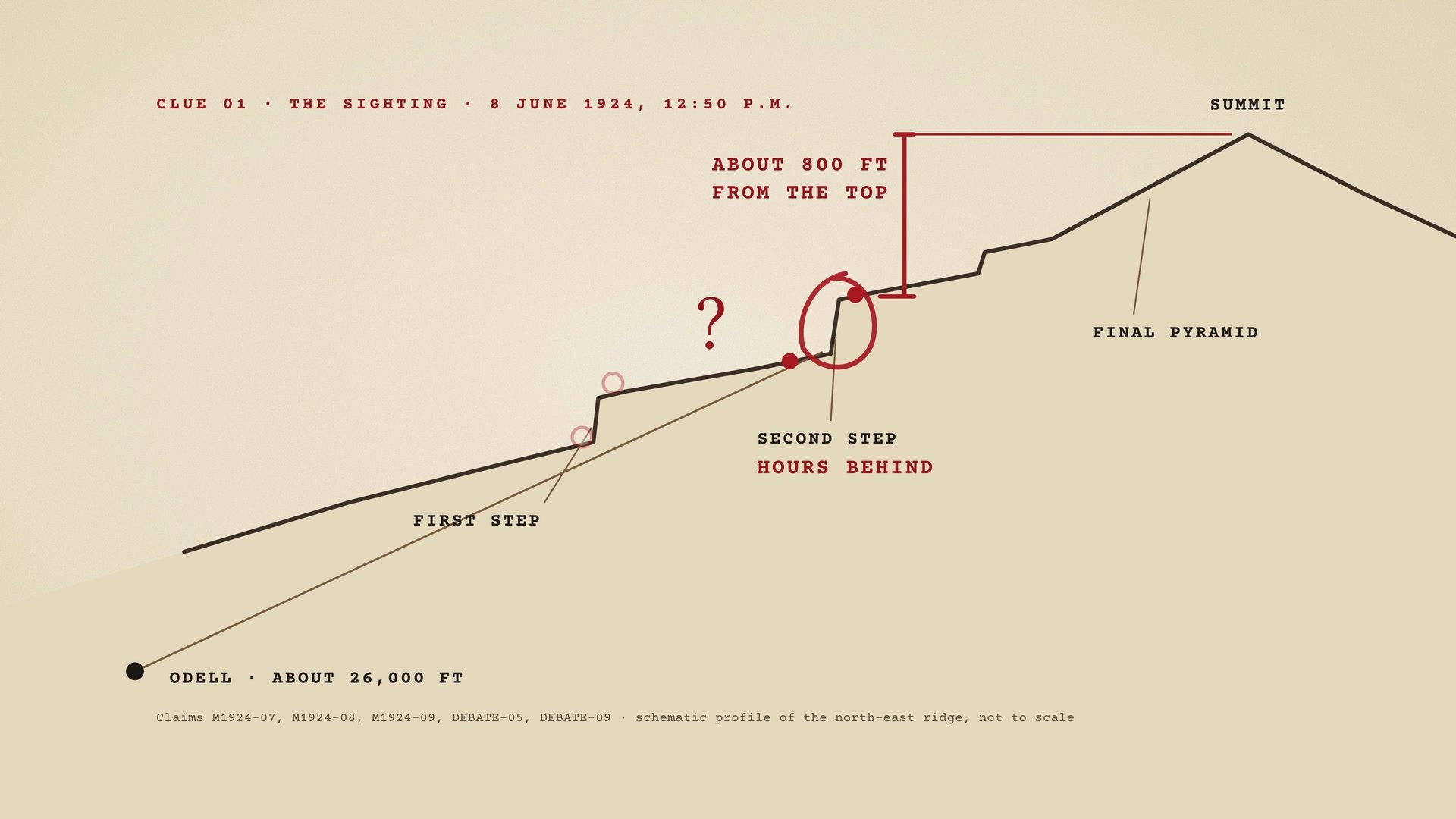
Exhibit AIn the film at 3:13
Clue one: the last sighting
At 12:50 p.m. on June 8, 1924, Noel Odell, climbing alone at about 26,000 feet, saw the cloud part: high on the ridge, a tiny figure moved toward a rock step, and a second followed. His first report said the great rock step. A year later he was not sure which step it was. If it was the Second Step, they were about 800 feet from the top, and hours behind.
Source: Drawn in code for this film from Odell's accounts (claims M1924-07, M1924-08, M1924-09, DEBATE-05 and DEBATE-09): a schematic profile of the north-east ridge, not to scale. The sources are under “1924: Mallory and Irvine” and “The sighting and the Second Step” below
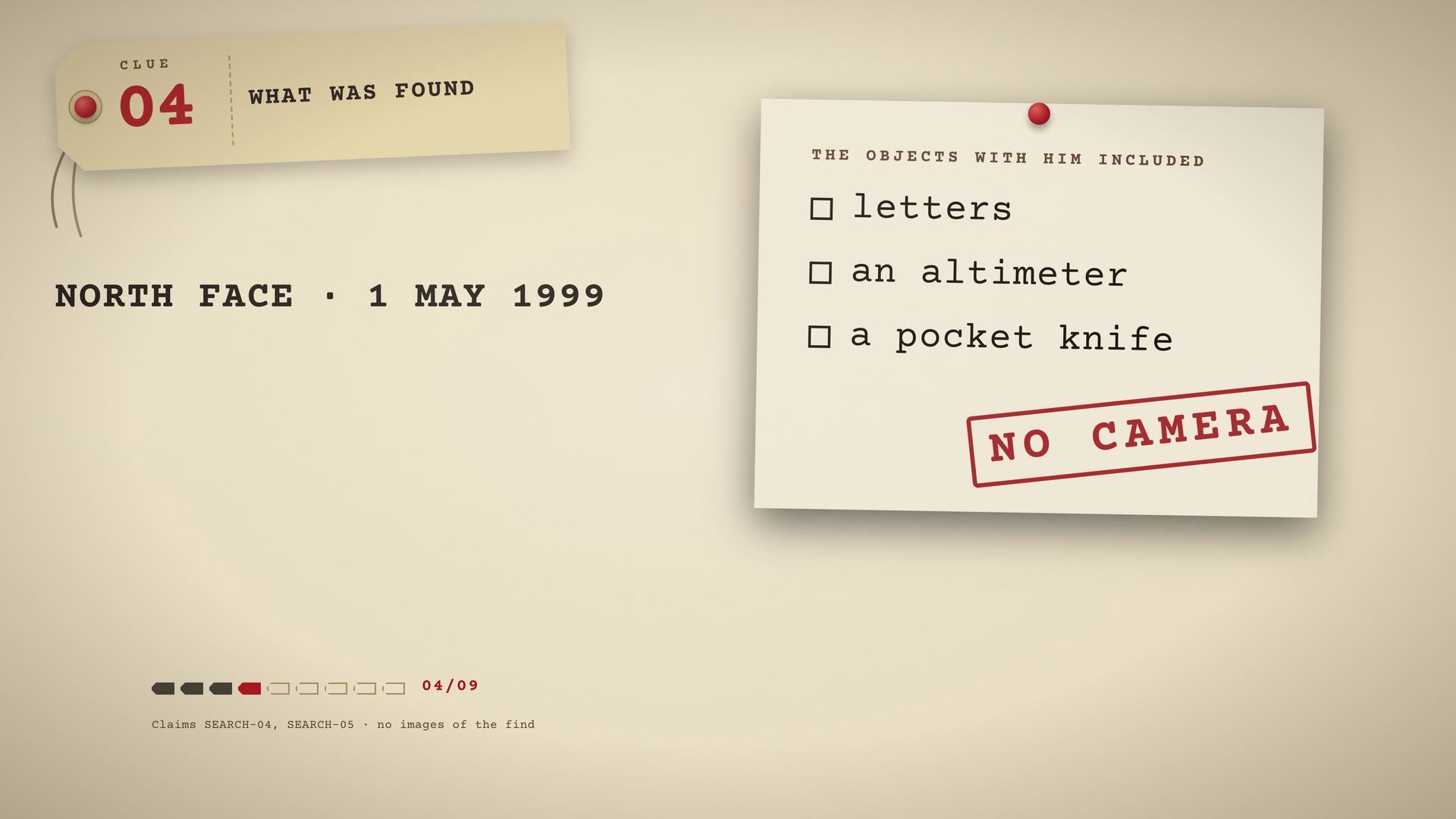
Exhibit BIn the film at 4:50
Clue four: what was found, and what was not
On May 1, 1999, a search team found George Mallory on the north face. The objects with him included letters, an altimeter and a pocket knife. There was no camera. In 2024 a film crew found a boot on the glacier below, with a sock labelled A. C. Irvine. Still no camera. The pair are believed to have carried a small Kodak; Kodak experts have said that if it is ever found, the film might still hold pictures.
Source: Typeset in code for this film from claims SEARCH-04 and SEARCH-05 (no images of the find). The sources are under “The search: the axe, the finds, the camera” below
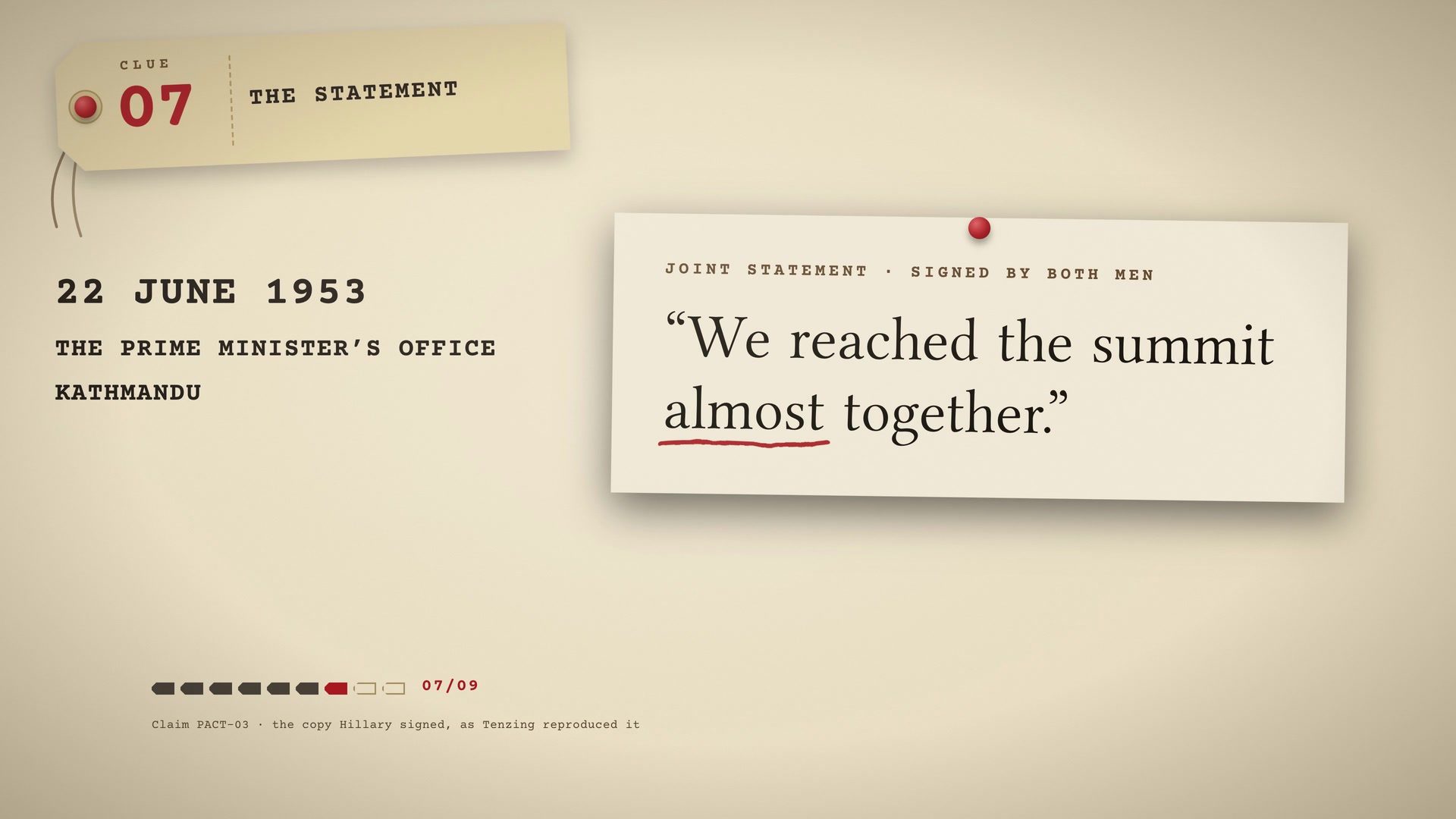
Exhibit CIn the film at 8:45
Clue seven: almost together
On June 22, 1953, in the Prime Minister's office in Kathmandu, Hillary and Tenzing signed a joint statement: “We reached the summit almost together.” Each signed a copy for the other; the words are from the copy Hillary signed, as Tenzing reproduced it. On the way down, newspapers in India and Nepal had wanted Tenzing to have been first.
Source: The joint statement of June 22, 1953, as reproduced in Tenzing Norgay, Tiger of the Snows (G. P. Putnam's Sons, New York, 1955). Typeset in code for this film (claims PACT-03 and PACT-02)
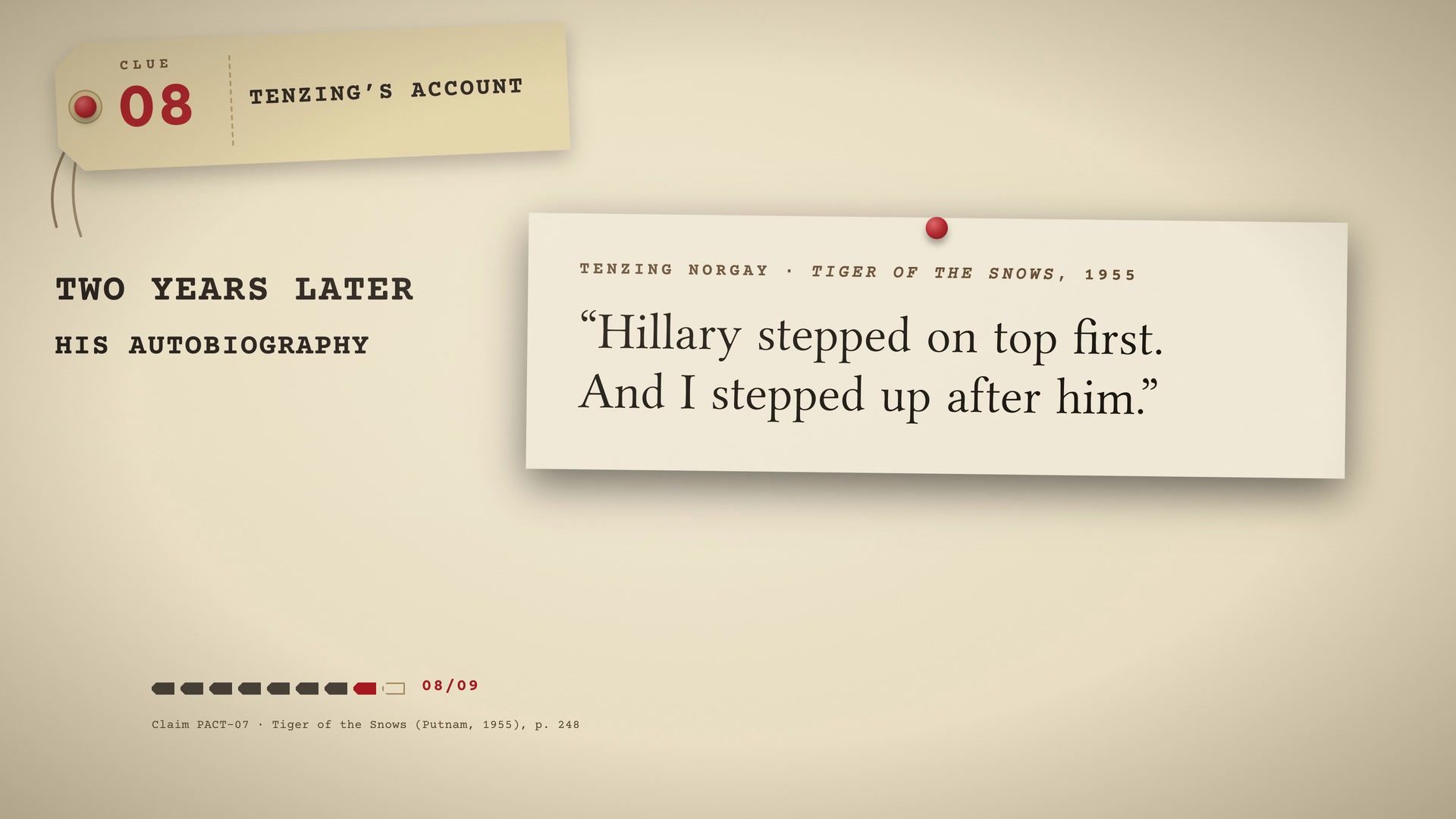
Exhibit DIn the film at 8:56
Clue eight: Tenzing's own account
Two years later, in his autobiography, Tenzing told it plainly: “Hillary stepped on top first. And I stepped up after him.” He wrote that many of his own people would be disappointed, and that he owed more to the truth. He did not call it a race: “We were not leader and led. We were partners.”
Source: Tenzing Norgay, with James Ramsey Ullman, Tiger of the Snows (G. P. Putnam's Sons, New York, 1955), p. 248. Typeset in code for this film (claims PACT-07 and PACT-10)
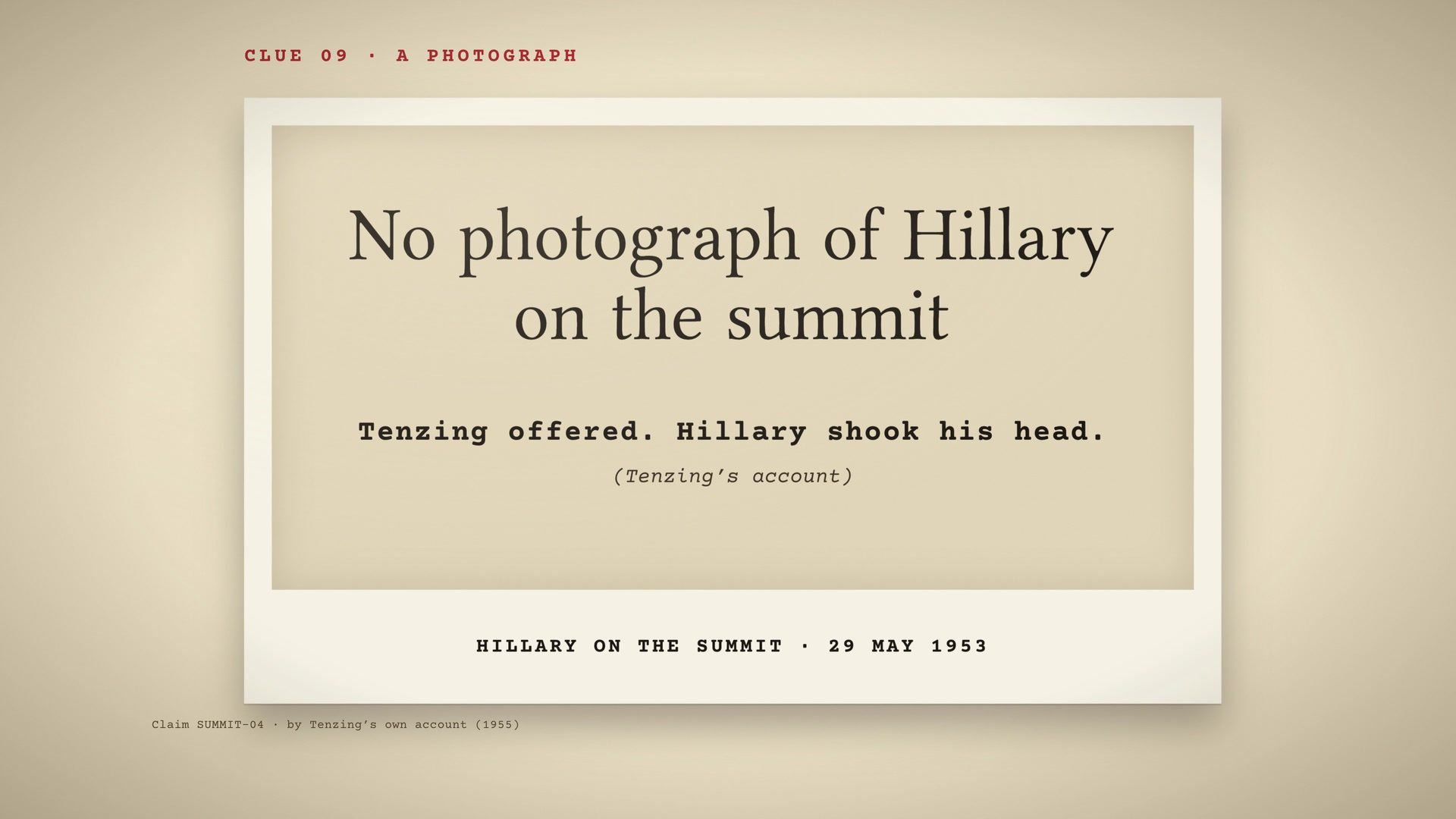
Exhibit EIn the film at 10:30
Clue nine: the photograph nobody took
On the summit Hillary photographed Tenzing holding up his ice axe with four flags: the United Nations, Britain, Nepal and India. There is no photograph of Hillary on top of Everest. Tenzing wrote that he offered to take one, and Hillary shook his head. Hillary gave his own reason: as far as he knew, Tenzing had never taken a photograph, and the summit was “hardly the place to show him how”. The film does not show the 1953 summit photograph.
Source: Tenzing Norgay, Tiger of the Snows (1955), and Edmund Hillary, High Adventure (1955). Typeset in code for this film (claims SUMMIT-03, SUMMIT-04 and SUMMIT-05)
Status
Where it stands (as of November 3, 2026)
The camera Mallory and Irvine are believed to have carried has not been found, and there is no physical evidence they reached the summit.
Re-checked on
Transcript
The full narration, 1,841 words
0:00The case
At half past eleven on the morning of the twenty-ninth of May, 1953, two men stood on the highest point on Earth. One of them stepped onto the top first. For two years, neither of them would say which. And twenty-nine years earlier, two other men had vanished on the same mountain, climbing toward the same summit. So who really stood on top of Everest first? This is a case with four explanations and nine clues. We will number every clue before we give the answer.
0:36The scene: a mountain with a borrowed name
In 1849, British surveyors on the plains of India took sightings on a distant, unnamed summit. They listed it as Peak Fifteen. The calculation that showed it was the highest is credited to the survey's chief computer, a Bengali mathematician named Radhanath Sikdar. In 1856 the Surveyor General named it after his predecessor, George Everest, because, he wrote, he could find no local name. Everest himself objected. His name, he said, could not even be written in Persian or Hindi. And the mountain had never been nameless to the people who lived beneath it. On the Tibetan side it was Chomolungma.
Everest stands on the border of two countries that were closed to outsiders. In 1921 Tibet let the British in from the north. For the next eighteen years, every British expedition came that way.
1:35Four explanations
Here are the four explanations. One: George Mallory and Andrew Irvine reached the top in 1924, and died coming down. Two: Edmund Hillary of New Zealand stepped up first, in 1953. Three: Tenzing Norgay, the Sherpa who had tried the mountain more times than anyone alive, stepped up first. Four: the answer the two men gave the world. They arrived together.
2:05File one: 1924
File one. The British came three times in four years. In 1921 a schoolmaster named George Mallory found the way to the mountain. In 1922 they came back with bottled oxygen, and reached higher than anyone had recorded. Then, below the North Col, an avalanche killed seven porters. The official account did not record their names. Later lists give them as Lhakpa, Norbu, Pasang, Pema, Sange, Temba and Dorje.
In 1924 Mallory was thirty-seven. He chose a partner of twenty-two: Andrew Irvine, an Oxford rower with little climbing experience and a gift for machines. When the oxygen sets arrived leaking, Irvine rebuilt them. On the morning of the sixth of June, they left the North Col. The expedition's book printed this photograph of them, about to go. From the top camp, Mallory sent down a note to the expedition's cameraman, John Noel: look out for us at eight in the morning.
Clue one. At ten to one in the afternoon on the eighth of June, Noel Odell, climbing alone far below, saw the cloud part. High on the ridge, a tiny figure moved toward a rock step. A second followed. The first climbed to the top of the step. Then the cloud closed in. Odell's first report said the great rock step. A year later he was not sure which step it was. If it was the Second Step, they were about eight hundred feet from the top, and hours behind. They never came back. Two days later Odell laid two sleeping bags on the snow in the shape of a T. It meant: no trace. The expedition's book opened: 'Mallory and Irvine may possibly have reached the summit; but they have not lived to tell us.'
Clue two. In 1933 the next British team found an ice axe lying on the slabs below the ridge. It had belonged to Mallory or to Irvine.
Clue three. Any 1924 summit had to pass the Second Step: a hundred-foot cliff on the ridge. The climbers who saw it in the thirties thought it could not be climbed directly. The first people known to climb it were Chinese mountaineers, in 1960, one man standing on another's shoulders. In 1975 a ladder was fixed to it. In 2007, with the ladder removed for a day, Conrad Anker climbed it free, and said Mallory and Irvine could have done the same. Others still disagree.
Clue four. In 1999 a search team found George Mallory on the north face. The objects with him included letters, an altimeter and a pocket knife. There was no camera. In 2024 a film crew found a boot on the glacier below. Inside was a sock with a name label: A. C. Irvine. Still no camera. The pair are believed to have carried a small Kodak. Kodak experts have said that if it is ever found, the film might still hold pictures.
5:23A red herring
Before we leave file one, a red herring, and we will label it as one. Some members of the 1999 team saw Mallory's snow goggles in his pocket as a sign he was coming down after dark, after a long summit day. Others said they could have been a spare pair. It proves nothing either way.
5:44The other road: Tenzing
After 1924, Tibet closed its door for nine years. When the British came back in the thirties, they needed men to carry their loads to the top camps. In 1935, in Darjeeling, Eric Shipton picked two extra men from a line of more than twenty. One of them, about twenty years old, on his first expedition, was Tenzing Norgay.
Nobody wrote down when he was born. He knew only that it was the Year of the Hare, late in May. He reckoned it as 1914. He said he was born near Makalu and grew up in the Sherpa village of Thame, in Nepal. Later research says Tibet. The record does not settle it. He came back to Everest in 1936 and in 1938, when he carried a load to twenty-seven thousand two hundred feet and earned the Tiger Medal.
That same decade Shipton looked across into a hidden valley on the south side, the Western Cwm. The way up it did not look impossible. But it lay in Nepal, and Nepal was closed. Then, around 1950, the doors swapped. Tibet closed. Nepal opened. In 1952 Tenzing went twice with the Swiss. In May, with the guide Raymond Lambert, he turned back about eight hundred feet below the top: higher than anyone was known to have climbed.
7:10Files two to four: 1953
Files two to four. In 1953 the British came from the south, under an Army officer, Colonel John Hunt. Twenty of the best high-altitude Sherpas arrived in Kathmandu, led by their sirdar, Tenzing Norgay. He was also a full climbing member. By his own count, this was his seventh time on Everest. A month before the summit, the ice gave way under Hillary in the Icefall. Tenzing held him on the rope.
On the twenty-sixth of May, the first pair, Tom Bourdillon and Charles Evans, reached the South Summit. Their oxygen would not last. They turned back. On the twenty-eighth, Hillary and Tenzing spent the night in a tent at twenty-seven thousand nine hundred feet. They left it at half past six in the morning. At half past eleven they stood on top. They shook hands. Then Tenzing threw his arms around Hillary, and they pounded each other on the back until they could hardly breathe. Before they left, both men looked around for any sign of Mallory and Irvine. They saw nothing.
Clue five. Hillary's first account, published that year, does not say who went first. With a few more whacks of the ice axe, he wrote, 'we stood on top'.
Clue six. On the way down, newspapers in India and Nepal wanted Tenzing to have been first. Outside Kathmandu, a crowd pulled him away and, he later said, had him sign papers he could not read.
Clue seven. On the twenty-second of June, in the Prime Minister's office in Kathmandu, the two men signed a statement: 'We reached the summit almost together.'
Clue eight. Two years later, in his autobiography, Tenzing told it plainly: 'Hillary stepped on top first. And I stepped up after him.' He wrote that many of his own people would be disappointed. He owed more, he said, to the truth. Clue nine is a photograph. We will come to it.
9:18The summation
The summation. Explanation one, Mallory and Irvine: clues one to four. A sighting that grew less certain, an axe below the ridge, a step they may or may not have climbed, and a camera nobody has found. Not proven. As of October 2026, there is no physical evidence they reached the top.
Explanations two, three and four: clues five to eight. The first accounts said nothing. The signed statement said almost together. And the man with the most reason to claim it for himself wrote that Hillary stepped up first. But Tenzing did not call it a race. 'We were not leader and led,' he wrote. 'We were partners.'
10:03Clue nine
10:12 to 10:30 and 10:47 to 10:54: the summit frame is a RECONSTRUCTION, drawn from the written accounts and labelled on screen: a drawn figure over real 2011 footage of the view from the summit. The 1953 summit photograph is not shown.
Now, clue nine. On the summit, Hillary took out the camera he had kept warm inside his shirt. Tenzing raised his ice axe with four flags tied to it: the United Nations, Britain, Nepal and India.
Strange to say, the man who, by Tenzing's own account, stepped onto the top first is the one man missing from the summit photographs. There is no photograph of Hillary on top of Everest. Tenzing wrote that he offered to take one, and Hillary shook his head. Hillary gave his own reason. As far as he knew, Tenzing had never taken a photograph, and the summit was 'hardly the place to show him how'. So the picture the world remembers as the first ascent shows the man who stepped up second.
10:54Why 'together'
Why did 'together' become the answer? Because in 1953 the question was never only about climbing. The news went out disguised as bad news: 'Snow conditions bad. Advanced base abandoned yesterday.' To The Times in London, it meant Everest had been climbed. It was published on the second of June, 1953: the morning of Queen Elizabeth the Second's coronation. Nepal's king, Tenzing noted, heard it a day late, from London.
Within a week, Hillary and Hunt were knighted. Tenzing received the George Medal. Why he was not knighted is still argued; his own answer was that India did not let its citizens accept foreign titles. India and Nepal both claimed him. He told reporters he was born in the womb of Nepal and raised in the lap of India. In that storm, 'together' was the only answer that belonged to everyone.
11:54Coda
Tenzing Norgay never knew his birthday. After 1953 he chose one: the twenty-ninth of May. He ran field training at the Himalayan Mountaineering Institute in Darjeeling for more than twenty years, and died there in 1986. Hillary stood at his funeral pyre. In 2008 Nepal named the airport at Lukla, where most Everest climbers now land, the Tenzing-Hillary Airport. Tenzing's name first.
And somewhere on the north face there may still be a small Kodak camera. If it is ever found, this case may need a new file. Until then, the record gives us two men on top on the twenty-ninth of May, 1953, one step apart, who chose to call it together.
Sources and credits
Every claim in the film has a source, and every photograph and document is credited. 66 sources, grouped by the part of the story they support, then the credits for every image and sound in the film, with the license for the 32 images used under Creative Commons.
Sources
The survey and the name
- Royal Geographical Society, 1857, Internet Archive full textProceedings of the Royal Geographical Society of London, vol. 1 (1855 to 1857), pages 345 to 351: 'Papers relating to the Himalaya and Mount Everest', meeting of 1857-05-11
- C. K. Howard-Bury and other members of the expedition (London: Edward Arnold, 1922), Internet Archive full textMount Everest: The Reconnaissance, 1921
- Lesley Shapland, Scroll.in, 2020-08-13 (first published on the British Library's Untold Lives blog)The story of how Mount Everest was measured and got its name
- Christopher Klein, History.com (A+E Networks), 2016-11-30, updated 2026-09-15Who is Mount Everest named after?
The British from the north, 1921 and 1922
- C. G. Bruce and other members of the expedition (London: Edward Arnold, 1923), Internet Archive full textThe Assault on Mount Everest, 1922
- The Alpine Club (Alpine Journal online archive, PDF)The Everest Expeditions (1922 notes), by J. P. Farrar, Alpine Journal vol. 34 (1922), pages 452 to 456
- Magdalene College, Cambridge, Archives (Mallory papers catalogue)Letter from George to Ruth Mallory, 9 June 1922 (MCPP/GM/3/1/1922/17)
- Himalayan Journal vol. 16 (1951), The Himalayan Club (Himalayan Journal online archive)Himalayan Porters (list compiled September 1950)
1924: Mallory and Irvine
- E. F. Norton and other members of the expedition (London: Edward Arnold, 1925), Internet Archive full text (public domain in the US)The Fight for Everest 1924
- The Alpine Club (Alpine Journal online archive, PDF)The Last Climb, by N. E. Odell, Alpine Journal vol. 36, November 1924, pages 265 to 272
- Merton College, OxfordSandy Irvine's Biography (exhibition 'Sandy Irvine: Everest 1924-2024')
- Magdalene College, Cambridge, Archives (Mallory papers catalogue)Series GM: Mallory, George (biographical history), MCPP/GM
- Julie Summers (Irvine's great-niece and biographer), website post by Chris Steele, 2024-04-11The Everest Mystery 100 years on: The 'and Irvine' of Mallory & Irvine
- The Alpine Club (Alpine Journal online archive, PDF)The Mount Everest Dispatches (Colonel Norton's dispatches Nos. 6 to 13, with 'Mr. Odell's Story'), Alpine Journal vol. 36, no. 229, November 1924, pages 195 to 241
- Magdalene College, Cambridge, Archives (Mallory papers catalogue)Noel, John Baptist Lucius (1890-1989), mountaineer and photographer (authority record)
- Bryony Dixon, BFI, 2013-10-17Restoring The Epic of Everest
The sighting and the Second Step
- Liesl Clark, NOVA Online, 1999-05-25Unanswered Questions (dispatches page, 1999-05-25)
- Jochen Hemmleb, 2024-05-14 (updated 2024-06-06)Mallory & Irvine's ascent beyond 8500 m/28,000 ft.
- NOVA Online, PBS / WGBH (1999 Mallory and Irvine Research Expedition coverage)The Search
- H. W. Tilman, Himalayan Journal vol. 11 (1939)Mount Everest, 1938
- The Alpine Club (Alpine Journal online archive, PDF)The Conquest of Mount Everest by the Chinese Mountaineering Team, by Shih Chan-chun, Alpine Journal vol. 66 (1961), pages 28 to 41
- The Alpine Club (Alpine Journal online archive, PDF)Chinese Everest Expedition, 1960: A Further Commentary, by B. R. Goodfellow, Alpine Journal vol. 66 (1961), pages 313 to 315
- American Alpine Journal vol. 22 (1979), American Alpine ClubAnother Ascent of the World's Highest Peak, Qomolangma (review)
- David Roberts, National Geographic (first in National Geographic Adventure, May 2008; online 2010-12-08)Conrad Anker on Everest: In the Footsteps of Mallory & Irvine
- Climbing.de news, 2007 (citing an expedition press release)Leo Houlding and Conrad Anker summit Everest
The search: the axe, the finds, the camera
- Jochen Hemmleb (historian, research adviser to the 1999 search), MountainGuides.comFirst Traces: 1933-1991 (Mallory and Irvine research pages)
- NOVA Online, PBS / WGBH (1999 Mallory and Irvine Research Expedition coverage)The Day Mallory Was Found
- Liesl Clark, NOVA Online, 1999-05-04Mallory's Discoverers Return
- Magdalene College, Cambridge, Archives (Mallory papers catalogue)Subseries 1924 (MCPP/GM/3/2/1924)
- Magdalene College, Cambridge, 2024-04-22Everest mountaineer's letters digitised for the first time
- Liesl Clark, NOVA Online, 1999-05-05Dearest George
- Liesl Clark, NOVA Online, 1999-05-25Unanswered Questions (2)
- Grayson Schaffer, National Geographic, 2024-10-11Exclusive: Remains of Andrew 'Sandy' Irvine believed to have been found on Everest
- Steve Garfinkel and Bob Strickland (Kodak), NOVA Online, 1999The Camera (A Kodak 'Vest Pocket' Camera)
- NOVA Online, PBS / WGBH (1999 Mallory and Irvine Research Expedition coverage)Mystery of Mallory and Irvine '24
- Pan Pylas, Associated Press, 2024-10-11Partial remains of British climber believed found 100 years after Everest ascent
The thirties and the road from the south
- Eric Shipton, Himalayan Journal vol. 8 (1936), The Himalayan Club (Himalayan Journal online archive)The Mount Everest Reconnaissance, 1935
- The Alpine Club (Alpine Journal online archive, PDF)The Mount Everest Expedition, 1933, by Hugh Ruttledge, Alpine Journal vol. 45 (1933), pages 226 to 227
- Audrey Salkeld and Liesl Clark, NOVA Online, PBSSherpas on Everest
- Mark Horrell (blog), 2012-09-05How the whim of Eric Shipton shaped the history of Everest
- W. H. Murray, Himalayan Journal vol. 17 (1952), The Himalayan Club (Himalayan Journal online archive)The Reconnaissance of Mount Everest, 1951
- Audrey Salkeld, NOVA Online, PBSSouth Side Story
Tenzing Norgay
- G. P. Putnam's Sons, New York, 1955 (first US edition; scan in the PAHAR Mountains of Central Asia Digital Dataset on the Internet Archive)Tiger of the Snows: the autobiography of Tenzing of Everest (written in collaboration with James Ramsey Ullman)
- Dorjee Lhatoo, The Himalayan Journal vol. 43, The Himalayan ClubIn Memoriam: Tenzing Norgay (Himalayan Journal vol. 43)
- Pratibha Tuladhar, dpa, published by Gulf Times, 2014-05-26Tenzing Norgay remembered 100 years after birth
- George Band (a member of the 1953 expedition), The Himalayan Journal vol. 56 (2000), The Himalayan ClubThe Family of Sherpa Tenzing Norgay GM
- National Geographic News, 2003-05-09, as republished by PhayulBiographer: Legacy of Tenzing Norgay's Historic Everest Climb (interview with Ed Douglas by Johnna Rizzo)
- Hemlata Rai, Nepali Times issue 147, 2003-05-30The Fortunate Son: Nepal remembers Tenzing
- Rene Dittert, Gabriel Chevalley and Raymond Lambert, English version by Malcolm Barnes, George Allen and Unwin, London, 1954 (PAHAR scan on the Internet Archive)Forerunners to Everest: the story of the two Swiss expeditions of 1952
1953: the summit and who stepped up first
- John Hunt, Hodder and Stoughton, London, first published November 1953 (second impression, December 1953; PAHAR scan on the Internet Archive). Chapter 16, 'The Summit', is Hillary's own narrativeThe Ascent of Everest
- Brigadier Sir John Hunt and Sir Edmund Hillary, The Geographical Journal vol. 119 part 4, December 1953 (Royal Geographical Society); PAHAR scan on the Internet ArchiveThe Ascent of Mount Everest
- David Roberts, National Geographic Adventure, April 2003 (web page dated 2013-03-03)50 Years on Everest (excerpt: Hillary and Tenzing, 1953)
- Michael Westmacott and Stephen Venables, The Himalayan Journal vol. 55, The Himalayan ClubIn Memoriam: Lord Hunt
- Edmund Hillary, 1955 edition (Internet Archive scan, borrow-only; text read through the archive's full-text search)High Adventure
- Edmund Hillary, 1958 printing (Internet Archive scan, borrow-only; text read through the archive's full-text search)High Adventure
Afterwards: the news, the honours, the airport
- Royal Geographical Society (with IBG)Tenzing Norgay (factsheet)
- Mark Horrell (mountaineering writer), 2020-12-02, quoting James (Jan) Morris, Coronation Everest (1958), code table p. 47What was Jan Morris's secret code to say that Everest had been climbed?
- Kris Annapurna, ExplorersWeb, 2023-05-29Mount Everest's First Ascent, 70 Years Ago Today
- The London Gazette (HM Stationery Office)The London Gazette, issue 39886, page 3273 (Friday 12 June 1953)
- Heidelberg University Library digital collectionThe Himalayan Times (Kalimpong), July 1953
- Wikipedia (used only as a map to sources)Tenzing Norgay
- Himalayan Mountaineering Institute, Darjeeling (official website)Origin and Growth
- United Press International, Calcutta, 1986-05-14Hillary at funeral for Sherpa
- The Himalayan Times, 2008-01-15Airport to be renamed after Hillary, Tenzing
- Liz Roberts, grough, 2008-02-11Nepal airport honour for Everest heroes
- Himalayan Trust NepalThe Tenzing Hillary Airport (Lukla) project
Credits
Photographs and film
- From Mount Everest: The Reconnaissance, 1921 (1922), Internet Archive mounteverestreco00howaMembers of the Expedition, The Kama Valley
- ETH Library Zurich, Image Archive / Comet Photo AG, Com_M02-0281-0010, CC BY-SA 4.0Edmund Hillary, Conqueror of Mount Everest, in Kloten (record Com_M02-0281-0010, ETH Library e-pics), License: CC BY-SA 4.0
- ETH Library Zurich, Image Archive / Comet Photo AG, Com_M02-0281-0014, CC BY-SA 4.0John Hunt, Conqueror of Mount Everest, in Kloten (record Com_M02-0281-0014, ETH Library e-pics), License: CC BY-SA 4.0
- ETH Library Zurich, Image Archive / Comet Photo AG, Com_M02-0281-0001, CC BY-SA 4.0Mount Everest conquerors in Kloten: Tenzing Norgay, John Hunt, Edmund Hillary (record Com_M02-0281-0001, ETH Library e-pics), License: CC BY-SA 4.0
- The Epic of Everest (1924), directed by J.B.L. Noel; restoration BFI National Archive; via Internet ArchiveThe Epic of Everest (John Noel, 1924), BFI National Archive 2013 restoration, 1080p cut: rongbuk monastery everest
- Portraits du Monde, CC BY 3.0, via Wikimedia CommonsMount Everest from a plane (2013), License: CC BY 3.0
- Archives New Zealand Te Rua Mahara o te Kāwanatanga, CC BY 3.0Hillary Returns (New Zealand National Film Unit, 1953), Ross Sea Appeal: Children Meet Hillary (New Zealand National Film Unit, 1955), License: CC BY 3.0
- ETH Library Zurich, Image Archive / Comet Photo AG, Com_M02-0281-0022, CC BY-SA 4.0Mount Everest Climbers in Kloten: Tenzing Norgay and Raymond Lambert (record Com_M02-0281-0022, ETH Library e-pics), License: CC BY-SA 4.0
- Bibliothèque nationale de France (Gallica), via Wikimedia CommonsMembers of the expedition learn to use the oxygen apparatus (Gaumont, 1922)
- From The Assault on Mount Everest, 1922 (1923), Internet Archive assaultonmountev00brucMallory and Norton approaching their Highest Point, 26,985 feet, Oxygen Apparatus
- From The Fight for Everest: 1924 (1925), Internet Archive fightforeverest10000efnoAndrew Irvine, George H. Leigh-Mallory, Mallory and Irvine about to leave Chang La Camp for the Final Attempt to reach the Summit, The Highest Point in the World at which Photographs have been taken, 28,000 feet
- T. H. Somervell, in The Fight for Everest: 1924 (1925), Internet Archive fightforeverest10000efnoMount Everest from Base Camp, 1922: frontispiece painting signed T. H. Somervell
- City of Vancouver Archives, Yaletown Productions fonds, MI-327 (1991), CC BY 3.0"Everest - Climb for Hope" 16 mm camera rolls 31-36 and 38-40, on the route to Everest (Yaletown Productions, 1991), MPEG-2 cut: climber steep slope, License: CC BY 3.0
- City of Vancouver Archives, Yaletown Productions fonds, MI-324 (1991), CC BY 3.0"Everest - Climb for Hope" 16 mm camera rolls 23-26 (15B) (Yaletown Productions, 1991), MPEG-2 cut: sunset on peaks, License: CC BY 3.0
- City of Vancouver Archives, Yaletown Productions fonds, MI-325 (1991), CC BY 3.0"Everest - Climb for Hope" 16 mm camera rolls 23-26 and 27-29 (Yaletown Productions, 1991), MPEG-2 cut: everest north face base camp, License: CC BY 3.0
- Photo: Daderot / Wikimedia Commons (CC0)Vest Pocket Kodak, 1914, in the Fox Talbot Museum, License: CC0 1.0
- Gannu03, CC BY-SA 4.0, via Wikimedia CommonsDarjeeling toy train (2024), License: CC BY-SA 4.0
- Library of Congress, Prints & Photographs Division, LC-DIG-stereo-1s26716Nepalese porter-girls who carry baggage many miles for two-pence-Darjeeling (n.e.) India
- ETH Library Zurich, Image Archive / Comet Photo AG, Com_M02-0281-0003, CC BY-SA 4.0Mount Everest Conqueror in Kloten, Tenzing Norgay (record Com_M02-0281-0003, ETH Library e-pics), License: CC BY-SA 4.0
- ETH Library Zurich, Hs_0494b-0039-146-AL, CC BY-SA 4.0Sherpa Angthar Kai, 16 October 1936, License: CC BY-SA 4.0
- Photo: Vyacheslav Argenberg / Wikimedia Commons, CC BY 4.0Khumbu Glacier and Khumbu Icefall, Nepal, 2009, Tengboche Buddhist Monastery, Nepal, 2009, License: CC BY 4.0
- ETH Library Zurich, Hs_0494b-0039-Bl-135-001, Public Domain MarkAugust Gansser, Eric Shipton and Arnold Heim, 16 October 1936
- NASA / ISS Expedition 22 (Gateway to Astronaut Photography of Earth)ISS022-E-37302: Mount Everest, Lhotse, Nuptse and the Western Cwm from the International Space Station (cropped)
- ETH Library Zurich, Image Archive / Swissair, LBS_SR01-01956-03, CC BY-SA 4.0Teilnehmer der Schweizer Himalaya-Expedition 1952 Herbst (members of the Swiss autumn 1952 Everest expedition), License: CC BY-SA 4.0
- ETH Library Zurich, Image Archive / Comet Photo AG, Com_M02-0281-0016, CC BY-SA 4.0Mount Everest Climbers in Kloten: Tenzing Norgay and Raymond Lambert (record Com_M02-0281-0016, ETH Library e-pics), License: CC BY-SA 4.0
- ETH Library Zurich, Image Archive / Comet Photo AG, Com_M02-0281-0004, CC BY-SA 4.0Mount Everest Conqueror in Kloten, Tenzing Norgay (record Com_M02-0281-0004, ETH Library e-pics), License: CC BY-SA 4.0
- Sgascoin, CC BY-SA 4.0, via Wikimedia CommonsEVEREST (Sentinel-2 image on an 8 m elevation model, Sgascoin, 2021), License: CC BY-SA 4.0
- Alan Arnette, CC BY 3.0, via Wikimedia CommonsEverest Khumbu Icefall Ladder Crossing (Alan Arnette), Rappelling in the Khumbu Icefall (Alan Arnette, 2008), License: CC BY 3.0
- Video Panuru Sherpa, upload Alan Arnette, CC BY 3.0, via Wikimedia CommonsAlan Arnette Everest 2011 Summit for Alzheimer's (video by Panuru Sherpa, 2011), License: CC BY 3.0
- Collection of Auckland Museum Tāmaki Paenga Hira, 2008.30.1, CC BY 4.0Ice axe used by Sir Edmund Hillary on the first ascent of Everest, 29 May 1953, License: CC BY 4.0
- ETH Library Zurich, Image Archive / Comet Photo AG, Com_M02-0281-0018, CC BY-SA 4.0Mount Everest Conqueror in Kloten, Tenzing Norgay (record Com_M02-0281-0018, ETH Library e-pics), License: CC BY-SA 4.0
- ETH Library Zurich, Image Archive / Comet Photo AG, Com_M02-0281-0005, CC BY-SA 4.0Mount Everest Climbers in Kloten: Tenzing Norgay and Raymond Lambert (record Com_M02-0281-0005, ETH Library e-pics), License: CC BY-SA 4.0
- Nationaal Archief / Anefo, photo J. D. Noske (CC0)Kroning Elizabeth op televisie te Amsterdam voor Engelse kolonie (the British community in Amsterdam watches the coronation on television), License: CC0 1.0
- ETH Library Zurich, Image Archive / Comet Photo AG, Com_M02-0281-0023, CC BY-SA 4.0Mount Everest Conqueror in Kloten, Tenzing Norgay, John Hunt (record Com_M02-0281-0023, ETH Library e-pics), License: CC BY-SA 4.0
- ETH Library Zurich, Image Archive / Comet Photo AG, Com_M02-0281-0012, CC BY-SA 4.0Mount Everest Conquerors in Kloten: Raymond Lambert, Tenzing Norgay (record Com_M02-0281-0012, ETH Library e-pics), License: CC BY-SA 4.0
- ETH Library Zurich, Image Archive / Comet Photo AG, Com_M02-0281-0024, CC BY-SA 4.0Mount Everest Climbers in Kloten: Tenzing Norgay and Annelies Lohner (record Com_M02-0281-0024, ETH Library e-pics), License: CC BY-SA 4.0
- Photo: PP Yoonus / Wikimedia Commons, CC BY-SA 3.0Himalayan Mountaineering Institute, Darjeeling: entrance emblem and climbing sculpture, 2011, License: CC BY-SA 3.0
- Ugyal Yolmo, CC BY-SA 4.0, via Wikimedia CommonsKhanchendzonga from Jorebunglow, Darjeeling (2026), License: CC BY-SA 4.0
- Tom Evans, CC BY 3.0, via Wikimedia CommonsLanding and taking off at the most dangerous airport in the world (Tom Evans, 2011), License: CC BY 3.0


Documents and maps
- Survey of India, via Wikimedia CommonsIndex chart of the Great Trigonometrical Survey of India
- Proceedings of the Royal Geographical Society, vol. 2 (1858), Natural History Museum Library, London, via Biodiversity Heritage LibraryMap to illustrate Col. A. S. Waugh's paper on Mont Everest and Deodanga (1858)
- From John Noel, Through Tibet to Everest (1927), Internet Archive bwb_KU-568-148Mallory's last note, written at the 27,000 ft. bivouac
- Evening Star (Washington, D.C.), via Library of Congress, Chronicling AmericaEvening Star (Washington, D.C.), 1953-06-02, p. 1, Evening Star (Washington, D.C.), 1933-06-05, p. A-16, Evening Star (Washington, D.C.), 1953-06-22, p. A-4, Evening Star (Washington, D.C.), 1953-06-15, p. A-4

Artwork and graphics
- From John Noel, Through Tibet to Everest (1927), Internet Archive bwb_KU-568-148Odell's last view of Mallory and Irvine (drawing, shown on the Clue 01 card)
Cover photo and thumbnail
- Hillary Step, 2010, photo: Debasish Biswas / Wikimedia Commons, CC BY-SA 4.0Hillary Step near Everest top (May 17, 2010), License: CC BY-SA 4.0

Music
- Music generated with ElevenLabs Music
Narration
- Narration voice generated with ElevenLabs (voice: Peter)
Sound effects
- Sound effects generated with ElevenLabs sound effects
Cards, maps and charts
- Drawn in code for this film from the sourced records: the case-file cards and clue tags, the schematic ridge and route diagrams and the schematic maps (not to scale), the coded telegram, and the summit reconstruction at 10:12 to 10:30 and 10:47 to 10:54, labelled RECONSTRUCTION on screen: a drawn figure over real 2011 footage of the view from the summit, credited above. The 1953 summit photograph is not shown. The photographs and film cut into the cards are real and credited above. No picture in the film is AI-generated.